(L-R) Lebanon's late Hezbollah chief Hassan Nasrallah, Syria's Bashar Al Assad and his Iranian counterpart at the time, Mahmoud Ahmadinejad, at an official dinner in Damascus on February 25, 2010. AFP


The fall of the Syrian government should prompt Hezbollah and Iran to rethink their strategies


  • English
  • Arabic

December 11, 2024

As the government of Bashar Al Assad in Syria collapsed, Hezbollah and Iran were watching closely to see how this would affect their weapons supply lines between Iraq and Lebanon. Even before Mr Al Assad fled his capital, the news last Friday that the Albukamal crossing had been taken over by the Syrian Democratic Forces, a US ally, must have been harsh, since the crossing was used to rearm Hezbollah.

More broadly, what the region has been witnessing is the crippling of the so-called Axis of Resistance that Iran had built up over the years – the regional alliance of states and non-state actors, including Hezbollah in Lebanon, Hamas in the Palestinian territories, Syria under Mr Al Assad, the Popular Mobilisation Forces in Iraq and the Houthis in Yemen, as well as sectarian Islamist militias from Afghanistan and Pakistan.

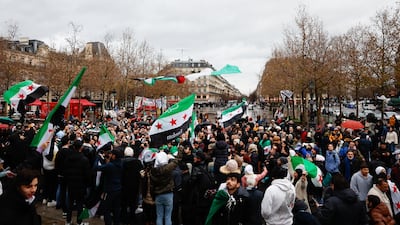
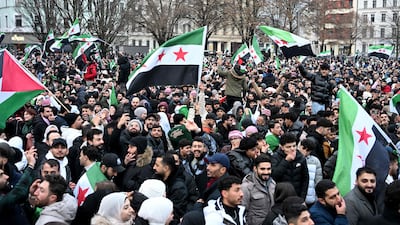
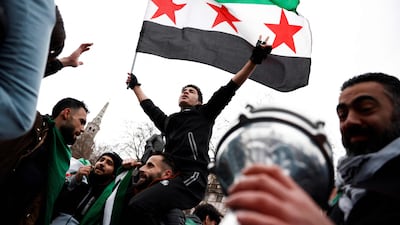
  • Supporters of the Syrian opposition celebrate the rebel takeover of Damascus, in Place de la Republique, Paris. EPA
    Supporters of the Syrian opposition celebrate the rebel takeover of Damascus, in Place de la Republique, Paris. EPA
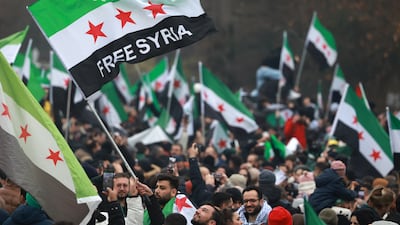
  • Syrian opposition flags are waved at Place de la Republique, Paris, after president Bashar Al Assad fled his country. EPA
    Syrian opposition flags are waved at Place de la Republique, Paris, after president Bashar Al Assad fled his country. EPA
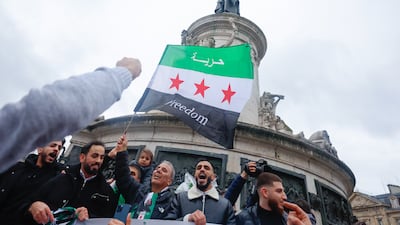
  • Celebrations among Syrian opposition supporters in Place de la Republique. EPA
    Celebrations among Syrian opposition supporters in Place de la Republique. EPA
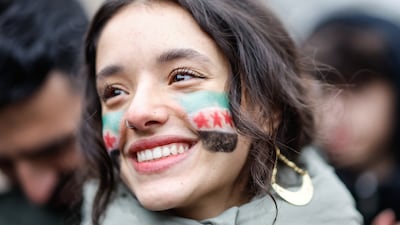
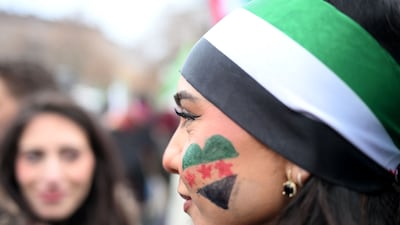
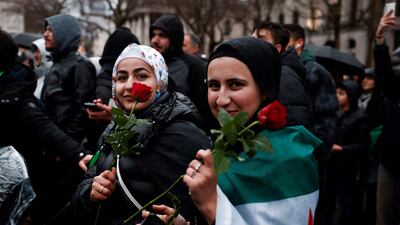
  • A Syrian opposition supporter with the opposition flag painted on her face in Paris. EPA
    A Syrian opposition supporter with the opposition flag painted on her face in Paris. EPA
  • A Syrian opposition supporter in Paris. AP
    A Syrian opposition supporter in Paris. AP
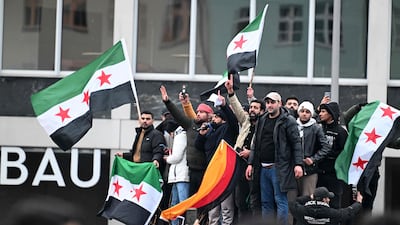
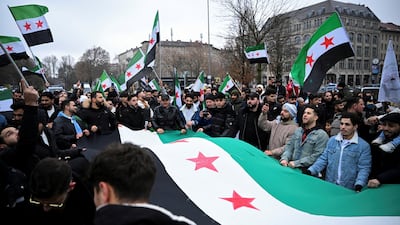
  • Members of the Syrian community celebrate with opposition and German flags in Berlin. AFP
    Members of the Syrian community celebrate with opposition and German flags in Berlin. AFP
  • Celebrations in Berlin. Syrian rebels took Damascus after a lightning-fast campaign. AFP
    Celebrations in Berlin. Syrian rebels took Damascus after a lightning-fast campaign. AFP
  • Members of the Syrian community celebrate in Berlin. About 1.3 million people with Syrian roots live in Germany, most of whom arrived during Syria's civil war. AFP
    Members of the Syrian community celebrate in Berlin. About 1.3 million people with Syrian roots live in Germany, most of whom arrived during Syria's civil war. AFP
  • Syrian opposition flags at Oranienplatz in Berlin. Reuters
    Syrian opposition flags at Oranienplatz in Berlin. Reuters
  • A member of the Syrian community in Berlin. AFP
    A member of the Syrian community in Berlin. AFP
  • Celebrations in Berlin. EPA
    Celebrations in Berlin. EPA
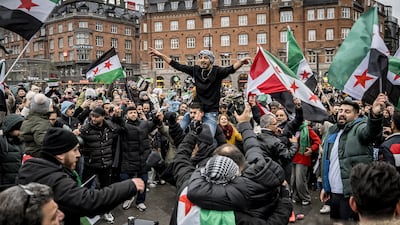
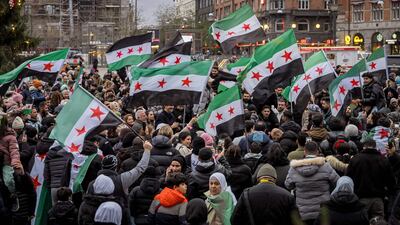
  • Syrian community members celebrate in City Hall Square in Copenhagen, Denmark. Reuters
    Syrian community members celebrate in City Hall Square in Copenhagen, Denmark. Reuters
  • Syrian opposition flags at the Copenhagen rally. AFP
    Syrian opposition flags at the Copenhagen rally. AFP
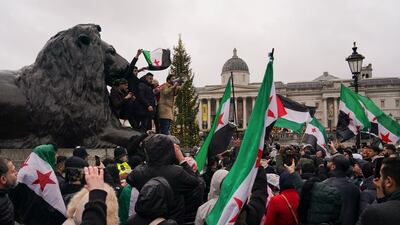
  • A rally to mark the fall of Bashar Al Assad, in Trafalgar Square, London. AP
    A rally to mark the fall of Bashar Al Assad, in Trafalgar Square, London. AP
  • The London rally was called by the Syria Solidarity Campaign group. AFP
    The London rally was called by the Syria Solidarity Campaign group. AFP
  • The Syrian opposition flag is held aloft at Trafalgar Square. AFP
    The Syrian opposition flag is held aloft at Trafalgar Square. AFP
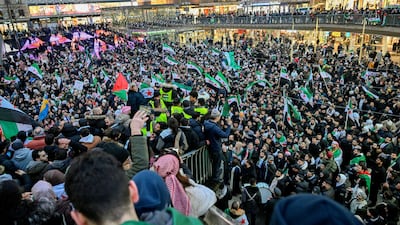
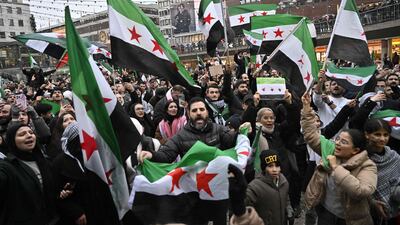
  • A rally celebrating the end of Assad rule in Syria, in Sergels Square in Stockholm, Sweden. AFP
    A rally celebrating the end of Assad rule in Syria, in Sergels Square in Stockholm, Sweden. AFP
  • Celebrations in Sergels Square. AFP
    Celebrations in Sergels Square. AFP
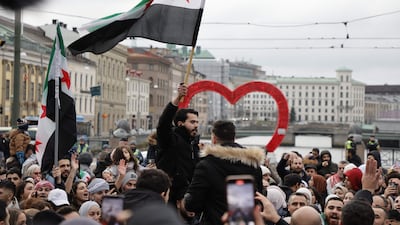
  • Members of the Syrian community hold opposition flags in Gothenburg, Sweden. AFP
    Members of the Syrian community hold opposition flags in Gothenburg, Sweden. AFP

In the aftermath of the Hamas attack against Israel on October 7 last year, this network sought to respond in a co-ordinated way to the Israeli retaliation against Gaza. It did so under the rubric of a highly perilous strategy devised by Iran and its allies called the “unity of the arenas”, which held that if Israel attacked one member of the Axis of Resistance, other members would intervene in support of their ally.

The consequences were catastrophic for the Axis. Ironically, Mr Al Assad appeared to have anticipated the risks, and tried to steer Syria clear of the wars in Gaza and Lebanon. However, this could not save him, as the Lebanese conflict’s undermining of one of the main pillars supporting his rule, namely Hezbollah, may have accelerated the offensive against the areas his government controlled at the time, even if it was not necessarily the cause.

In Lebanon, until Mr Al Assad’s downfall, Hezbollah and Iran always sought to return to the situation in which they found themselves prior to October 7 last year. There was something profoundly unrealistic in such thinking, particularly after the Israelis launched their onslaught against Lebanon in September that targeted Hezbollah and led to the killing of its former secretary general, Hassan Nasrallah. While the environment had changed, Hezbollah and Iran persisted in putting up a front suggesting that nothing had.

Hezbollah continues to adopt this pose, with its secretary general, Naim Qassem, seeking to limit the scope of UN Security Council Resolution 1701 in a speech on social media last Thursday, arguing that the resolution only applies south of the Litani River. In fact, it encompasses much more, reaffirming another resolution, Resolution 1559, which aims to disarm all militias in Lebanon.

The end of Mr Al Assad’s rule has completely transformed the regional context. Iran’s network of alliances may still exist on paper, but its linchpin, Syria, is no more. Hezbollah now finds itself isolated in Lebanon, facing a society in which most political factions deeply oppose the party’s retention of its weapons. Gone are the days when Iranian officials could fly into Beirut to issue instructions to Lebanese officials.

Additionally, of what value is the Axis of Resistance if Israel has so thoroughly reworked the deterrence equation to its advantage? In other words, if attacking Israel invites major retaliatory destruction of the territories of the Axis, especially of Iran itself, how probable is it that members will engage in future military actions against Israel?

Hezbollah may soon feel the backlash of anger from Lebanon’s Shiite community. Already, there is much denigration of Iran within the community, which feels Tehran abandoned it. Mr Al Assad’s suspiciously swift demise will only add to its mistrust. What were years of sacrifice for, many will ask, when young Hezbollah men went to fight and be killed in Syria?

What purpose did Hezbollah’s opening of a front with Israel serve, other than to bolster Iran and its interests? Large swathes of Shiite-majority areas in Lebanon now lie in ruins, all to preserve an Iranian-led alliance that folded like a cheap suit in Damascus.

Starting today, Hezbollah and the Iranians will need to reconsider their entire regional strategy. Iran’s power was anchored in fragmented societies in dysfunctional Arab states – states often perverted to serve Tehran’s interests. This has already generated great resentment throughout societies in the Middle East.

Hezbollah, too, must engage in a full reassessment of its actions in Lebanon and Syria. It can no longer ignore that its behaviour at home provoked considerable hostility among the various communities, which left the party hanging alone in its war with Israel. Mr Nasrallah’s killing, and that of his apparent successor, Hashem Safieddine, compelled Iran to take a leadership role in Hezbollah that only further distanced it from Lebanon’s reality. Yet for now, the party stubbornly refuses to engage in a mea culpa, and it is likely to continue defending its weapons whatever happens.

If it does so, this would be another sign of its hubris and tone-deafness. Until a few days ago, Mr Qassem vowed to stand by Syria against the “terrorist groups”, though Mr Al Assad’s fate was sealed. The new secretary general is, plainly, no more than a facade of Iranian power, but Hezbollah would be making a mistake to presume it can survive in the treacherous Lebanese sectarian context if it remains an Iranian ventriloquist’s dummy.

Hezbollah may be making a mistake similar to Mr Al Assad's. He refused to negotiate when he had the upper hand, not wanting to concede anything from a position of strength, in favour of valuable gains. That is why he lost everything. By refusing to make concessions in Lebanon, Hezbollah, too, may soon find itself having to choose between increasingly dismal options.

Live updates: Follow the latest on Syria

Stage result

1. Pascal Ackermann (GER) Bora-Hansgrohe, in 3:29.09

2. Caleb Ewan (AUS) Lotto-Soudal

3. Rudy Barbier (FRA) Israel Start-Up Nation

4. Dylan Groenewegen (NED) Jumbo-Visma

5. Luka Mezgec (SLO) Mitchelton-Scott

6. Alberto Dainese (ITA) Sunweb

7. Jakub Mareczko (ITA) CCC

8. Max Walscheid (GER) NTT

9. José Rojas (ESP) Movistar

10. Andrea Vendrame (ITA) Ag2r La Mondiale, all at same time

UPI facts

More than 2.2 million Indian tourists arrived in UAE in 2023
More than 3.5 million Indians reside in UAE
Indian tourists can make purchases in UAE using rupee accounts in India through QR-code-based UPI real-time payment systems
Indian residents in UAE can use their non-resident NRO and NRE accounts held in Indian banks linked to a UAE mobile number for UPI transactions

COMPANY%20PROFILE
%3Cp%3E%3Cstrong%3EName%3A%20%3C%2Fstrong%3EEjari%3Cbr%3E%3Cstrong%3EBased%3A%20%3C%2Fstrong%3ERiyadh%2C%20Saudi%20Arabia%3Cbr%3E%3Cstrong%3EFounders%3A%20%3C%2Fstrong%3EYazeed%20Al%20Shamsi%2C%20Fahad%20Albedah%2C%20Mohammed%20Alkhelewy%20and%20Khalid%20Almunif%3Cbr%3E%3Cstrong%3ESector%3A%20%3C%2Fstrong%3EPropTech%3Cbr%3E%3Cstrong%3ETotal%20funding%3A%20%3C%2Fstrong%3E%241%20million%3Cbr%3E%3Cstrong%3EInvestors%3A%20%3C%2Fstrong%3ESanabil%20500%20Mena%2C%20Hambro%20Perks'%20Oryx%20Fund%20and%20angel%20investors%3Cbr%3E%3Cstrong%3ENumber%20of%20employees%3A%20%3C%2Fstrong%3E8%3C%2Fp%3E%0A
Fifa%20World%20Cup%20Qatar%202022%20
%3Cp%3E%3Cstrong%3EFirst%20match%3A%20%3C%2Fstrong%3ENovember%2020%0D%3Cbr%3E%3Cstrong%3EFinal%2016%20round%3A%20%3C%2Fstrong%3EDecember%203%20to%206%0D%3Cbr%3E%3Cstrong%3EQuarter-finals%3A%20%3C%2Fstrong%3EDecember%209%20and%2010%0D%3Cbr%3E%3Cstrong%3ESemi-finals%3A%20%3C%2Fstrong%3EDecember%2013%20and%2014%0D%3Cbr%3E%3Cstrong%3EFinal%3A%20%3C%2Fstrong%3EDecember%2018%3C%2Fp%3E%0A
ICC men's cricketer of the year

2004 - Rahul Dravid (IND) ; 2005 - Jacques Kallis (SA) and Andrew Flintoff (ENG); 2006 - Ricky Ponting (AUS); 2007 - Ricky Ponting; 2008 - Shivnarine Chanderpaul (WI); 2009 - Mitchell Johnson (AUS); 2010 - Sachin Tendulkar (IND); 2011 - Jonathan Trott (ENG); 2012 - Kumar Sangakkara (SL); 2013 - Michael Clarke (AUS); 2014 - Mitchell Johnson; 2015 - Steve Smith (AUS); 2016 - Ravichandran Ashwin (IND); 2017 - Virat Kohli (IND); 2018 - Virat Kohli; 2019 - Ben Stokes (ENG); 2021 - Shaheen Afridi

MATCH INFO

Newcastle United 2 (Willems 25', Shelvey 88')

Manchester City 2 (Sterling 22', De Bruyne 82')

THE BIO

Age: 30

Favourite book: The Power of Habit

Favourite quote: "The world is full of good people, if you cannot find one, be one"

Favourite exercise: The snatch

Favourite colour: Blue

Living in...

This article is part of a guide on where to live in the UAE. Our reporters will profile some of the country’s most desirable districts, provide an estimate of rental prices and introduce you to some of the residents who call each area home. 

TICKETS

Tickets start at Dh100 for adults, while children can enter free on the opening day. For more information, visit www.mubadalawtc.com.

ICC Awards for 2021

MEN

Cricketer of the Year – Shaheen Afridi (Pakistan)

T20 Cricketer of the Year – Mohammad Rizwan (Pakistan)

ODI Cricketer of the Year – Babar Azam (Pakistan)

Test Cricketer of the Year – Joe Root (England)

WOMEN

Cricketer of the Year – Smriti Mandhana (India)

ODI Cricketer of the Year – Lizelle Lee (South Africa)

T20 Cricketer of the Year – Tammy Beaumont (England)

Other workplace saving schemes
  • The UAE government announced a retirement savings plan for private and free zone sector employees in 2023.
  • Dubai’s savings retirement scheme for foreign employees working in the emirate’s government and public sector came into effect in 2022.
  • National Bonds unveiled a Golden Pension Scheme in 2022 to help private-sector foreign employees with their financial planning.
  • In April 2021, Hayah Insurance unveiled a workplace savings plan to help UAE employees save for their retirement.
  • Lunate, an Abu Dhabi-based investment manager, has launched a fund that will allow UAE private companies to offer employees investment returns on end-of-service benefits.
Best Foreign Language Film nominees

Capernaum (Lebanon)

Cold War (Poland)

Never Look Away (Germany)

Roma (Mexico)

Shoplifters (Japan)

Wicked: For Good

Director: Jon M Chu

Starring: Ariana Grande, Cynthia Erivo, Jonathan Bailey, Jeff Goldblum, Michelle Yeoh, Ethan Slater

Rating: 4/5

The biog

Age: 59

From: Giza Governorate, Egypt

Family: A daughter, two sons and wife

Favourite tree: Ghaf

Runner up favourite tree: Frankincense 

Favourite place on Sir Bani Yas Island: “I love all of Sir Bani Yas. Every spot of Sir Bani Yas, I love it.”

Factfile on Garbine Muguruza:

Name: Garbine Muguruza (ESP)

World ranking: 15 (will rise to 5 on Monday)

Date of birth: October 8, 1993

Place of birth: Caracas, Venezuela

Place of residence: Geneva, Switzerland

Height: 6ft (1.82m)

Career singles titles: 4

Grand Slam titles: 2 (French Open 2016, Wimbledon 2017)

Career prize money: $13,928,719

Updated: December 11, 2024, 12:37 PM