An Israeli flag still flies in the Lebanese village of Adaisseh after a ceasefire between Israel and Hezbollah. Reuters


Lebanon and Israel's many problems that this ceasefire alone won't solve


  • English
  • Arabic

December 02, 2024

This past week, Israeli, Lebanese and American leaders were busy patting themselves on the back announcing the completion of an Israel-Lebanon ceasefire agreement. The Israeli Prime Minister, Benjamin Netanyahu, crowed about Israel being victorious and now the unquestioned dominant force throughout the Middle East. Hezbollah declared a “divine victory” greater than the one they achieved in 2006. Meanwhile, US leaders were congratulating themselves for their leadership in a settlement they hoped would “advance broader peace and prosperity in the region”.

To say I’m sceptical about all of this is an understatement. At least for now, the Lebanese will have some respite from Israel’s relentless bombings. And Israeli forces will begin to withdraw from the south of the country. Nevertheless, I’m not uncorking the champagne to celebrate. Too many have died, too much bitterness has been sown, no lessons have been learnt and too many issues remain unresolved. There will be, as there always is, a reckoning for the consequences of this war.

The extensive physical damage to Lebanon and its people is staggering. Almost 4,000 dead and many thousands more wounded. International agencies report that 1.3 million were forced to flee from their homes – some forced to do so more than once – and upwards of 100,000 homes have been destroyed either by bombings or bulldozing of entire areas by Israeli forces in the border villages.

In his announcement of the ceasefire, US President Joe Biden said that Israelis and Lebanese can now return to their homes – except that, for hundreds of thousands of Lebanese, their homes no longer exist. And it’s important to acknowledge that the ceasefire is tentative, and its terms are decidedly lopsided.

Once again, as they did in 2006, Hezbollah miscalculated. It may have seemed honourable to demonstrate solidarity with the Palestinians in Gaza. But they were kicking the hornets’ nest of a foe whose ruthlessness knows no limits and faces no restraints. Israel responded as though it had complete impunity, violating all of the norms of international law and civilised behaviour.

At this point, Hezbollah has no doubt been weakened. It will be forced to relocate north of the Litani River and has lost its claim to being a feared deterrent against Israeli dominance. It remains to be seen to what extent it will be able to use its armed presence as the praetorian guard protecting the ancien regime in Lebanon.

Ceasefire or no ceasefire, Lebanon has internal problems that must be addressed, but which now, in the aftermath of this war, are less likely to be.

It’s true that Hezbollah plays a role in Iran’s regional strategy. But it is wrong to see it only in that light. What gave birth to this movement were problems internal to Lebanon. Hezbollah represents a community of Shiites who feel that they had been given the short end of the stick in Lebanese affairs. They suffered the consequences of Israel’s war with the Palestine Liberation Organisation, at the end of which their villages were occupied by the Israeli military for more than two decades. With Israel forced to end its occupation in 2000, Hezbollah’s stature grew.

Many Shiites have complained of disenfranchisement and are unwilling, especially after what they have recently endured, to accept a subordinate status.

Ceasefire or no ceasefire, Lebanon has internal problems that must be addressed

So while it is important, as some say, for Lebanon to “get its act together” and elect a new president and establish a government, that’s not nearly enough. There must be reform and an end to the corrupt, outmoded sectarian system. Whether one blames Hezbollah for this war or not, if real reform isn’t implemented, the inequities of Lebanon’s sectarian divisions will cause tensions and disruptions that will continue to place the country’s recovery at risk.

It was both frightening and disturbing to listen to Mr Netanyahu gloating about his great successes in defying world opinion and winning, as he described it, against all of Israel’s foes. He went further with the threat of continuing to use Israel’s unmatched military might to ensure Israel’s security and dominance. But here, too, there is a reckoning that must be addressed.

As we have learnt from past wars, there are wounds that do not heal.

As of now, Mr Netanyahu and most Israeli voters appear to have learnt no lessons at all. Blind self-righteousness emboldened by US support has metastasised into a cancerous sense of impunity. They continue their brutal campaign in Gaza hell-bent on the destruction of Hamas. But it is increasingly clear that isn’t their only goal; it is also to liquidate the Palestinian presence in most of Gaza and establish a permanent regime there. In the West Bank and East Jerusalem, the Israelis are also determined to subdue and annex and expand their settlement presence.

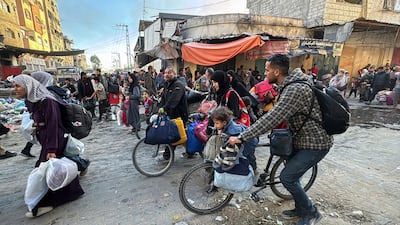
  • Displaced Palestinians flee after being ordered by the Israeli military to leave their neighbourhoods in Beit Lahiya, in the northern Gaza Strip. Reuters
    Displaced Palestinians flee after being ordered by the Israeli military to leave their neighbourhoods in Beit Lahiya, in the northern Gaza Strip. Reuters
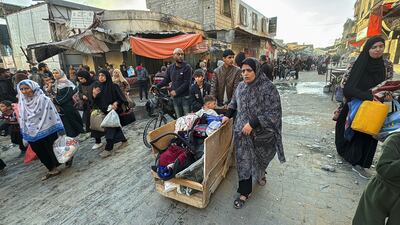
  • Beit Lahia and other parts of northern Gaza have been besieged by Israeli forces for several weeks, with little food, water or medical aid entering the area. Reuters
    Beit Lahia and other parts of northern Gaza have been besieged by Israeli forces for several weeks, with little food, water or medical aid entering the area. Reuters
  • Leaflets dropped by Israeli military drones warned residents in northern Gaza that they were in a 'dangerous combat zone'. Reuters
    Leaflets dropped by Israeli military drones warned residents in northern Gaza that they were in a 'dangerous combat zone'. Reuters
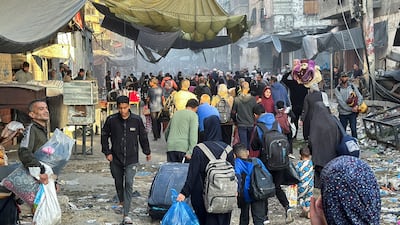
  • Palestinians were ordered to flee south towards the Indonesian Hospital in Beit Lahia. Reuters
    Palestinians were ordered to flee south towards the Indonesian Hospital in Beit Lahia. Reuters
  • Palestinians carry their belongs down a street in Beit Lahia, amid the ongoing conflict between Israel and Hamas. AFP
    Palestinians carry their belongs down a street in Beit Lahia, amid the ongoing conflict between Israel and Hamas. AFP
  • Families said they were fired on and Israeli forces set fire to buildings near the hospital in Beit Lahia where people had been sheltering. AFP
    Families said they were fired on and Israeli forces set fire to buildings near the hospital in Beit Lahia where people had been sheltering. AFP
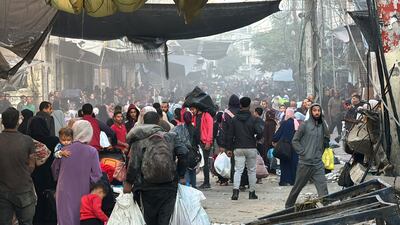
  • Palestinians walk down a street in Beit Lahia. Hundreds of thousands of people in northern Gaza remain under siege. AFP
    Palestinians walk down a street in Beit Lahia. Hundreds of thousands of people in northern Gaza remain under siege. AFP

Israel’s military may seem dominant, but unfortunately Israelis aren’t safer. Even now they daily fall victim to resistance born of anger at their brutal occupation policies. They will not be secure or achieve broader regional acceptance until they change. And given the hold the far-right has over Israeli politics, change isn’t coming any time soon.

As distressing as these failures of the Lebanese and Israeli leaderships may be, those of US policymakers are worse as they bear significant responsibility for what has transpired not just over the past year.

For decades, the US turned a blind eye to Israeli settlement expansion, their policies that sabotaged the peace process, contributed to the collapse of Palestinian governance and the rise of Hamas, the subjugation of the Palestinian people, and the empowerment of Israel’s extremist right-wing. Instead of accepting paternity for this mess it gave birth to, America has now armed Israel to the teeth and covered for its crimes in international fora.

The “deal” America negotiated between Israel and Lebanon addresses none of the root causes of conflict and only gives Israel a freer hand to pursue its goal of a “pax Israelica” – which is sure to produce greater conflict, not the hoped broader regional peace.


match details

Wales v Hungary

Cardiff City Stadium, kick-off 11.45pm

Who's who in Yemen conflict

Houthis: Iran-backed rebels who occupy Sanaa and run unrecognised government

Yemeni government: Exiled government in Aden led by eight-member Presidential Leadership Council

Southern Transitional Council: Faction in Yemeni government that seeks autonomy for the south

Habrish 'rebels': Tribal-backed forces feuding with STC over control of oil in government territory

MATCH INFO

Uefa Champions League semi-final, first leg
Bayern Munich v Real Madrid

When: April 25, 10.45pm kick-off (UAE)
Where: Allianz Arena, Munich
Live: BeIN Sports HD
Second leg: May 1, Santiago Bernabeu, Madrid

The%C2%A0specs%20
%3Cp%3E%3Cstrong%3EEngine%3A%20%3C%2Fstrong%3E3.5-litre%2C%20twin-turbo%20V6%0D%3Cbr%3E%3Cstrong%3ETransmission%3A%20%3C%2Fstrong%3E10-speed%20auto%0D%3Cbr%3E%3Cstrong%3EPower%3A%20%3C%2Fstrong%3E410hp%0D%3Cbr%3E%3Cstrong%3ETorque%3A%20%3C%2Fstrong%3E495Nm%0D%3Cbr%3E%3Cstrong%3EPrice%3A%20%3C%2Fstrong%3Estarts%20from%20Dh495%2C000%20(Dh610%2C000%20for%20the%20F-Sport%20launch%20edition%20tested)%0D%3Cbr%3E%3Cstrong%3EOn%20sale%3A%20%3C%2Fstrong%3Enow%3C%2Fp%3E%0A
How to watch Ireland v Pakistan in UAE

When: The one-off Test starts on Friday, May 11
What time: Each day’s play is scheduled to start at 2pm UAE time.
TV: The match will be broadcast on OSN Sports Cricket HD. Subscribers to the channel can also stream the action live on OSN Play.

Skoda Superb Specs

Engine: 2-litre TSI petrol

Power: 190hp

Torque: 320Nm

Price: From Dh147,000

Available: Now

CONFIRMED%20LINE-UP
%3Cp%3EElena%20Rybakina%20(Kazakhstan)%0D%3Cbr%3EOns%20Jabeur%20(Tunisia)%0D%3Cbr%3EMaria%20Sakkari%20(Greece)%0D%3Cbr%3EBarbora%20Krej%C4%8D%C3%ADkov%C3%A1%20(Czech%20Republic)%0D%3Cbr%3EBeatriz%20Haddad%20Maia%20(Brazil)%0D%3Cbr%3EJe%C4%BCena%20Ostapenko%20(Latvia)%0D%3Cbr%3ELiudmila%20Samsonova%0D%3Cbr%3EDaria%20Kasatkina%E2%80%AF%0D%3Cbr%3EVeronika%20Kudermetova%E2%80%AF%0D%3Cbr%3ECaroline%20Garcia%20(France)%E2%80%AF%0D%3Cbr%3EMagda%20Linette%20(Poland)%E2%80%AF%0D%3Cbr%3ESorana%20C%C3%AErstea%20(Romania)%E2%80%AF%0D%3Cbr%3EAnastasia%20Potapova%E2%80%AF%0D%3Cbr%3EAnhelina%20Kalinina%20(Ukraine)%E2%80%AF%E2%80%AF%0D%3Cbr%3EJasmine%20Paolini%20(Italy)%E2%80%AF%0D%3Cbr%3EEmma%20Navarro%20(USA)%E2%80%AF%0D%3Cbr%3ELesia%20Tsurenko%20(Ukraine)%0D%3Cbr%3ENaomi%20Osaka%20(Japan)%20-%20wildcard%0D%3Cbr%3EEmma%20Raducanu%20(Great%20Britain)%20-%20wildcard%3Cbr%3EAlexandra%20Eala%20(Philippines)%20-%20wildcard%3C%2Fp%3E%0A
The specs: 2018 Maxus T60

Price, base / as tested: Dh48,000

Engine: 2.4-litre four-cylinder

Power: 136hp @ 1,600rpm

Torque: 360Nm @ 1,600 rpm

Transmission: Five-speed manual

Fuel consumption, combined: 9.1L / 100km

Mercer, the investment consulting arm of US services company Marsh & McLennan, expects its wealth division to at least double its assets under management (AUM) in the Middle East as wealth in the region continues to grow despite economic headwinds, a company official said.

Mercer Wealth, which globally has $160 billion in AUM, plans to boost its AUM in the region to $2-$3bn in the next 2-3 years from the present $1bn, said Yasir AbuShaban, a Dubai-based principal with Mercer Wealth.

Within the next two to three years, we are looking at reaching $2 to $3 billion as a conservative estimate and we do see an opportunity to do so,” said Mr AbuShaban.

Mercer does not directly make investments, but allocates clients’ money they have discretion to, to professional asset managers. They also provide advice to clients.

“We have buying power. We can negotiate on their (client’s) behalf with asset managers to provide them lower fees than they otherwise would have to get on their own,” he added.

Mercer Wealth’s clients include sovereign wealth funds, family offices, and insurance companies among others.

From its office in Dubai, Mercer also looks after Africa, India and Turkey, where they also see opportunity for growth.

Wealth creation in Middle East and Africa (MEA) grew 8.5 per cent to $8.1 trillion last year from $7.5tn in 2015, higher than last year’s global average of 6 per cent and the second-highest growth in a region after Asia-Pacific which grew 9.9 per cent, according to consultancy Boston Consulting Group (BCG). In the region, where wealth grew just 1.9 per cent in 2015 compared with 2014, a pickup in oil prices has helped in wealth generation.

BCG is forecasting MEA wealth will rise to $12tn by 2021, growing at an annual average of 8 per cent.

Drivers of wealth generation in the region will be split evenly between new wealth creation and growth of performance of existing assets, according to BCG.

Another general trend in the region is clients’ looking for a comprehensive approach to investing, according to Mr AbuShaban.

“Institutional investors or some of the families are seeing a slowdown in the available capital they have to invest and in that sense they are looking at optimizing the way they manage their portfolios and making sure they are not investing haphazardly and different parts of their investment are working together,” said Mr AbuShaban.

Some clients also have a higher appetite for risk, given the low interest-rate environment that does not provide enough yield for some institutional investors. These clients are keen to invest in illiquid assets, such as private equity and infrastructure.

“What we have seen is a desire for higher returns in what has been a low-return environment specifically in various fixed income or bonds,” he said.

“In this environment, we have seen a de facto increase in the risk that clients are taking in things like illiquid investments, private equity investments, infrastructure and private debt, those kind of investments were higher illiquidity results in incrementally higher returns.”

The Abu Dhabi Investment Authority, one of the largest sovereign wealth funds, said in its 2016 report that has gradually increased its exposure in direct private equity and private credit transactions, mainly in Asian markets and especially in China and India. The authority’s private equity department focused on structured equities owing to “their defensive characteristics.”

Kanye%20West
%3Cp%3EYe%20%E2%80%94%20the%20rapper%20formerly%20known%20as%20Kanye%20West%20%E2%80%94%20has%20seen%20his%20net%20worth%20fall%20to%20%24400%20million%20in%20recent%20weeks.%20That%E2%80%99s%20a%20precipitous%20drop%20from%20Bloomberg%E2%80%99s%20estimates%20of%20%246.8%20billion%20at%20the%20end%20of%202021.%3Cbr%3EYe%E2%80%99s%20wealth%20plunged%20after%20business%20partners%2C%20including%20Adidas%2C%20severed%20ties%20with%20him%20on%20the%20back%20of%20anti-Semitic%20remarks%20earlier%20this%20year.%3Cbr%3EWest%E2%80%99s%20present%20net%20worth%20derives%20from%20cash%2C%20his%20music%2C%20real%20estate%20and%20a%20stake%20in%20former%20wife%20Kim%20Kardashian%E2%80%99s%20shapewear%20firm%2C%20Skims.%3C%2Fp%3E%0A
Updated: December 04, 2024, 6:57 AM