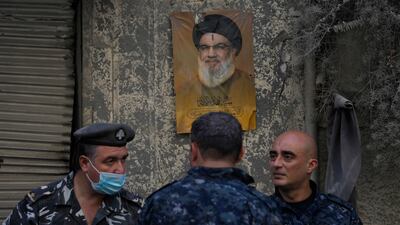
Lebanese police stand in front of a portrait of the late Hezbollah leader Hassan Nasrallah in Beirut on Saturday. AP


Why taming Hezbollah is in Iran’s interest


  • English
  • Arabic

November 24, 2024

Does Iran have a compelling reason to agree for Hezbollah to be tamed?

This would, after all, involve the Tehran-backed group transforming itself into an exclusively political party that relinquishes its weapons to the Lebanese army and allows the state to exercise authority over territory that is currently under its control. And this would entail the Islamic Republic abandoning its most critical regional tool of influence and reforming its core doctrine.

The answer may be “yes” – for a few notable reasons.

First, Iran faces a stark choice: to either preserve its nuclear weapons programme or maintain its regional proxies. If it insists on the latter, it risks exposing its nuclear facilities to military retaliation from Israel. Tehran’s nuclear ambitions are an absolute priority for its leadership.

The ball is in Iran’s court to revive negotiations with the US and the other permanent members of the UN Security Council, which would ensure the protection of its nuclear facilities and the preservation of its ambition to maintain its “right” to nuclear development (although not necessarily to develop nuclear weapons).

Tehran has apparently understood its military inferiority to Israel and recalibrated its priorities accordingly, returning to the policy drawing board. It has distanced itself from Hamas’s missteps and Hezbollah’s adventures, prioritising its national interests over its “Axis of Resistance” strategy.

Lebanese Parliament Speaker Nabih Berri meets US special envoy Amos Hochstein in Beirut last week. EPA

Second, Israel, with firm US support, has presented Tehran with a blunt ultimatum: either rein in Hezbollah or risk its military elimination. Tehran has little room for manoeuvre. It cannot provide direct military support to Hezbollah, nor can it protect the group from Israeli attacks on the ground or in its tunnel networks.

In light of this, Iran has sought to present itself as a diplomatic and political facilitator, contributing to the implementation of UN Security Council Resolution 1701 and achieving a ceasefire. While its initial steps faltered, it ultimately realised that its interests required acknowledging the value of its influence in this pivotal moment. Today, its role in Lebanon is markedly different from in the past, prompting a re-evaluation of its calculations.

Third, both US President Joe Biden and president-elect Donald Trump have agreed on two fundamental points regarding Iran: one, reviving nuclear negotiations with Tehran depends on the latter demonstrating goodwill through modifications in its regional behaviour; and two, Lebanon is the immediate test of Iran’s intentions.

The Iranians initially expected Mr Trump to adopt an aggressive stance after his election, but they were surprised when he signalled a willingness to negotiate with them. Mr Trump, it seems, conveyed that genuine co-operation would yield significant rewards, while deception would result in severe sanctions and economic collapse.

The president-elect, meanwhile, has reportedly thrown his support behind Mr Hochstein’s mission to secure a ceasefire in Lebanon.

Strategically, Iran assigns great importance to improving relations with the incoming Trump administration, especially as it recognises its inability to rescue Hezbollah militarily. Tehran, therefore, has concluded that taming Hezbollah is preferable to witnessing its total annihilation.

Accordingly, the group has in recent days adopted positions that have facilitated negotiations between Mr Hochstein and Lebanese Speaker of Parliament Nabih Berri. It has expressed support for a presidential election in Lebanon, which is a departure from its earlier obstructionist policy. It has also stated its intention to abide by Lebanon’s post-civil war Constitution.

This marks a significant shift in the group’s stance, as the Constitution emphasises the state’s sovereignty and the exclusive possession of arms by the state.

These shifts may or may not reflect the true intentions of the group or its patrons in Tehran. However, the reality is that a degraded Hezbollah faces a choice: either elimination or acceptance of a role in Lebanon’s political landscape.

If negotiations between Israel and Hezbollah succeed, the subsequent agreement will act as a mechanism for implementing Resolution 1701, which encompasses Resolution 1559. Together, these resolutions provide a roadmap for Lebanon’s recovery and its liberation from the grip of both Israel and Hezbollah.

If and when both sides agree to a deal, Mr Hochstein will request them to commit in writing to the terms of the agreement by a specified date, marking the cessation of hostilities. From that point on, a 60-day period will begin, during which time the Lebanese army will be posted in the area between the border and the Litani River.

A broader implementation monitoring committee – including Lebanon, Israel, the UN Interim Force in Lebanon, the US and France – will oversee the execution process. A trilateral military committee comprising Lebanon, Israel and Unifil will address the 13 disputed points along the border in preparation for formal border demarcation. (Eight of these 13 points were resolved last year before the recent conflicts erupted.)

Demarcating the border will be immensely important. For one, it would end Israeli occupation and eliminate Hezbollah’s justification for maintaining weapons under the pretext of resistance. In other words, the resistance narrative will end, along with Hezbollah’s rationale for bearing arms.

Over the next three months, Lebanon’s Parliament should elect a president. Then, discussions on a national defence strategy will begin, followed by Hezbollah handing over its weapons to the Lebanese army.

This, in a nutshell, is the roadmap for saving Lebanon from destruction and for sparing Hezbollah from annihilation. It is also the roadmap for preventing Israel from occupying Lebanese territory under the pretence of targeting Hezbollah’s missiles and tunnels. Additionally, it is the roadmap for disarming Palestinian factions that claim to resist Israel no Lebanese soil.

This is not a matter of optimism or pessimism. It is political realism, which Iran understands well. And this could explain its submission to the idea of taming Hezbollah.


Indoor Cricket World Cup - Sept 16-20, Insportz, Dubai

The%20pillars%20of%20the%20Dubai%20Metaverse%20Strategy
%3Cp%3EEncourage%20innovation%20in%20the%20metaverse%20field%20and%20boost%20economic%20contribution%3C%2Fp%3E%0A%3Cp%3EDevelop%20outstanding%20talents%20through%20education%20and%20training%3C%2Fp%3E%0A%3Cp%3EDevelop%20applications%20and%20the%20way%20they%20are%20used%20in%20Dubai's%20government%20institutions%3C%2Fp%3E%0A%3Cp%3EAdopt%2C%20expand%20and%20promote%20secure%20platforms%20globally%3C%2Fp%3E%0A%3Cp%3EDevelop%20the%20infrastructure%20and%20regulations%3C%2Fp%3E%0A
How to help

Send “thenational” to the following numbers or call the hotline on: 0502955999
2289 – Dh10
2252 – Dh 50
6025 – Dh20
6027 – Dh 100
6026 – Dh 200

While you're here
What is Diwali?

The Hindu festival is at once a celebration of the autumn harvest and the triumph of good over evil, as outlined in the Ramayana.

According to the Sanskrit epic, penned by the sage Valmiki, Diwali marks the time that the exiled king Rama – a mortal with superhuman powers – returned home to the city of Ayodhya with his wife Sita and brother Lakshman, after vanquishing the 10-headed demon Ravana and conquering his kingdom of Lanka. The people of Ayodhya are believed to have lit thousands of earthen lamps to illuminate the city and to guide the royal family home.

In its current iteration, Diwali is celebrated with a puja to welcome the goodness of prosperity Lakshmi (an incarnation of Sita) into the home, which is decorated with diyas (oil lamps) or fairy lights and rangoli designs with coloured powder. Fireworks light up the sky in some parts of the word, and sweetmeats are made (or bought) by most households. It is customary to get new clothes stitched, and visit friends and family to exchange gifts and greetings.  


What vitamins do we know are beneficial for living in the UAE

Vitamin D: Highly relevant in the UAE due to limited sun exposure; supports bone health, immunity and mood.Vitamin B12: Important for nerve health and energy production, especially for vegetarians, vegans and individuals with absorption issues.Iron: Useful only when deficiency or anaemia is confirmed; helps reduce fatigue and support immunity.Omega-3 (EPA/DHA): Supports heart health and reduces inflammation, especially for those who consume little fish.

Multitasking pays off for money goals

Tackling money goals one at a time cost financial literacy expert Barbara O'Neill at least $1 million.

That's how much Ms O'Neill, a distinguished professor at Rutgers University in the US, figures she lost by starting saving for retirement only after she had created an emergency fund, bought a car with cash and purchased a home.

"I tell students that eventually, 30 years later, I hit the million-dollar mark, but I could've had $2 million," Ms O'Neill says.

Too often, financial experts say, people want to attack their money goals one at a time: "As soon as I pay off my credit card debt, then I'll start saving for a home," or, "As soon as I pay off my student loan debt, then I'll start saving for retirement"."

People do not realise how costly the words "as soon as" can be. Paying off debt is a worthy goal, but it should not come at the expense of other goals, particularly saving for retirement. The sooner money is contributed, the longer it can benefit from compounded returns. Compounded returns are when your investment gains earn their own gains, which can dramatically increase your balances over time.

"By putting off saving for the future, you are really inhibiting yourself from benefiting from that wonderful magic," says Kimberly Zimmerman Rand , an accredited financial counsellor and principal at Dragonfly Financial Solutions in Boston. "If you can start saving today ... you are going to have a lot more five years from now than if you decide to pay off debt for three years and start saving in year four."

Avatar: Fire and Ash

Director: James Cameron

Starring: Sam Worthington, Sigourney Weaver, Zoe Saldana

Rating: 4.5/5

Our legal consultant

Name: Dr Hassan Mohsen Elhais

Position: legal consultant with Al Rowaad Advocates and Legal Consultants.

GRAN%20TURISMO
%3Cp%3E%3Cstrong%3EDirector%3A%3C%2Fstrong%3E%20Neill%20Blomkamp%3C%2Fp%3E%0A%3Cp%3E%3Cstrong%3EStars%3A%3C%2Fstrong%3E%20David%20Harbour%2C%20Orlando%20Bloom%2C%20Archie%20Madekwe%2C%20Darren%20Barnet%3C%2Fp%3E%0A%3Cp%3E%3Cstrong%3ERating%3A%3C%2Fstrong%3E%203%2F5%3C%2Fp%3E%0A
UAE currency: the story behind the money in your pockets

Hotel Silence
Auður Ava Ólafsdóttir
Pushkin Press

WOMAN AND CHILD

Director: Saeed Roustaee

Starring: Parinaz Izadyar, Payman Maadi

Rating: 4/5

Afcon 2019

SEMI-FINALS

Senegal v Tunisia, 8pm

Algeria v Nigeria, 11pm

Matches are live on BeIN Sports

The studios taking part (so far)
  1. Punch
  2. Vogue Fitness 
  3. Sweat
  4. Bodytree Studio
  5. The Hot House
  6. The Room
  7. Inspire Sports (Ladies Only)
  8. Cryo
Game Changer

Director: Shankar 

Stars: Ram Charan, Kiara Advani, Anjali, S J Suryah, Jayaram

Rating: 2/5

Dubai Creek Open in numbers
  • The Dubai Creek Open is the 10th tournament on this year's Mena Tour
  • It is the first of five events before the season-concluding Mena Tour Championship
  • This week's field comprises 120 players, 21 of which are amateurs
  • 15 previous Mena Tour winners are competing at Dubai Creek Golf and Yacht Club  
Keep it fun and engaging

Stuart Ritchie, director of wealth advice at AES International, says children cannot learn something overnight, so it helps to have a fun routine that keeps them engaged and interested.

“I explain to my daughter that the money I draw from an ATM or the money on my bank card doesn’t just magically appear – it’s money I have earned from my job. I show her how this works by giving her little chores around the house so she can earn pocket money,” says Mr Ritchie.

His daughter is allowed to spend half of her pocket money, while the other half goes into a bank account. When this money hits a certain milestone, Mr Ritchie rewards his daughter with a small lump sum.

He also recommends books that teach the importance of money management for children, such as The Squirrel Manifesto by Ric Edelman and Jean Edelman.

Mercer, the investment consulting arm of US services company Marsh & McLennan, expects its wealth division to at least double its assets under management (AUM) in the Middle East as wealth in the region continues to grow despite economic headwinds, a company official said.

Mercer Wealth, which globally has $160 billion in AUM, plans to boost its AUM in the region to $2-$3bn in the next 2-3 years from the present $1bn, said Yasir AbuShaban, a Dubai-based principal with Mercer Wealth.

Within the next two to three years, we are looking at reaching $2 to $3 billion as a conservative estimate and we do see an opportunity to do so,” said Mr AbuShaban.

Mercer does not directly make investments, but allocates clients’ money they have discretion to, to professional asset managers. They also provide advice to clients.

“We have buying power. We can negotiate on their (client’s) behalf with asset managers to provide them lower fees than they otherwise would have to get on their own,” he added.

Mercer Wealth’s clients include sovereign wealth funds, family offices, and insurance companies among others.

From its office in Dubai, Mercer also looks after Africa, India and Turkey, where they also see opportunity for growth.

Wealth creation in Middle East and Africa (MEA) grew 8.5 per cent to $8.1 trillion last year from $7.5tn in 2015, higher than last year’s global average of 6 per cent and the second-highest growth in a region after Asia-Pacific which grew 9.9 per cent, according to consultancy Boston Consulting Group (BCG). In the region, where wealth grew just 1.9 per cent in 2015 compared with 2014, a pickup in oil prices has helped in wealth generation.

BCG is forecasting MEA wealth will rise to $12tn by 2021, growing at an annual average of 8 per cent.

Drivers of wealth generation in the region will be split evenly between new wealth creation and growth of performance of existing assets, according to BCG.

Another general trend in the region is clients’ looking for a comprehensive approach to investing, according to Mr AbuShaban.

“Institutional investors or some of the families are seeing a slowdown in the available capital they have to invest and in that sense they are looking at optimizing the way they manage their portfolios and making sure they are not investing haphazardly and different parts of their investment are working together,” said Mr AbuShaban.

Some clients also have a higher appetite for risk, given the low interest-rate environment that does not provide enough yield for some institutional investors. These clients are keen to invest in illiquid assets, such as private equity and infrastructure.

“What we have seen is a desire for higher returns in what has been a low-return environment specifically in various fixed income or bonds,” he said.

“In this environment, we have seen a de facto increase in the risk that clients are taking in things like illiquid investments, private equity investments, infrastructure and private debt, those kind of investments were higher illiquidity results in incrementally higher returns.”

The Abu Dhabi Investment Authority, one of the largest sovereign wealth funds, said in its 2016 report that has gradually increased its exposure in direct private equity and private credit transactions, mainly in Asian markets and especially in China and India. The authority’s private equity department focused on structured equities owing to “their defensive characteristics.”

How much of your income do you need to save?

The more you save, the sooner you can retire. Tuan Phan, a board member of SimplyFI.com, says if you save just 5 per cent of your salary, you can expect to work for another 66 years before you are able to retire without too large a drop in income.

In other words, you will not save enough to retire comfortably. If you save 15 per cent, you can forward to another 43 working years. Up that to 40 per cent of your income, and your remaining working life drops to just 22 years. (see table)

Obviously, this is only a rough guide. How much you save will depend on variables, not least your salary and how much you already have in your pension pot. But it shows what you need to do to achieve financial independence.


Updated: November 24, 2024, 3:16 PM