


Access to safe and clean drinking water is one of the most basic human rights. And life as we know it is dependent on water. And yet, about 29 per cent of the world’s population, approximately 2.4 billion people, live in water-stressed countries, with 26 per cent of the world's population lacking access to safe drinking water.
Safeguarding it and ensuring adequate supply for future generations must be a priority for all countries and governments. Water insecurity also has significant economic consequences, with the problem causing an estimated $470 billion of losses annually.
As Cop28 proved – with the unprecedented UAE Consensus – global collaboration and collective action across governments, financial institutions and technology leaders will form a critical part of ensuring universal access to clean water.
Climate change is exacerbating water stress across the globe, lowering the availability of fresh water and furthering the need for water production methods such as desalination, as seen in the increasing number of desalination projects showing up in unexpected regions in Europe, the UK and North America.
As temperatures rise and populations grow, demand for potable water is also increasing at a rapid rate. This is especially pertinent for the Middle East and North Africa, home to seven of the top 10 most water-stressed countries in the world.
-
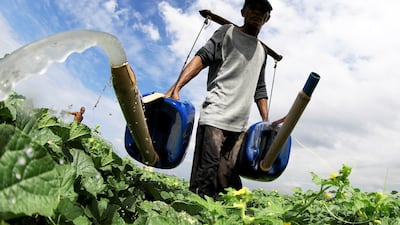
Watering vegetables in Taguig City, Philippines. Authorities say about 40 million Filipinos still lack access to a formal water supply while 74 million of the population have access to piped and potable water. World Water Day is observed annually on March 22, to highlight the global need for access to safe and clean water. EPA -
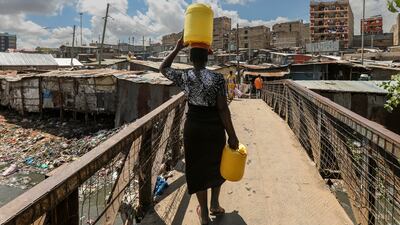
Fetching water in the Mathare slums of Nairobi, Kenya. Middlemen exploit shortages to sell water at exorbitant prices. PA -
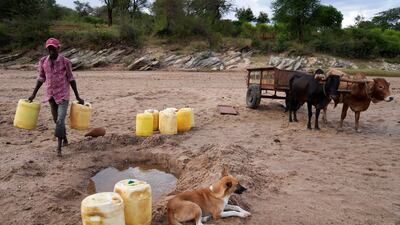
Drawing water from a hole in a sandy riverbed in Makueni County, Kenya. There have been fatal clashes between clans in the country who dispute each other’s access to water and pasturelands. AP -
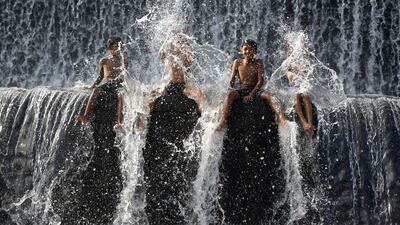
Residents bathe in a dam of the Unda river in Klungkung, Indonesia. AP -
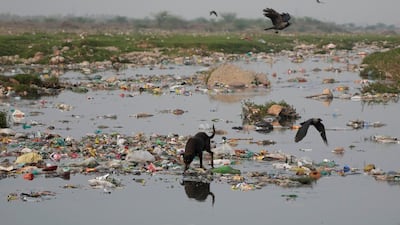
The polluted waters of the Tawi river in Jammu, India. AP -
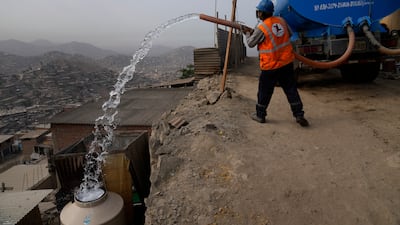
A water lorry worker fills tanks at houses in the Pamplona Alta area in Lima, Peru. Residents buy water for drinking, cooking and cleaning from private suppliers. AP -
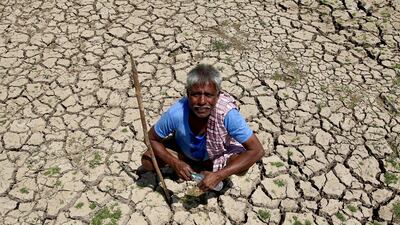
The dried Bheeman Lake bed on the outskirts of Bengaluru, India. EPA -

An internally displaced Palestinian girl carrying containers on the way to fetch water, in Khan Younis, southern Gaza Strip. EPA -
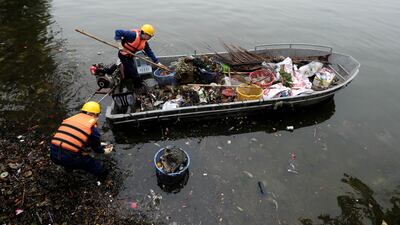
Workers remove waste from West Lake in Hanoi, Vietnam. EPA -

A communal well in Peshawar, Pakistan. EPA -
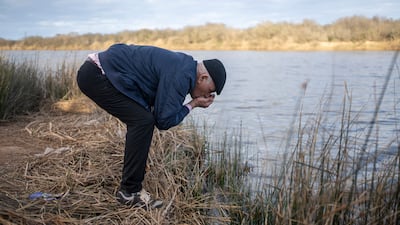
Mimoun Nadori tastes the water of the Moulouya River to check its salinity, in Nador, north of Morocco. Where the river once flowed from the mountains into the Mediterranean, it now sits stagnant, allowing seawater to creep inland and turning water from a source of life to a deadly poison. AP -
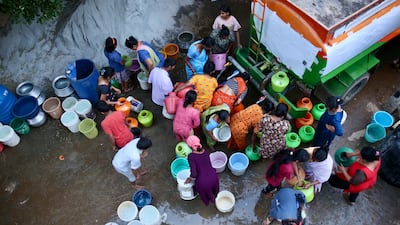
Residents collect clean drinking water from a free distribution water tanker in Rajarajeshwari Nagar, Bengaluru. EPA -

Fred Imfeld dumps water into a bowl for his chickens, in Corning, California. The US state is notorious for droughts and water shortages. AP -

Thousands of South Africans are lining up for water as the country's largest city, Johannesburg, confronts an unprecedented collapse of its water system affecting millions of people. AP -
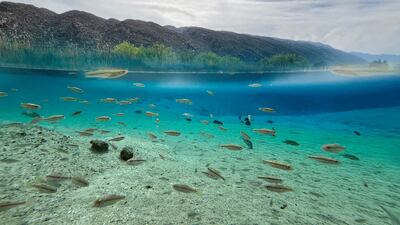
Mexico's pools of Poza de la Becerra. The 170 cactus-ringed pools contain important species of fish, snails, turtles, bacteria and unique living rock structures that offer important clues to life on Earth millions of years ago. Reuters -

A vessel cruises over the river Main in Frankfurt, Germany. AP -

Boats at Cardo Beach in Rio de Janeiro, Brazil. Reuters -

The polluted Dahisar River, passing through a residential district in Mumbai, India. EPA -
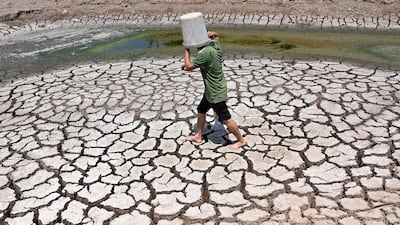
A dried-up pond in Vietnam's southern Ben Tre province. A blazing month-long heatwave has brought drought, parching the land in the region. AFP


Even regions that are historically not as prone to water stress are facing prolonged heatwaves and droughts due to rising temperatures. Failure to adequately address the growing water crisis increases the threat of intensifying conflicts to heightening food insecurity and health crises.
Given the scarcity, the region’s top priorities are researching, developing and implementing innovative technologies as well as the sustainable management of water.
Based on current policy, the International Energy Agency (IEA) predicts the demand for desalination will increase its share of final energy consumption in the Middle East to 10 per cent in 2030 and 15 per cent in 2040, up from 7 per cent today.
The scaling up of development of renewable energy and other efficient technologies is critical to reduce the current policy forecast.
As the largest producer of desalinated water in the UAE, Taqa is acutely aware of the increasing demand and committed to meeting that demand through sustainable water solutions. As such, we are further strengthening our desalination capabilities in alignment with the UAE’s Mohamed bin Zayed Water Initiative, which aims to address water scarcity globally by accelerating the development of sustainable solutions through awareness, innovation and action.
Desalination through reverse osmosis is a much more efficient technique than thermal-based ones such as multi-stage flash desalination that are also energy intensive. Combining reverse osmosis with renewable energy further reduces the carbon intensity of water production significantly and demonstrates potentially carbon-free sustainable water solutions.
About 50km north of Abu Dhabi, the Taweelah Reverse Osmosis independent water plant, which is now operational, is an example of how reverse osmosis technology can be implemented at scale – it is the largest such RO plant in the world and vital to meet the UAE’s water needs. This and other such upcoming plants can be models for countries in the region and beyond facing similar challenges.
Although desalination is important to tackle the water crisis, it is not the only one. Effective water management practices extend beyond producing desalinated water. They must include efficient distribution throughout the network; reduced consumption through awareness-raising and adoption of new technology; and the recycling of wastewater for reuse. By integrating these practices, we can create a circular water economy that maximises every drop and ensures sustainable water use, benefiting people and the environment.
The Middle East isn't the only region facing the issue of access to water. It is an issue every country faces. A report by the Global Commission on the Economics of Water found that the world potentially faces a 40 per cent shortfall in fresh water supply by 2030, with severe shortages in water-constrained regions.
The only way in which countries across the world can meet the growing demand for water is through multilateral action, with collaboration across governments, industries and the financial community.
The UAE has established itself as a global leader in developing large-scale affordable desalination and water treatment solutions, with the adoption of the public-private partnership model enabling companies such as Taqa to blend private international capital and technological expertise to deliver water technologies at scale without delay.
Knowledge-sharing platforms such as the World Utilities Congress next week, the International Desalination and Reuse Association World Congress, along with high-level forums such as the World Economic Forum and Cop29 later this year, will play a crucial role in advancing progress in tackling water scarcity and scaling up desalination efforts globally.
As we stand on the precipice of a potential water crisis, there is a great urgency to act. The region’s proactiveness in championing desalination technology offers a glimpse into a future where water scarcity can be mitigated sustainably.
It is a collective journey that requires the collaboration of nations, industries, and communities to safeguard our most precious resource.

