


Washington's refusal to call for a permanent end to the war in Gaza is chipping away at US credibility on the global stage.
The Biden administration insists it is pushing Israel to reduce civilian casualties in the Gaza Strip, while at the same time supplying Israeli military with some of the bombs it is using to destroy much of the tiny Palestinian enclave.
The jarring disconnect was on painful display at the weekend at the Munich Security Conference, where Vice President Kamala Harris and Secretary of State Antony Blinken went to reassure jittery allies of America's determination to defend the “rules-based” international order it has underwritten since the end of the Second World War.
“We are committed to pursue global engagement, to uphold international rules and norms, to defend democratic allies at home and abroad and to work with our allies and partners in pursuit of shared goals,” Ms Harris told a rapt audience.
She also spoke of how the Biden administration had re-established America’s place on the world stage after four wobbly years of Donald Trump pandering to dictators and blasting allies.
Under President Joe Biden, she argued, Nato's resolve is stronger than ever in the wake of the Russia’s invasion of Ukraine.
But even as the US seeks to assert its leadership role, Republicans are withholding extra money for Ukraine. It is entirely possible Kyiv will lose the war because conservatives in Washington don't want to hand Mr Biden a win in an election year.
And when it comes to Gaza, Washington's stubborn stance underscores another mixed message.
Local health authorities say the death toll since the war began after the Hamas attacks on Israel on October 7 has now surpassed 29,000.
While Mr Biden has said Israel's reaction in Gaza has been “over the top”, nothing has changed his “unwavering” support of Israel, and the US is set to veto a UN Security Council resolution put forward by Algeria on Tuesday calling for an immediate humanitarian ceasefire.
The US is now proposing a separate resolution that would endorse “a temporary ceasefire in Gaza as soon as practicable”, according to the text seen The National.
The vagueness appears out of step with global calls for an immediate stop to the bloodshed.
Mr Blinken said the administration is working “24 hours a day” to try to come to a solution, but he failed to explain how he sees it materialising.
Meanwhile, Chinese Foreign Minister Wang Yi made clear that Beijing wants an immediate ceasefire and an “accelerated state of Palestine”.
Mr Wang’s speech, which took place immediately before Mr Blinken took the stage with the foreign ministers of India and Germany, made clear that China sees itself in the same realm as the US and as a leading voice for “stability” in the world.
His stance on the Israel-Gaza war is a striking and important divergence from the US.
As the death toll in Gaza continues to rise, and with the Israelis now preparing for a military operation in Rafah, the last place of refuge for more than 1.4 million Palestinians who have already fled their homes elsewhere in the enclave, frustration with Washington’s unyielding stance appears to be growing.
At home, protesters have been interrupting Mr Biden’s speeches, while abroad more and more countries believe the time for ceasefire has come. The road outside Mr Blinken's home is being sprayed with fake blood and an encampment of demonstrators is on standby to heckle him as he leaves the house.
The US, the biggest supporter of Israel’s war efforts, holds billions of dollars of leverage that it appears unwilling to use. Instead, it is trying to massage Israel into reducing civilian casualties and allowing more humanitarian aid into the strip.
It hasn't been working.
'Speed dating' for diplomats
America, despite attracting growing criticism at home and abroad over its stance on Israel, is still at the peak of global power.
At the recent Munich Security Conference, the delegation set up shop on the second floor of the historic Bayerischer Hof Hotel, in the heart of the city.
Two floors below them, the conference was in full swing, with world leaders trading places at the podium inside the grand ballroom to discuss today's most pressing issues, chief among them the wars in Gaza and Ukraine.
While Ms Harris and Mr Blinken were among those who shared their countries' visions, it was the work being done on the second floor that demonstrated America's still unmatched role in the world.
Throughout the conference, a seemingly never-ending procession of diplomats and politicians from across the globe made their way up the hotel’s spiral staircase to a constellation of US officials, which included Mr Blinken, Homeland Security Secretary Alejandro Mayorkas and a number of US congressmen and senators.
Mr Blinken called the annual security conference “speed dating for diplomats”. Indeed, a dizzying number of interactions and meetings took place over the three-day event, the brevity of some leaving one to question just how productive they could have really been.
Mr Blinken held more than a dozen meetings over the course of Friday and Saturday including with Israeli President Isaac Herzog, new French Foreign Minister Stephane Sejourne, with Mr Wang and the heads of Armenia and Azerbaijan.
Given this background and the obvious clout the US has, Washington’s refusal to pressure Israel to stop the killing in Gaza feels like more and more of an abdication of responsibility.
While it’s clear that the US remains the great power of our time, its failure to call for a ceasefire is deafening.
Munich Security Conference – in pictures
-
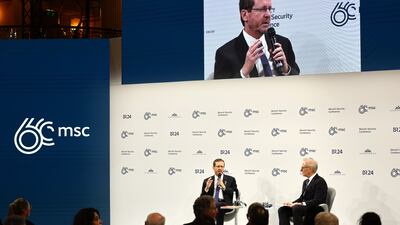
Israeli President Isaac Herzog, left, and American journalist David Ignatius at a panel talk. EPA -
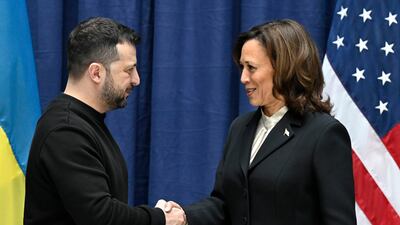
Ukrainian President Volodymyr Zelenskyy and US Vice President Kamala Harris conclude a joint press conference at the Munich Security Conference. AP -
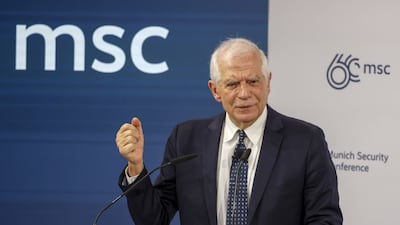
EU foreign affairs and security chief Josep Borrell speaks on the closing day of the annual conference in Munich. Bloomberg -

Mr Zelenskyy and President of Azerbaijan Ilham Aliyev attend a bilateral meeting on the sidelines of the conference. EPA -
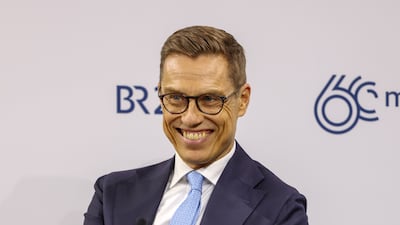
Alexander Stubb, Finland's president-elect, speaks on the closing day of the event. Bloomberg -

A Ukrainian protest against Russia's invasion takes place outside the the Bayerischer Hof Hotel, the venue for the Munich Security Conference. EPA -
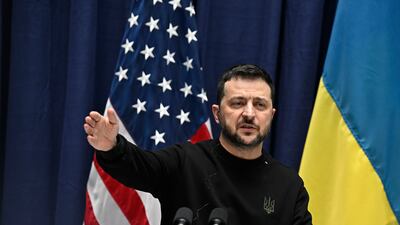
Mr Zelenskyy addresses a press conference in Munich. AP -
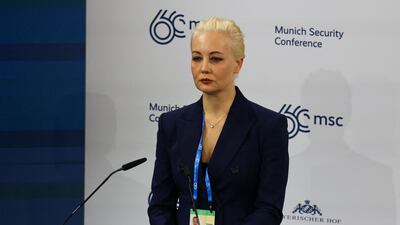
Yulia Navalnaya, wife of late Russian opposition leader Alexei Navalny, attends the event. AFP -
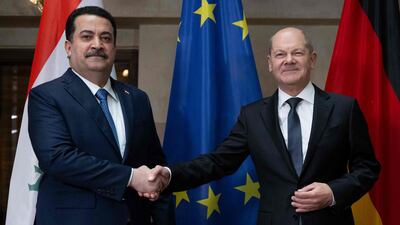
German Chancellor Olaf Scholz, right, and Iraqi Prime Minister Mohammed Shia Al Sudani at the conference. AFP -
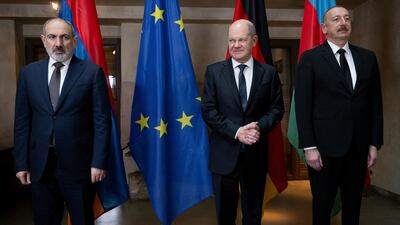
From left, Armenian Prime Minister Nikol Pashinyan, Mr Scholz and Mr Aliyev. Reuters -
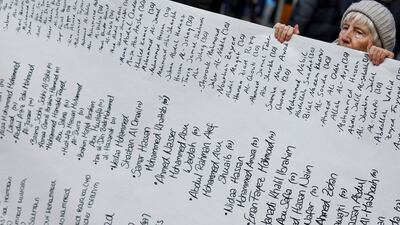
An anti-war demonstrator holds a banner with a list of names of Palestinians killed in the conflict between Israel and Hamas, outside the conference venue in Munich. Reuters -
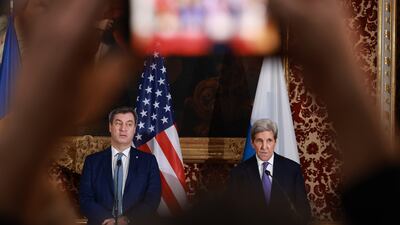
Bavaria's state governor Markus Soder, left, and former US secretary of state John Kerry at a dinner reception at the Munich royal residence. Getty Images -
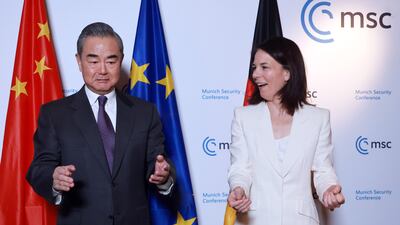
China's Foreign Minister Wang Yi and his German counterpart Annalena Baerbock arrive for a bilateral meeting. Getty Images -
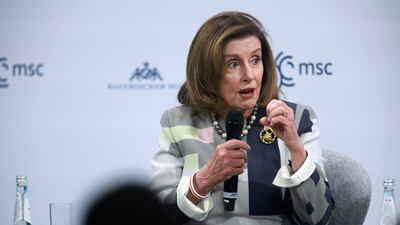
US Representative and former speaker Nancy Pelosi in conversation. Getty Images -

US Vice President Kamala Harris prepares to address the gathering. AP -

UN Secretary General Antonio Guterres delivers the opening speech. EPA -
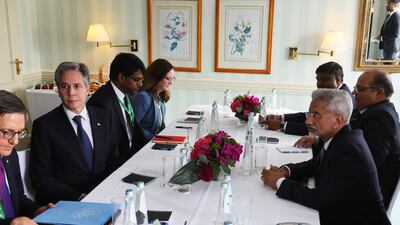
US Secretary of State Antony Blinken meets Indian Foreign Minister Subrahmanyam Jaishankar on the sidelines of the conference in Munich. Reuters -
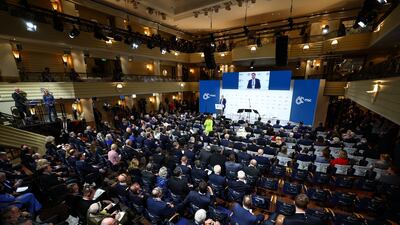
The three-day meeting featured more than 180 senior government representatives from all over the world. EPA -
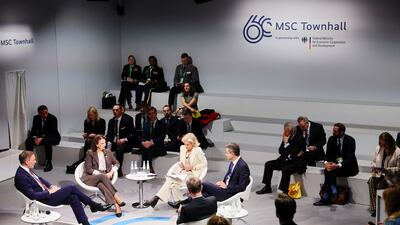
German Finance Minister Christian Lindner, left, Argentinia's Foreign Minister, Diana Mondino, second left, and Greek Prime Minister Kyriakos Mitsotakis, right, take part in a townhall at the conference. Reuters -
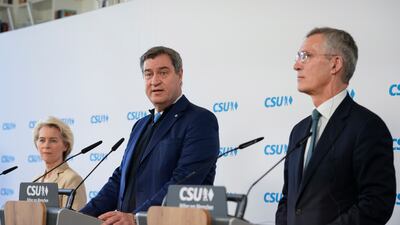
From left, European Commission President Ursula von der Leyen, Bavarian state premier Markus Soder and Nato Secretary General Jens Stoltenberg address the opening session. AP -

A sniffer dog checks a car for explosives in front of the conference venue. EPA -
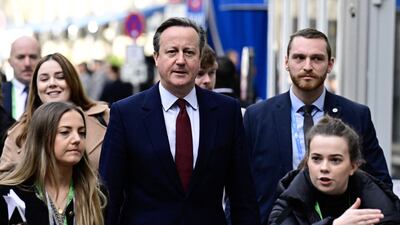
Britain's Foreign Secretary David Cameron arrives at the Bayerischer Hof. AFP -
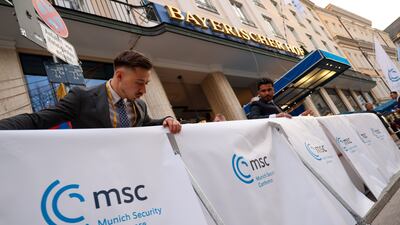
Workers check the security barriers. Bloomberg -

German police officers patrol the area surrounding the conference venue. EPA



