


When Joe Biden was elected US President in November 2020, many were delighted. What was there not to like about genial Joe, the long-serving Democratic senator and vice president known for his cross-party friendships, such as with the late Republican senator John McCain?
Forged partly through his own painful experience of loss – his first wife and one-year-old daughter were killed just after he was elected to the Senate in 1972, and his elder son Beau died of cancer in 2015 – Mr Biden seemed to be the very embodiment of compassion. After four years of Donald Trump tearing up the norms of presidential behaviour, it felt like a relief, a return to usual, to have such a palpably normal man in the White House.
I could never have imagined that a few months short of the next election, I would now find myself asking: is Joe Biden the most dangerous man on the planet?
It is not just the verbal slips, although they reveal a catastrophic decline in his mental capabilities. In the past few weeks, he has referred to talking to “Mitterrand from Germany, I mean France” at a G7 meeting in 2021 – Francois Mitterrand died in 1996, a year after he finished 14 years as France’s president. Mr Biden later said he had also spoken to former German chancellor Helmut Kohl at the summit, although Mr Kohl died in 2017.
Then at a news conference held to rebut special counsel Robert Hur’s report that described Mr Biden as an “elderly man with a poor memory” who couldn’t remember exactly when he’d been vice president, he called Egyptian President Abdel Fattah El Sisi “the president of Mexico” and continued without correcting himself.
This is not someone whose fingers should be allowed anywhere near the nuclear codes.

At the same time, the Biden administration has been giving wings to the wildest fantasies of the warmongering neo-cons and liberal interventionists in Washington, whose joint determination to spread “freedom” by the sword, if necessary, has justly earned them the nickname, “the uniparty”. In the past week, reports have come out, both in Taiwan and in Newsweek magazine, that specialists from the US army are going to be based permanently on the Kinmen Islands, which are governed by Taiwan.
Up until 2021, the fact that the US military has been training Taiwanese forces wasn’t even admitted publicly, and it provoked an angry reaction from Beijing (which considers Taiwan a renegade province) when it was. Neither have any US troops been permanently based there since 1979, when America established diplomatic relations with the People’s Republic of China and recognised it in a joint communique as “the sole legal Government of China”.
The permanent stationing of US troops in Taiwanese bases was in itself considered a move that risked war in the past. But the Kinmen Islands are not 160km away from mainland China, as the island of Taiwan is. They are a mere 10km away – so close that that the view from its shores of the Chinese city of Xiamen is crystal clear.
It is hard to think of anything more needlessly provocative, given that the US still officially supports the “One China” policy, and the White House continually insists that has not changed, even when Mr Biden keeps saying that the US would defend Taiwan militarily in contradiction of that policy.
Can anyone imagine what the reaction would be if China managed to set up a military base 10km away from the Statue of Liberty? The idea is unthinkable because we know Washington would never allow it. So why is it acceptable for American troops to be stationed on land that China considers its own, and from which you could wave to an observer on the mainland?
The idea that the US is allowed to do what others are not because it possesses some unique inherent virtue won’t wash any more. In terms of moral standing, it is on a par with former US president Richard Nixon’s insistence that “when the president does it, that means it is not illegal”.
-
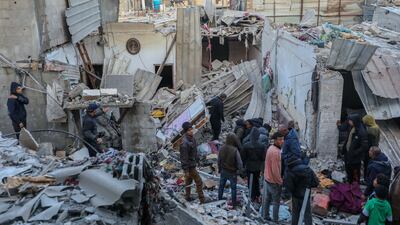
People inspect the damage to their homes following Israeli air strikes. Strikes intensified overnight as Israel reiterated intent to press on with a ground offensive in the city of Rafah, in southern Gaza. Some 1.4 million internally displaced Palestinians are sheltering there, and a growing number of countries are expressing alarm about the operation. Getty Images -
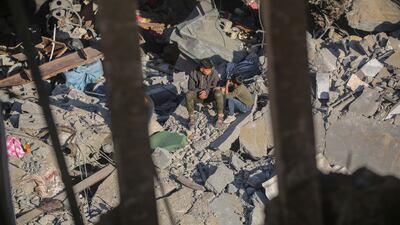
People sit amid the rubble of their homes following Israeli air strikes. Getty Images -
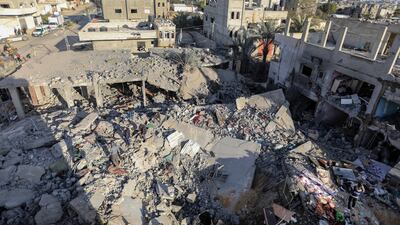
Homes lie in ruins after Israeli air strikes. Getty Images -
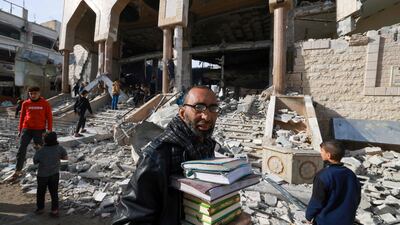
A man walks with salvaged religious books as people inspect the damage to a mosque in Rafah following Israeli bombardment. AFP -
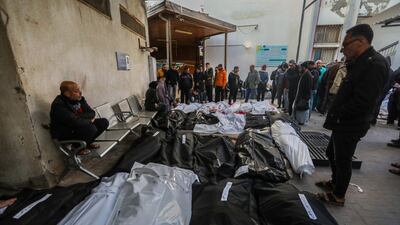
People mourn by the bodies of victims of an Israeli strike in Rafah. Getty Images -

The loved ones of victims of an Israeli strike in Rafah mourn and comfort each other. Getty Images -
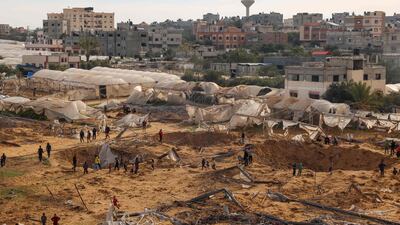
People stand around craters caused by Israeli bombardment in Rafah, in the south of the Gaza Strip. AFP -
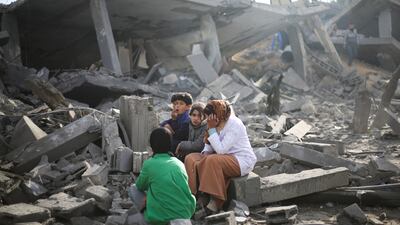
Palestinians sit in the ruins of their home in Rafah after Israeli bombardment of the city. AP -
A member of the Palestinian Civil Defence works at the site of Israeli strikes in Rafah, in the south of the Gaza Strip. Reuters -
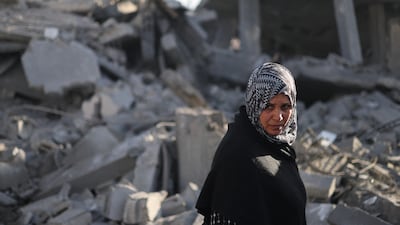
A Palestinian woman surveys the devastation after an Israeli air strike in Rafah. Reuters -
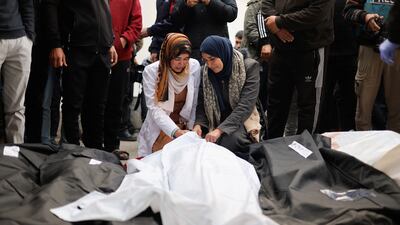
Women at Abu Yousef Al-Najjar hospital in Rafah mourn by the bodies of Palestinians killed in Israeli strikes. Reuters -
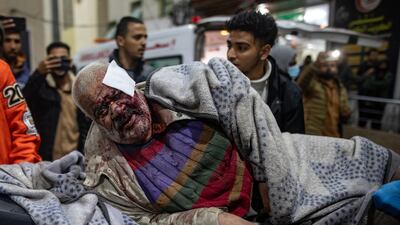
Wounded people are transported to Kuwait Hospital in Rafah following Israeli air strikes. EPA -
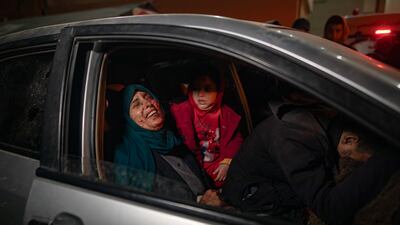
A wounded woman on her way to Kuwait Hospital in Rafah following Israeli air strikes on the city. EPA


But it seems there are no limits to what the Biden administration will do to support its friends and allies, however many thousands may die, and however close it brings the prospect of further cataclysmic conflict. Mr Biden has prolonged the wars in Ukraine and Israel-Gaza at terrible cost with all the military equipment the US has supplied.
By this point, it must be a matter of debate if Mr Biden either means what he says or understands what he is saying, but his recent description of Israel’s collective punishment of Gaza as “over the top” – what a casual, callous understatement – is a case in point. The EU’s foreign policy chief, Josep Borrell, gave the obvious riposte on Monday when he said: “Well, if you believe that too many people are being killed, maybe you should provide less arms in order to prevent so many people from being killed.”
Long ago, I quoted the words that former US president Jimmy Carter said to me when I interviewed him: “I think the US, since the Second World War, has been the most warlike nation on Earth. We’ve been involved probably 30 times in military action in foreign countries, which has been almost invariably a mistake.”
For all his shortcomings on the domestic front, Mr Carter was a peacemaker. It was he who recognised the People’s Republic of China in 1979, and it was he who brokered the Camp David Accords the previous year that led to a peace treaty between Egypt and Israel.
That Mr Biden – a man to whom he is so close that Mr Carter has reportedly asked him to deliver the eulogy when he dies – should prove to be the opposite is not a tragedy solely for America, for his appetite for war could engulf us all. This “elderly man with a poor memory” may present himself as “sympathetic” and “well-meaning”, as special counsel Robert Hur put it, but the world needs him to go – and as soon as possible.

