


Last Friday, Hezbollah’s secretary general, Hassan Nasrallah, gave a much-anticipated speech that left the impression that he was engaged in a high-wire balancing act. Mr Nasrallah had to balance his often-contradictory commitments, and in the end succeeded in buying himself time, while insisting that all options remained open for his party as it observes developments in the Israel-Gaza war.
Mr Nasrallah’s first obligation was to his partners in the so-called Axis of Resistance, an Iranian-sponsored alliance of armed militant groups that includes Hezbollah, Hamas, the Palestinian Islamic Jihad, the Houthis in Yemen, militias close to Tehran in the Popular Mobilisation Forces in Iraq, and various smaller groups.
Earlier this year, Mr Nasrallah first began speaking of what he called a “unity of the arenas” strategy, or a “unity of the fronts”, whereby the militias of the Axis of Resistance would co-ordinate their military operations against Israel in order to surround it with a ring of fire. This meant that when Israel crossed certain red lines on Muslim holy sites in Jerusalem or in its dealings with Axis of Resistance members, these militias would retaliate in unison.
The war in Gaza has put this strategy to the test, but it has also forced the partners in the Axis to clarify what co-ordination means. From the beginning, Hezbollah and Iran made clear that there were limits to what the Axis would allow Israel to do in Gaza, including invading the territory. However, they never spelt out what their response would be, nor how far they would go, retaining a margin of manoeuvre.
This created a dilemma for Mr Nasrallah. His commitment to the Axis hit up against his commitment at home to his own Shiite community and, perhaps to a lesser extent, to his sectarian counterparts in Lebanon, that Hezbollah could guarantee the country’s security. If Hezbollah entered the war fully against Israel, provoking huge Israeli retaliation that led to the country’s destruction, then Hezbollah risked being blamed both by Shiites and by other Lebanese communities.
Hezbollah is well aware that the aftermath of a ruinous war could threaten its dominant position. Israel has vowed to bomb Lebanon “back to the stone age” if the party were to enter the war with all its might. Inside the country, Hezbollah is already isolated, as most Lebanese have no desire to see Lebanon ravaged because of a conflict in Gaza. While there is sympathy for the Palestinians, Lebanon’s economic collapse in 2019 has made more advanced expressions of solidarity impossible.
In his speech, Mr Nasrallah did not rule out an escalation, but all the optics of his speech made it evident that Hezbollah sought to avoid a conflict that might quickly turn into a regional conflagration. Mr Nasrallah made a point of underlining that the party had entered the battle from day one, and it had drawn Israeli forces away from Gaza. This was, implicitly, a response to those who accused the group of not doing enough.
Yet as most observers have said, Hezbollah’s exchanges with Israel, while far from insignificant (dozens of combatants and civilians in total have been killed), have remained within the traditional “rules of engagement”. This means that fighting has been mostly contained to the broader border area, with both sides primarily engaged in tit-for-tat operations and avoiding hitting major strategic targets and large urban areas.
-

Women attend the funeral of a Hezbollah militant killed during clashes against Israeli forces in the southern border of Lebanon. Getty Images -
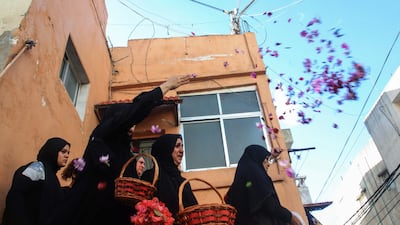
Women at the funeral of Hezbollah fighter Kamal Al Masri in Burj Al Shemali, southern Lebanon. AFP -
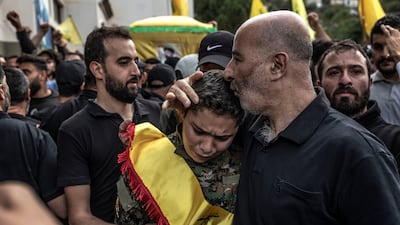
A man comforts the son of a Hezbollah militant killed during clashes against Israeli forces in the southern border of Lebanon. Getty Images -
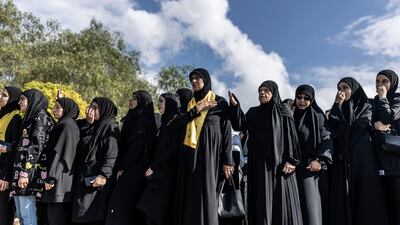
Hezbollah supporters attend the funeral of a Hezbollah militant killed in Lebanon. Getty Images -
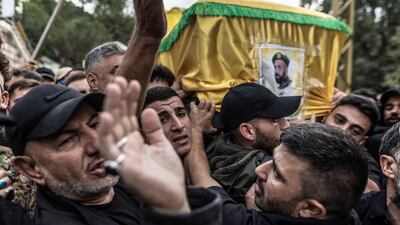
Hezbollah supporters carry the coffin of a Hezbollah militant. Getty Images -
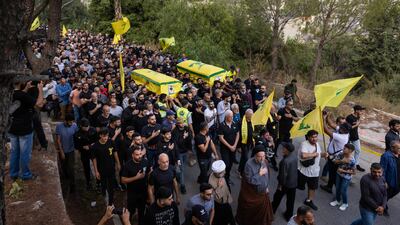
Men carrying the coffins at a funeral for two Hezbollah soldiers killed in south Lebanon. Getty Images -

Members and supporters of Hezbollah take part in the funeral of Kamal Al Masri, one of the group's fighters, in southern Lebanon. AFP -
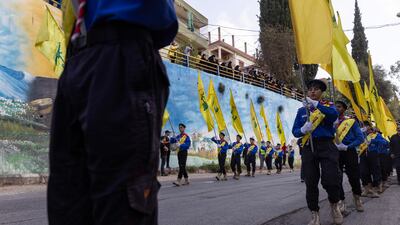
Scouts carry Hezbollah flags at a funeral for two Hezbollah soldiers killed in South Lebanon. Getty Images -

Hezbollah fighters attend the funeral procession of two comrades in Kherbet Selem, south Lebanon. AP Photo -
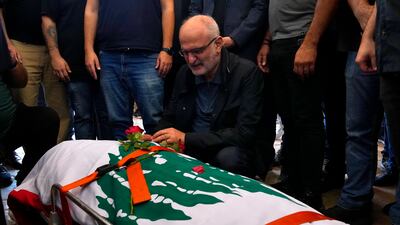
Member of Lebanese parliament Ali Hassan Khalil mourns the body of Reuters videographer Issam Abdallah, who was killed by Israeli shelling, during his funeral in Khiam, southern Lebanon. AP Photo -
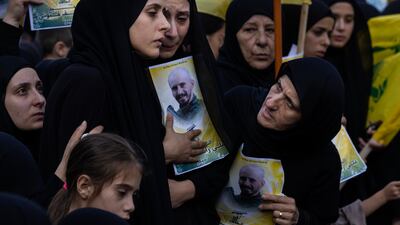
Women at a funeral for two Hezbollah soldiers killed in south Lebanon. Getty Images -
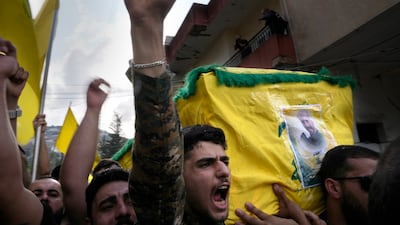
A Hezbollah fighter carries the coffin of his comrade who was killed by Israeli shelling in Kherbet Selem, south Lebanon. AP Photo -

Hezbollah fighters at the funeral of their two comrades in Kherbet Selem. AP Photo -
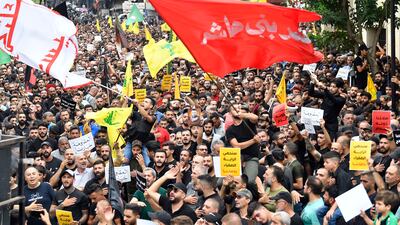
Hezbollah supporters shout religious slogans during the funeral of Hezbollah fighter Ahmed Qassas in a southern suburb of Beirut. EPA


Something else must have greatly shaped Mr Nasrallah’s response: Iran’s priorities.
From the start, it was clear that the Iranians and the Americans shared an objective in not wanting to allow the conflict in Gaza to spin out of control and lead to a regional war that could draw in both countries. In the same way that Washington sought to control Israel’s response to avoid such an outcome, Mr Nasrallah must have known that his latitude to act was also limited, even if he was in full agreement with its implications.
It is unclear in which direction Hezbollah will go if Israel threatens Hamas existentially. Even if Mr Nasrallah did leave the door open to raising the ante in that case, his bottom line may not change very much – namely avoiding Lebanon’s devastation, management of which could absorb the group’s attention for many years, thereby neutralising Hezbollah and its ability to maintain a deterrence capability on Iran’s behalf.
The latter point cannot be underestimated. One of Hezbollah’s principal roles is to act as a shield against any US or Israeli attempt to bomb Iran, in particular its nuclear programme. Putting Hezbollah in a position where it may see this role undermined is probably not an option for Mr Nasrallah, even if he wants to avoid showing this.
A broader question is what Hezbollah’s reluctance to be drawn into a full-scale war with Israel, beyond the hitherto contained attacks in the broad border area with Israel, means for Iran’s and Hezbollah’s “unity of the arenas” strategy. In terms of expectations, it will certainly limit what Iran’s allies can anticipate Hezbollah will do on their behalf if the group’s power is threatened by Israel’s retaliation. Therefore, the strategy, which is a work in progress, may already have shown some of its limits.

