


The Saudi presidency of the Arab League over the coming year is expected to exert a magnetic pull, drawing the region towards its orbit, as Riyadh aims to embark on a path of openness, moderation and a forward-looking future.
In the Saudi calculus, Iran plays an important role in regional considerations. Over the next year, it is hoped that Tehran will go from being an “enemy”, “saboteur” and “aggressor” – as has been described in some of the previous Arab summits – to a co-operative partner contributing to solutions and avoiding encroachments on the sovereignty of Arab states.
The Saudi presidency will aim to strike a balance between the US and China while simultaneously building confidence within a fresh framework of relations with the two powers. Riyadh also intends to follow a roadmap that prioritises the kind of initiatives launched during the Jeddah summit over the weekend, marking a milestone in the journey of Arab summits.
The G7 summit in Hiroshima, also held last weekend, marked the beginning of a cautious chapter in the grouping’s relations with China and Russia, conveying a deficit of trust in Beijing and complete absence of trust in Moscow.
A G8 member until the war in Ukraine broke out in 2014, Russia has since become a pariah to the West. The Hiroshima meeting was swiftly transformed into a Ukraine summit, with the G7 leaders unanimously agreeing to bolster military and economic support for Kyiv. The summit's key resolutions centred around intensifying pressure on Moscow through the expansion of long-term sanctions – including secondary sanctions on companies engaged in business with Russia.
The G7, it appears, is also determined to prevent China from fulfilling its aspiration to broker a solution to end the war. According to several experts, there is little scope to end the conflict, which could last for years unless it escalates into a broader, deeper, and more dangerous confrontation.

One may not be able to draw a line connecting the Jeddah and Hiroshima summits. However, the dynamics of the western-Chinese relationship, specifically the US-Chinese relationship, will influence the Saudi presidency’s positions. Both American and Chinese diplomats recognise Saudi leadership in the Arab region, especially during this pivotal moment for all parties involved. This represents a qualitatively new development.
Few major powers have been accustomed to adapting to the choices and orientations of smaller states, including regional powers. In the past, their policies were crafted based on a "top-down" approach, particularly during the Cold War.
Today, there is a shared understanding around the world that the Gulf countries have undergone significant transformations. These nations embody youth, vision, courage, attentiveness and boldness. Their leaders skillfully navigate the future through the lens of technology, AI, development and progress. They not only acknowledge the worth of their heritage but also grasp the value of their strategies. As a result, they engage with counterparts around the world in a language characterised by mutual respect.
This language has been endorsed by other Arab countries – as evidenced in Jeddah, where there was an interest in not just resolving conflicts but also in contributing to a radical transformation across the Arab world.
Until not long ago, political discourse in the Arab League summits was characterised by ideological one-upmanship and false promises of unity. Today, the political discourse has shifted towards emphasising the importance of legitimacy and national sovereignty of each nation, highlighting the crucial role of Arab nation-states. If there is a genuine aspiration for integration, then it must be pursued at a higher level, within the framework of an advanced modernisation project that embraces future technologies, rather than clinging to outdated ideologies.
Perhaps the Jeddah summit could be credited with helping to construct a new Arab order. The Saudi leadership is among the first to recognise the centrality of Gulf and Arab countries and their potential to have a significant role within the upcoming global order shaped by developments among major powers and within themselves, economically and politically.
The current approach focuses on taking carefully measured steps that respect international resolutions and sanctions. From resolving the Yemen conflict to stabilising Sudan, and from testing the Syrian leadership to addressing the challenges in Palestine, Lebanon, Iraq and other Arab nations, the Jeddah summit has ignited an effective Arab machinery with real impact.
-
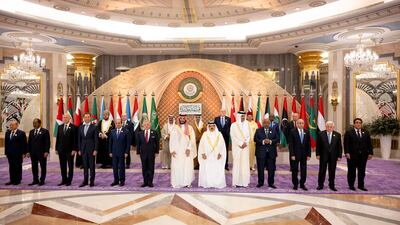
Sheikh Mansour bin Zayed, Vice President, Deputy Prime Minister and Minister of the Presidential Court, stands for a photo with other leaders during the Arab League summit -
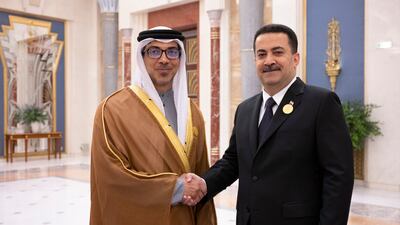
Sheikh Mansour bin Zayed, Vice President, Deputy Prime Minister and Minister of the Presidential Court, meets Iraqi Prime Minister Mohammed Shia Al Sudani during the Arab League summit -
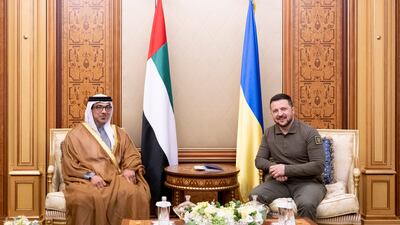
Sheikh Mansour bin Zayed, Vice President, Deputy Prime Minister and Minister of the Presidential Court, meets Ukrainian Prime Minister Volodymyr Zelenskyy in Jeddah -

Sheikh Mansour bin Zayed, Vice President, Deputy Prime Minister and Minister of the Presidential Court, speaks with Mr Zelenskyy during the summit -
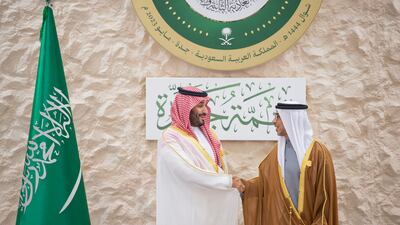
Sheikh Mansour bin Zayed, Vice President, Deputy Prime Minister and Minister of the Presidential Court, greets Saudi Crown Prince Mohammed bin Salman during the summit -

Sheikh Mansour bin Zayed, Vice President, Deputy Prime Minister and Minister of the Presidential Court, attends the summit -
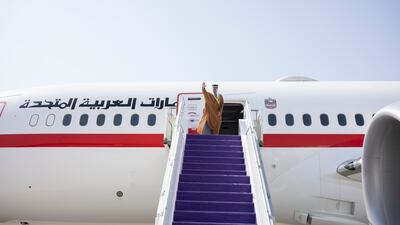
Sheikh Mansour bin Zayed, Vice President, Deputy Prime Minister and Minister of the Presidential Court, departs from Jeddah, Saudi Arabia. All photos: UAE Presidential Court


Resolving differences with Iran will be of great priority, building on the Arab position articulated in the final statement of the summit that guarantees the resumption of diplomatic relations, reopening of missions, and activation of the security and economic co-operation agreement between the two nations. For the first time in many years, the statement issued by the summit did not condemn Iranian behaviour.
The strategic intentions of Iran, which remains ubiquitous in the Arab region, are yet unclear. Tehran has adopted a soft diplomacy approach today, distancing itself from making threats, as if it is presenting credentials of moderation to Saudi Arabia and China. Yet, there is little indication of any radical reform within and there is no evidence to suggest disengagement between the regime and the Islamic Revolutionary Guard Corps or its regional proxies.
Nevertheless, Riyadh appears determined to give Iran an opportunity to test the benefits of peace, dialogue, and ending interference in Arab countries and violation of their sovereignty. These benefits go beyond the economic dimension and will be crucial for the Iranian regime if it truly chooses a path of modifying its own logic and developing the state to join the regional march towards the future.
It is a gamble, but Saudi diplomacy seems to believe it is possible to persuade the regime and that the desired transformation could encourage the US to resume nuclear negotiations with Tehran.
Some worry that all this will come at a price, and that some powers will turn a blind eye towards Iran's interference in the Arab world. But these are mere conjectures. In fact, such scenarios lack logic because allowing, for example, the Lebanese state to be taken over by Hezbollah would give the Iranian-backed militia the chance to regroup and resume its regional disruptive operations. Logically, Arab powers are unlikely to let the IRGC control sovereign states in the region.
Finally, on the international level, the Saudi presidency intends to highlight the capability of the Gulf and Arab countries to mediate between countries in conflict. Ukrainian President Volodymyr Zelenskyy’s presence in Jeddah may have been the Arab League’s message to the G7 that it is ready to play a constructive role in the Ukrainian crisis, as well as in other crises whenever the need arises.

