


Within the next few days, the UAE will record its 1 millionth Covid-19 case since the pandemic began.
On Thursday, the total number of cases identified in the country since 2020 was 995,777 after 1,084 positive tests were returned from more than 242,000 PCR tests. It is a matter of absolute certainty – when rather than if – that the figure will go beyond 1 million this month.
All of us will react differently to that milestone number being breached, just as we have throughout a two-and-a-half-year health event that has seen periods when infections have ebbed and flowed intensely. The same troughs and peaks that we saw in 2020 and 2021 may well continue to repeat themselves as the months and years roll by.
What that number means is that at around one in 10 of us living in this country has contracted the virus over that period, although some people have tested positive for a second time months after their first diagnosis, which slightly alters the calculation. The vast majority of the 1 million who have tested positive have thankfully recovered and the active case figure in the UAE is less than 20,000 in August 2022.
For context, the global historical caseload over the entire pandemic is around 580 million worldwide, according to the Johns Hopkins Covid-19 dashboard, while its global cases tracker shows 28 million new infections have been identified and recorded around the world in the past four weeks.
So is the 1 million figure a number to let slide by as we get on with our lives, or should it prompt a more protracted moment of reflection? The answer is probably both.
If the most visceral and dramatic periods of the crisis are now mostly behind us – such as when the first cases were identified, or when the initial period of lockdown was announced, or when the first new variants were identified adding uncertainty to our world and so on – it is hard to ignore the marks that the receding tide has left behind.
One of the more striking elements of the pandemic is how differently the virus applied itself to each one of us. For the nearly 1 million people who have tested positive in this country since 2020, some will have exhibited few or no symptoms during the period of infection, others will have endured some temporary discomfort and then there is another set of people for whom testing positive would have wrought upon them serious and potentially long-term consequences to their health. Researchers have this week released data showing how three different types of long Covid can be identified, such as brain fog, respiratory problems or aches and pains.
And then there are the other scars.
If you, like me, are part of the statistics of case numbers and infections – and often the narrative of this global health event has been charted in tracking data rather than human stories – the virus has left some almost invisible marks behind.
All of our lives have changed in the past two-and-a-half years, regardless of whether we have contracted or avoided infection. From the way we work to the way we now interact with friends, family or colleagues and classmates, the world is a changed landscape to the one we left behind to temporarily shelter at home in the spring of 2020. We have all had to draw on our reservoirs of resilience and adaptability over the past two years to deal with moments of instability and anxiety. We have gained a lot, too, particularly in increased flexibility and potentially generational changes to work practices.
-

Mandatory checking of the Al Hosn app by security at every entrance of the Khalidiyah Mall in Abu Dhabi. Khushnum Bhandari / The National -

Al Hosn green pass awareness signs are placed at every entrance of Khalidiyah Mall. Khushnum Bhandari / The National -

An EDE scanner sign at the main entrance of Khalidiyah Mall. The scanners can detect whether a person may have coronavirus. Khushnum Bhandari / The National -
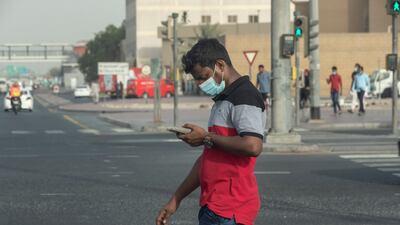
Masks are worn to prevent the spread of Covid-19. Antonie Robertson/The National -
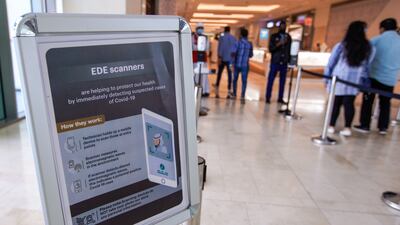
Yas Mall Al Hosn signs. Victor Besa / The National -
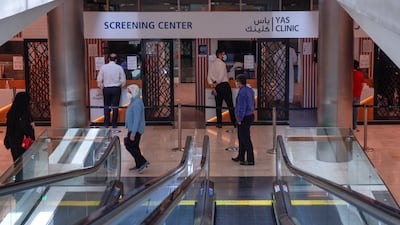
Yas Clinic screening centre at Yas Mall in Abu Dhabi. Victor Besa / The National -
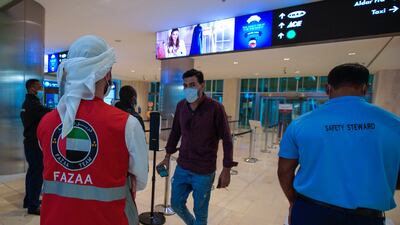
The UAE has taken robust action to help stem the spread of Covid-19 since the virus first emerged two-and-a-half years ago. Victor Besa / The National -

A number of safety measures governing the economy, education, travel and the health sector were introduced as part of a major drive to protect public health. Victor Besa / The National -
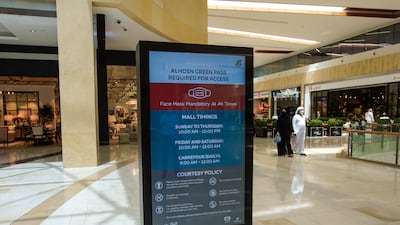
Some restrictions have been eased in recent months — including the wearing of masks outdoors — but other rules remain in place. Victor Besa / The National -
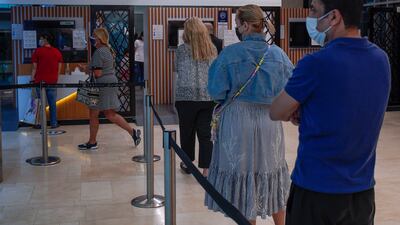
Yas Clinic screening centre at Yas Mall in Abu Dhabi. Victor Besa / The National -

A member of staff takes a Covid-19 sample at the NMC Royal Hospital in DIP, Dubai. Chris Whiteoak / The National -

A person with two positive tests is a confirmed case in Abu Dhabi. Chris Whiteoak / The National -

A member of staff cleans a surgery room at the NMC Royal Hospital in DIP, Dubai. Chris Whiteoak / The National -

Covid-19 cases are on the rise in UAE and authorities have told residents to wear masks as a preventive measure. Pawan Singh / The National -
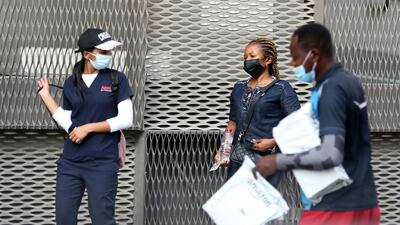
In Dubai, anyone with a positive PCR test for Covid-19 is a confirmed case. That means you have to isolate for 10 days, even if you do not have symptoms. Pawan Singh / The National -
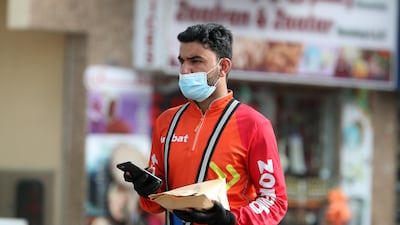
In Dubai, the 10-day home isolation period is mandatory. The first day is the day you took the PCR test. Pawan Singh / The National -
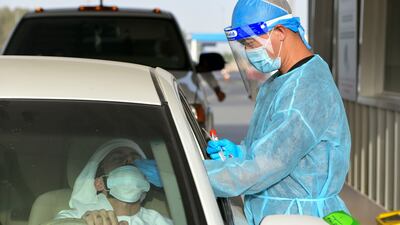
Covid testing carried out at Seha Covid-19 Drive Through Screening Centre Rabdan, in Abu Dhabi. Khushnum Bhandari / The National -
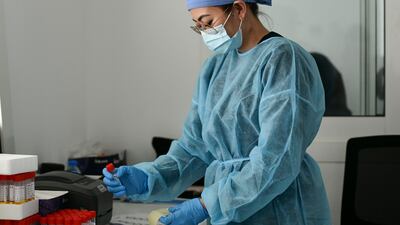
At a coronavirus briefing on Monday, authorities said the wearing of face masks in indoor public settings would be strictly enforced, with Dh3,000 fines for those breaching rules. Khushnum Bhandari / The National


The UAE has, of course, dealt well with this major health crisis, adhering to regular testing, rolling out a comprehensive and successful vaccine programme and opening up borders when it was appropriate to do so. Little wonder that it has consistently ranked in the upper reaches of the Bloomberg Resilience Index, which measures pandemic response in countries around the globe.
There are many signs, both large and small, that we are moving towards the post-pandemic world. Last week, authorities in Abu Dhabi announced that one of its drive-through testing centres would close. Separately, some pharmacies will be allowed to administer vaccines and carry out tests, according to a Department of Health – Abu Dhabi directive. Home self-administered tests could be a further initiative to introduce to aid the transition further, but more broadly some of the architecture of the pandemic response is being packed away as the threat of the virus recedes.
That, perhaps, is the greatest takeaway from the 1 million figure when it is breached this month. The third summer of this global health event marks a time when Covid-19 has transitioned to a virus that can be managed via appropriate and well-practised responses and protocols. The worst of the emergency has passed, replaced by pressing concerns elsewhere in our world.
As last week’s dramatic weather events in the northern emirates demonstrate, as one crisis subsides, another can emerge unexpectedly that demands urgent attention and rapid intervention.

