


Images of Taliban fighters comfortably ensconced in Afghanistan's presidential palace have shocked the world. It is easy enough to imagine that things will work the way they did when the Taliban were in power from 1996 to 2001. But the past two decades of war have left a mark on every player in the region, the Taliban most of all. The group’s determination to survive and win means that it has no interest in repeating its experiences of regional isolation and total dependence on Pakistan.
Although it is too early to predict what sort of regime the Taliban will choose to build in Afghanistan, they have worked astutely to lay the groundwork for strong ties with enough countries in the region to ensure their autonomy from any single power. The international system is not dealing with an unsophisticated protectorate of Pakistan anymore, but rather a very canny independent player.
Few outside Pakistan dispute that its government has an exceptionally close relationship with the so-called Haqqani Network in parts of eastern Afghanistan. But the profound betrayal felt by the rest of the Taliban movement over Pakistan’s decision after the 9/11 terror attacks on American soil to fully collaborate with the US’s overthrow of their state cannot be overstated. It made crystal clear that national interests, rather than any ideological or religious bond, had driven Pakistan’s support since the 1970s. The Pakistan military’s subsequent decision to secretly provide safe harbour for the Taliban’s leadership and their insurgency only reinforced that lesson.
While there have been high-profile stories of Taliban leaders' access to high-quality medical care in Pakistan, there are also frequent reports of coercion by the authorities. It appears that these authorities maintained a constant threat of arrest over Taliban exiles and their families to ensure co-operation with, which included sitting at the negotiating table with the Americans and the Afghan government. The result is that there is no love lost between the two sides, only a wary and uncomfortable working relationship.

All of this explains why the Taliban have fostered alliances with Iran and Russia. Both countries have backed the group for many years now against the US-aligned Kabul government with funds, equipment, intelligence and advice. This has done much more than simply reduce Pakistan’s bargaining power. It has destroyed the basis of the partnership that kept the Northern Alliance opposition against the Taliban from 1996 to 2001 alive. The Northern Alliance not only prevented the consolidation of Taliban rule, it also provided the essential boots on the ground, without which the US air campaign could not have succeeded.
The strong relationship with Russia, and increasingly with China, is a game-changer in diplomatic terms as well. These countries’ UN Security Council veto powers mean that the kind of sanctions that first isolated the Taliban government and then authorised its destruction are almost impossible. Of course, it does not prevent the US from taking unilateral air strikes or covert action, but it does significantly reduce the risk of another invasion.
However, these alliances also impose limits that could reduce the risks of mass repression and civil war. Iran and Pakistan alike have grown weary of hosting millions of Afghan refugees over the past four decades. They have maintained significant pressure on the Taliban to avoid bloodshed or persecution that might create fresh refugee flows. This, along with the Taliban’s desire for international recognition, has played a role in its comparatively restrained behaviour since the government's collapse.
This moderation should not be taken for granted. Although pragmatic forces in the Taliban have held the upper hand since the death of their former leader Mullah Omar, there are many within the group who still share his extreme worldview. There will inevitably be fresh power struggles as the different groups of exiled leaders in Qatar, Iran and Pakistan return to face new realities, including the – at least temporary – need to accommodate community powerbrokers from the defunct government. As with the Iranian revolution, it is possible that the hardline extremists could triumph in this process of consolidation, regardless of all the external incentives to conform with international norms.
It isn’t just the Taliban whose approach is believed to have changed. Back in the 1980s, when tensions with India were reaching new heights, Pakistan’s then president, Gen Zia ul Haq, adopted a vision of “strategic depth”. This vaguely defined goal aimed to give Pakistan immunity from any potential Indian threat to its existence through deep integration with friendly Muslim neighbours. The essential first step in this plan was to install a puppet government in Kabul, and the second was to absorb it into a new confederation. Beyond supporting the Afghan mujahideen’s war, it meant working to erase the border between the two countries, as well as the legal differences between Afghans and Pakistanis in the name of Islamic solidarity.
-

Afghan women and a boy outside a shop in the old quarter of Kabul. -
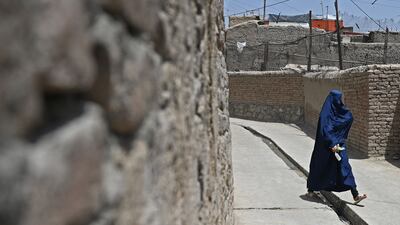
An Afghan woman in an alley in Kabul's old quarter. -
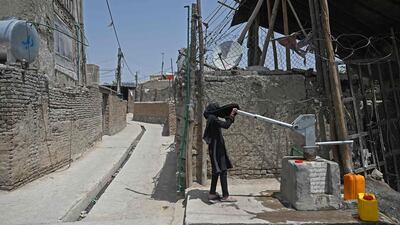
A girl uses a hand pump to fill a container with drinking water in Kabul, Afghanistan. -

A young girl in the old quarter of Kabul. -
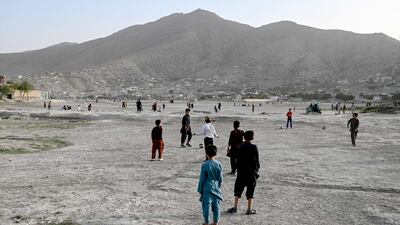
Children play football on a dried-up lake bed in Kabul. -

An Afghan security official searches a vehicle at a check point in Lashkar Gah, the provincial capital of Helmand province, Afghanistan. -
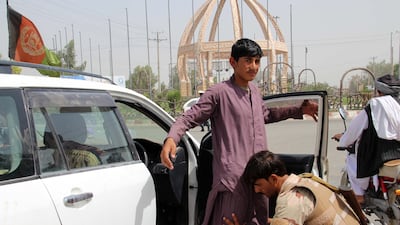
A security official checks people at a check point in Lashkar Gah, in Helmand province, Afghanistan. -

Afghan National Army soldiers at a roadside check point in Herat, the provincial capital of Herat province in Afghanistan. -
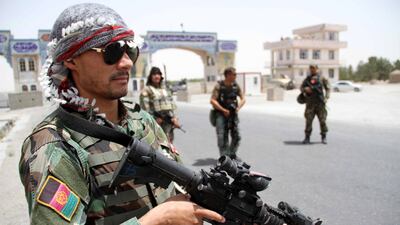
Afghan soldiers stand guard at a check point in Herat, Afghanistan.


But the backwash from the unresolved state of war fostered in Afghanistan has proved overwhelmingly distasteful to the Pakistani public and elites alike. The extreme violence from Tehrik-e-Taliban Pakistan (TTP) since 2007 has led to a complete about-face, moving from integration to enforced separation. Pakistan has worked hard to fence the border and sometimes coercively force refugees back into Afghanistan. When the Taliban seized Kabul, the government immediately closed the main border crossing at Torkham. As a result, Pakistan is now content to let an independent Taliban take power, so long as they don’t ally with India.
In fact, now that the Taliban have unofficial direct relationships with a number of countries, including the US, the balance of power in the relationship with Pakistan could shift even further. The Taliban have never ended their friendly relationship with the TTP, and have in fact released all TTP prisoners across Afghanistan. They have also never renounced traditional Afghan claims to the Pashtun lands conquered by colonial Britain and incorporated into Pakistan. And of course, their ultimate reserve card remains building a relationship with New Delhi, which is far from closed to the idea.
As long as the Taliban maintain their strong diplomatic game, they could become something like the military junta in Myanmar, a country with few real friends but also few real enemies and one that carefully balances its rival neighbours. Or, they could become something like the regime in North Korea, where a strong state behaves dangerously towards all but is protected by strong neighbours whose greater fear is the country's disintegration and extra-regional intervention. Or, like every Afghan government that came before, they could develop open hostility with Pakistan and friendship with India. In its own strange way, Afghanistan – and the Taliban along with it – has been far more globalised than either of the aforementioned regimes, thanks to two decades of multinational occupation and migration. What follows may be nothing like what has come before.

