

The May deadline for the withdrawal of US troops from Afghanistan looms large over Washington. But it looms much larger over Kabul.
The US's intervention in the country, launched nearly 20 years ago, began as a mission to oust the Taliban and became a project to secure and stabilise the country. But today Afghanistan is neither secure nor stable, and the Taliban is as pervasive as ever.
A round of peace talks that began last September were meant to set the stage for real progress. They started an agreement in Doha, in which the Taliban consented to the talks and in exchange for the scheduled US withdrawal. But after five months of deliberations in plush Doha hotels, the talks have gone nowhere. A two-week recess was called in December, but has not really ended. The Taliban blames its dithering on the newly inaugurated administration of US President Joe Biden, indicating that it is waiting to see how the American approach to the talks may change.
Mr Biden has indicated that he will consider keeping US troops in Afghanistan a while longer. This is partly because the Taliban, according to the most recent report by the US's special inspector general for Afghanistan, has not met the deal's other two conditions: a commitment to reducing violence and a total end to the group's relationship with terrorist organisations.
Instead of returning to talks, senior Taliban operatives spent last week in the Iranian capital, Tehran. The Taliban, who before the US intervention were in a state of near-open warfare with Tehran, have recently begun ingratiating themselves, reportedly receiving money and even weapons from Iranian sources. This has been a point of concern for Kabul, which has long maintained a cautious, but friendly relationship with Tehran.
For Iran, which has already successfully implanted itself as a powerful wirepuller in its other large neighbour Iraq, Afghanistan could be fertile ground in which to extend its hegemony eastward. Even as they kept their Taliban guests from the negotiating table, Iranian officials assured them that they were better poised to mediate with Kabul than Washington.
-
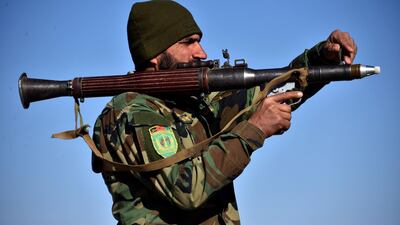
An Afghan National Army soldier during an operation in Arghandab district of Kandahar Province on February 3, 2021. AFP -
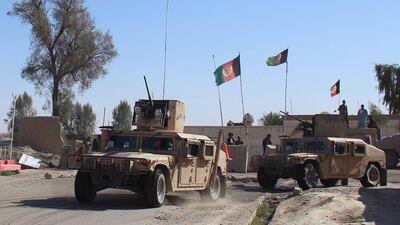
Afghan security forces patrol on the outskirts of Helmand, on January 17, 2021. Violence has surged across the country in recent weeks, despite the Afghan government and the Taliban committing to reduce their attacks. EPA -
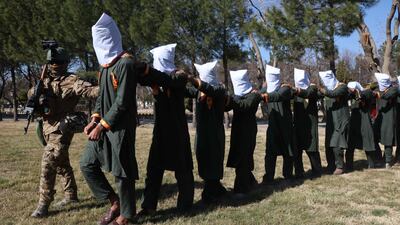
Afghan security officials present arrested members of the Taliban, in Herat, Afghanistan, on February 2, 2021. EPA -
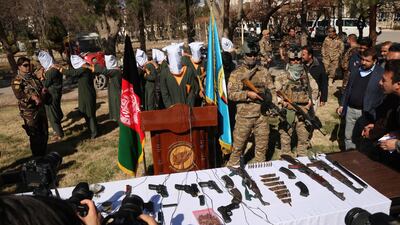
Afghan security officials present weapons confiscated from arrested members of the Taliban, in Herat, Afghanistan, on February 2, 2021. EPA -
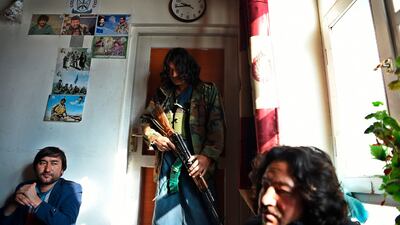
Hazara militia fighters stand inside their base ahead of a patrol against Taliban insurgents in Wardak Province, Afghanistan, on January 9, 2021. Comprising roughly 10 to 20 percent of Afghanistan's 38-million population, Hazaras have long been persecuted by the Taliban. AFP -
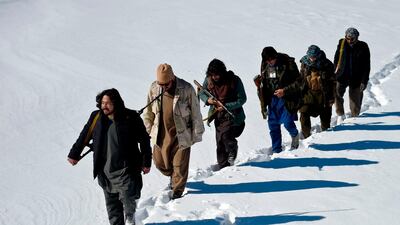
Hazara militia fighters patrol against Taliban insurgents in Wardak Province, Afghanistan, on January 9, 2021. Comprising roughly 10 to 20 percent of Afghanistan's 38-million population, Hazaras have long been persecuted by the Taliban. AFP -
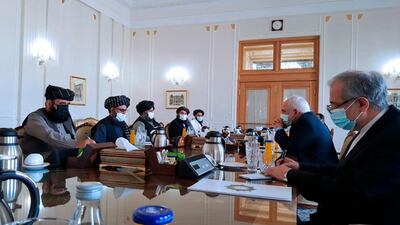
Iran's Foreign Minister Mohammad Javad Zarif, second right, meets with a Taliban delegation in Tehran, Iran on January 31, 2021. Tasnim News Agency


With resurging violence, continued safe haven for terrorists in Taliban areas and a total lack of appetite from the Taliban for peace talks, it is difficult to see any progress since the original deal was signed last February. The Taliban’s flirtations with Tehran will also put Washington in a state of alarm. In trying to bide its time to gain the upper hand, the Taliban has rendered the deal useless and probably precipitated a prolonging of the US intervention it means to end.
But if there was ever a time to sue for peace, it is now. Afghanistan had a particularly difficult 2020, both by the standards of 2020 itself and by those of recent Afghan history. Nearly 3,000 civilians were killed in the ongoing civil war, and 5,500 were wounded. The figure is 21 per cent lower than 2019, but that macabre silver lining was washed away by a further 2,400 deaths from Covid-19.
Compounding the tragedy, the country is experiencing a surge of polio cases and an epidemic of violent crime in its largest cities. The continued operation of schools and universities was meant to be a steady contributor to social and economic progress, but the pandemic has closed them. Forty per cent of young Afghans, according to the UN, are out of school and unemployed.
Afghan lives and livelihoods are deteriorating quickly. If the parties to the peace talks continue to ignore this and cannot secure a ceasefire, then whichever of them wins the war will merely be king of the ashes.

