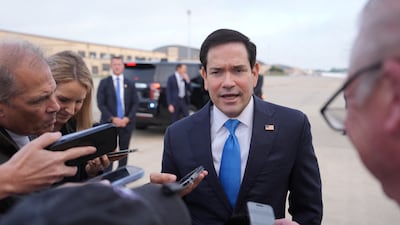

US Secretary of State Marco Rubio said on Monday that Saudi Arabia has a right to defend itself against attacks by Yemen's Houthis.
Before a trip to Iceland and mainland Europe, Mr Rubio also said Washington would honour its defence and security agreement with the kingdom, as Saudi-backed Yemeni forces launched an offensive against Iran-aligned Houthi fighters.
Yemeni government forces on Monday said they had secured control of the Bab Al Mandeb strait, the Dhubab area overlooking the sea lane and the strategic port city of Mokha, as the Saudi-led coalition provided aerial support and carried out air strikes on Houthi targets.
“Obviously the Saudis have come under Houthi attack and see the threat that that poses, and they have a right to defend themselves,” Mr Rubio said. “And obviously the Yemeni forces are going to try to retake territory that they were ousted from.”
He was asked if the US would provide air support for the Saudis, or if Washington had helped to co-ordinate the counter-offensive to retake Houthi territory.
“The United States has a defence and security agreement with Saudi Arabia and we intend to live by it,” Mr Rubio said, without elaborating.
President Donald Trump earlier rebuffed requests for direct US military action from Saudi Crown Prince Mohammed bin Salman.

Elizabeth Dent, a senior fellow at the Washington Institute for Near East Policy, said the US can do a lot without becoming actively engaged in military combat.
"It is likely already providing intelligence, surveillance and reconnaissance support on missile and drone launch sites, Houthi leadership movements, maritime activity, command and control nodes [and] active threats," said Ms Dent, who was previously the Pentagon’s director for the Gulf and Arabian Peninsula, overseeing US defence relations with Saudi Arabia and Yemen.
Washington may also be providing more assistance for air and missile defence through interceptors and radar coverage, as well as logistics and sustainment operations.
"The US is also likely co-ordinating with the Saudi-led maritime coalition and may be providing targeting information for Saudi strikes," Ms Dent added.
Mr Rubio confirmed senior US officials had met at Camp David, 100km from Washington, last week for an unannounced meeting. Axios reported Yemen was among the topics discussed when Mr Rubio joined Vice President JD Vance, Pentagon chief Pete Hegseth, CIA director John Ratcliffe, special envoy Steve Witkoff and other senior officials.
“We’re constantly meeting for long-term strategic planning and things of this nature,” Mr Rubio said. The National Security Council regularly brings together senior officials to consider issues “six months, nine months, but in many cases five or 10 years down the road”, he added.
During Prince Mohammed's visit to Washington last November, the US and Saudi Arabia signed a Strategic Defence Agreement major and Mr Trump declared Riyadh to be a major non-Nato ally.
The designation will make it easier for the US to share military technology with Saudi Arabia and increase security co-operation.
The Yemen conflict began after the Houthis seized the capital Sanaa in 2014, prompting the Saudi-led coalition to intervene the following year with a campaign aimed at restoring the government and ousting the rebel group.
Since the Houthi takeover, the Saudi-backed Presidential Leadership Council, also recognised by the UN, has controlled the south and east of the country and is based in the southern city of Aden.
The Houthis have more recently launched attacks on Saudi Arabia and on commercial and military shipping in the Red Sea and Gulf of Aden.
Beyond reducing the Houthis' ability to threaten the Bab Al Mandeb strait, Saudi Arabia's broader objective is to alter the strategic balance in Yemen and ultimately create the conditions for a more favourable political settlement for Riyadh, Ms Dent said.

