
Iranian authorities have been attacking young protesters, many of whom have been shot in the head, a US-based doctor who compiles witness accounts from Iran's two largest cities has said.
Dr Kayvan Mirhadi, an Iranian-American physician working in New York state, said the latest death toll from the protests that have gripped Iran for weeks is a significant undercount and the full extent of the violence is unknown given the internet shutdown.
Many injuries initially appeared to have come from pellet guns and anti-riot weapons, but more and more victims of live fire are now being brought to hospital, he said.

A doctor in Mashhad, north-east Iran, told him about 20 people were taken to hospital with gunshot wounds to the head.
“There's an X-ray of an individual with the bullet inside their head that [my contact] sent me, but they said many of the bullets had already gone through the body, so the exit wound was very large,” Dr Mirhadi told The National on Monday.
“They're deliberately targeting this young demographic. [Starting on] Thursday, there was a lot of young people [in hospitals]. Before that, it was a mix.”
Dr Mirhadi shares many of the messages and images he receives on an Instagram page, which he launched after the death in September 2022 of Mahsa Amini, a young woman who died in Iranian custody after her being arrested over how she was wearing her hijab.
A look at the images he has shared shows numerous pellet-gun wounds and broken bones. Messages in Farsi talk about police using gas and other tactics. One image shared by Dr Mirhadi, who left Iran with his family when he was 12, shows an X-ray of a skull with a bullet lodged in it. The National was not able to verify its authenticity.

He said deaths and injuries rose sharply on Thursday, as protests became more violent. The demonstrations were initially driven by anger over Iran's economy but then expanded to include broader demands for political change.
Foreign Minister Abbas Araghchi said on Monday the situation was “under total control” after violence had peaked at the weekend.
At least 544 people have been killed according to the US-based Human Rights Activists News Agency, including 483 protesters and 47 members of the security forces. It said more than 10,600 people had been arrested.
Dr Mirhadi noted he is primarily compiling information from Tehran and Mashhad, and suspects the death toll in more rural parts of the country are underreported. He thought about 200 people had been killed in Mashhad last Thursday alone, based on messages he was sent and doctors he had heard from.
The communications shutdown has made it harder for doctors to co-ordinate care with each other but hospitals across the country are said to be completely overwhelmed. He estimated that as many as 8,000 people across Iran had been killed or injured by Friday night.
Iran has not given an official death toll, but blames the bloodshed on US interference and what it calls Israeli- and US-backed terrorists. State-run media has focused attention on the deaths of security forces.
-

Anti-government demonstrators and supporters of exiled Iranian crown prince Reza Pahlavi outside the Houses of Parliament in London. EPA -

Iranians during a protest in Tehran on January 9. AFP -
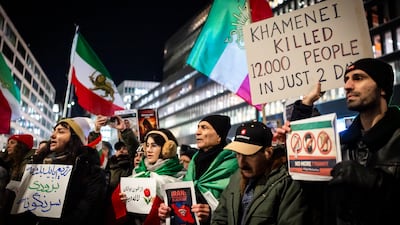
Protesters attend a rally in Zurich on January 13 in support of the nationwide mass demonstrations in Iran. EPA -

A screengrab shows body bags lying outside Kahrizak Forensic Medical Centre in Tehran, after deadly protests across Iran. Reuters -

Activists attend a rally in support of the protesters, in Los Angeles, California. AFP -

Protesters burn a picture of Iran's supreme leader Ayatollah Ali Khamenei outside Downing Street, in London. AFP -

Demonstrators gather in Paris to support the Iranian people amid the anti-government protests in Iran. AFP -
Smoke rises from a mosque as protesters gather amid evolving anti-government unrest in Tehran, Iran, on Friday. Reuters -
Protesters gather amid evolving anti-government unrest in Tehran, Tehran Province, Iran, on Friday. Reuters -
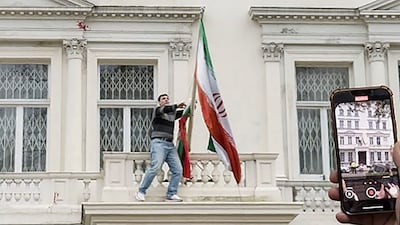
A protester pulls down the Iranian flag from the balcony of Iran's embassy in central London on Saturday. AFP -
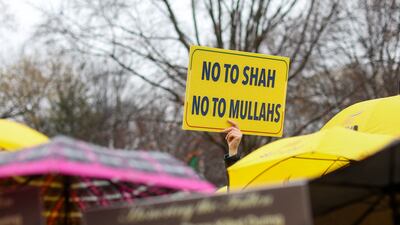
A person holds a placard, as demonstrators and activists rally in support of nationwide protests in Iran, outside the White House in Washington. Reuters -
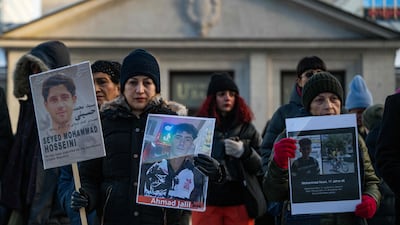
Protesters display placards featuring portraits of Iranians executed by the Iranian regime, during a rally in Berlin on Saturday. AFP -
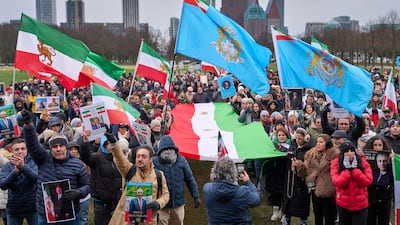
People protest in solidarity with demonstrations in Iran at Malieveld Square, Netherlands on Saturday. AFP


Many hospitals have patients in intensive care, “so they're still on a major shortage of orthopaedic surgeons, vascular surgeons and they have no way to reach that because the internal phone lines are also cut”.
US President Donald Trump has repeatedly threatened to take “very strong” military action against Iran if the government continues mass killings of protesters.
“I tell the Iranian leaders: you better not start shooting, because we’ll start shooting, too,” he said last week.
Dr Mirhadi said Iranians he had spoken to want the US to intervene. “I talk to people inside Iran, that's all they're waiting for,” he said. “They said that we're not armed, we cannot make this revolution happen ourselves. They've told me that they don't feel like this is foreign intervention, they feel like it's just [Mr Trump] protecting human rights.”
The Centre for Human Rights in Iran shared the testimony of a doctor who works in Iran. He provided a detailed account of what he witnessed inside hospitals and on the streets of Tehran and Isfahan, as the government escalated its response from crowd-control tactics to the use of live ammunition. Much of what he said echoed Dr Mirhadi's findings.
“The images and data broadcast by the international media do not represent even 1 per cent of the reality, because the information simply does not reach them,” the unnamed doctor told the organisation.
“When I went to the hospital, I saw the nature of the injuries and the number of gunshot wounds had changed completely. Shots from close range, injuries leading to death.”
He said victims included children, the elderly and bystanders.

