Venezuelan President Nicolas Maduro, who was captured by US forces at the weekend, pleaded not guilty in a New York federal court on Monday to four drug and weapons charges.
Mr Maduro is accused of overseeing a cocaine-trafficking network that partnered with violent groups including Mexican cartels, Colombian guerrillas and Venezuela's notorious Tren de Aragua gang.
The 63-year-old deposed leader pleaded not guilty to four criminal counts that include narco-terrorism, cocaine importation conspiracy and possession of machineguns and destructive devices.

“I’m innocent. I’m not guilty. I am a decent man,” Mr Maduro told the judge. His wife Cilia Flores, who was captured in the predawn raid and is named in the indictment against Mr Maduro, also pleaded not guilty.
Speaking in Spanish, Mr Maduro told the judge he had been “kidnapped” from his home in Caracas.
Mr Maduro has long denied the allegations, saying they are a mask for imperialist designs on Venezuela's rich oil reserves. Mr Maduro has hired the prominent criminal defence lawyer Barry Pollack, who long represented WikiLeaks founder Julian Assange, as his counsel in the Manhattan criminal proceedings. Given the magnitude of the case, it could take many months for a jury to be chosen and the trial to start.
Protesters supporting and opposing the US capture of Mr Maduro gathered outside the courthouse, many of them waving Venezuelan flags.
Carlos, 26, told The National he welcomed Mr Maduro’s capture and said it marked a turning point for the country. “Everything is going to change,” he said. “Our country has been suffering from this cancer called communism for 26 years – the same age I am.”
Sue, who is originally from Venezuela, said: “We don't have words to express our happiness inside, because the only president to support Venezuela is Donald Trump.”
Another protester told The National that Mr Maduro being captured alive was the best that could have happened, because he will have to “pay for what he has done, so much damage to Venezuela”.
Another criticised protesters who had gathered in support of Mr Maduro. “Nobody knows anything,” the person said. “I'm from Venezuela ... I know what a real dictatorship is.”
The Venezuelan leader and his wife's court appearance came shortly after the UN Security Council held an emergency meeting on the situation in Caracas. The capture of Mr Maduro and his wife has drawn condemnation from several countries, which accuse the US of violating Venezuela's sovereignty and breaching international law.
-
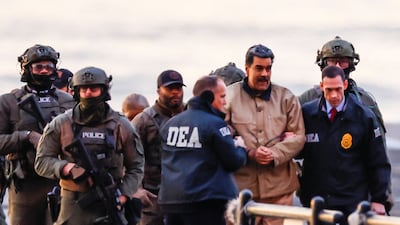
Captured Venezuelan President Nicolas Maduro arrives at the Downtown Manhattan Heliport. Reuters -
Mr Maduro is in the US after being captured by US forces during a military operation in Venezuela. Reuters -
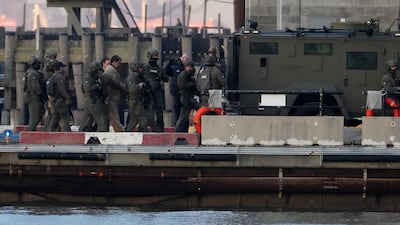
US security troops lead Mr Maduro from the heliport. He has been president of Venezuela since 2013. Reuters -
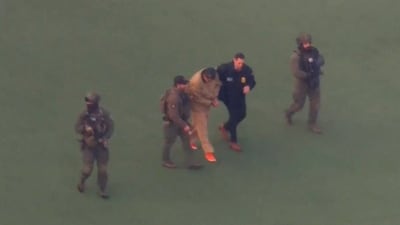
Mr Maduro being moved from a vehicle to a helicopter. Reuters -
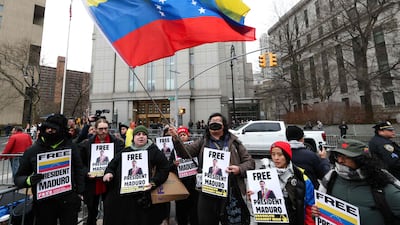
Demonstrators hold signs in support of Mr Maduro outside the Daniel Patrick Moynihan United States Courthouse in New York. AFP -
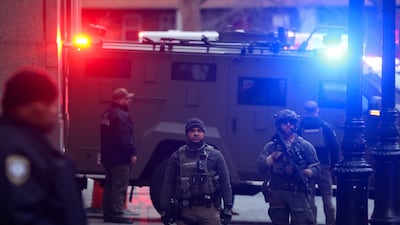
US security forces patrol near the Daniel Patrick Moynihan United States Courthouse, where Mr Maduro was due to appear. Reuters -
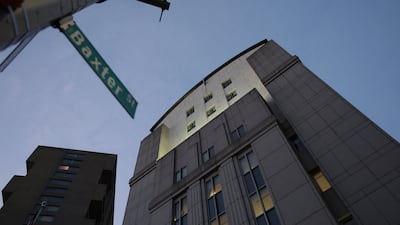
The courthouse in New York City. The US has long accused the Venezuelan government of crimes including drug trafficking. Reuters -
A motorcade thought to be carrying Mr Maduro departs from the Metropolitan Detention Centre in Brooklyn. Bloomberg


At the UN, Secretary General Antonio Guterres warned the Security Council that recent developments in Venezuela risk deepening instability and setting a dangerous precedent for international relations.
In a statement delivered by the UN political affairs chief Rosemary DiCarlo, Mr Guterres said he was “deeply concerned about the possible intensification of instability in the country, the potential impact on the region, and the precedent it may set for how relations between and among states are conducted”.
The emergency council meeting was requested by Venezuela and formally conveyed to the council by Colombia, which joined the body as a non-permanent member on January 1. Colombia’s UN ambassador Leonor Zalabata Torres rejected “any unilateral military action” that could worsen the crisis or endanger civilians.
Russia also sharply criticised the US's actions, with its UN ambassador Vasily Nebenzya calling on the US to “immediately release the legitimately elected president of an independent state and his spouse”.
The US rejected the criticism at the UN, however, with its ambassador Mike Waltz telling the council that the US is not at war with Venezuela.
“We are not occupying a country,” Mr Waltz said. “This was a law enforcement operation in furtherance of lawful indictments that have existed for decades.”
Mr Waltz accused Mr Maduro and his inner circle of working for years with drug traffickers and “narco-terrorists”, assisting the entry of what he said were hundreds of tonnes of illegal narcotics to the US annually. He said the Venezuelan leader had enriched himself through those networks while aiding groups such as Hezbollah and co-ordinating with Iranian officials and other “malign actors”.
US special forces conducted the operation in Caracas after months of planning, during which a large military presence was built up. The Trump administration has hinted that it has other countries in its sights for possible future interventions, including Cuba, Colombia and Greenland.
US military intervention in Venezuela, a country which President Donald Trump says the US will now run indefinitely, has prompted concerns that the US is again becoming embroiled on foreign territory with unpredictable results. The US has accused Mr Maduro of involvement in the regional drug trade and other criminal activity, in addition to political violence and repression.
The main charges brought against him are related to “narco-terrorism” and conspiracy to import cocaine, which carry maximum sentences of life imprisonment. The indictment, unsealed on Saturday, said Mr Maduro and his wife have also been charged with “possession of machineguns and destructive devices, and conspiracy to possess machineguns and destructive devices against the United States”.
Mr Maduro came to power in Venezuela following the death of Hugo Chavez in 2013. He took over the presidency shortly before a major oil market crash sent the Venezuelan economy into freefall. His reign was defined by national shortages of basic commodities, a plummeting currency and mass emigration.
Venezuela's Vice President Delcy Rodriguez has assumed power in Mr Maduro's absence. She has declared his capture a “kidnapping” and demanded his immediate release.
Speaking to reporters at the White House, Trump aide Stephen Miller said the situation was "an active and ongoing US government military operation" and that Washington was setting the "terms and conditions" in Venezuela.
"The government of Venezuela is working directly and co-operatively with the United States," he added.
Mr Trump has said the US will "run" Venezuela, although Secretary of State Marco Rubio has since softened that stance, saying America would not govern the country. But Mr Miller repeated Mr Trump's claims.
"The United States of America is running Venezuela by definition," he told CNN. "For them to be able to run an economy, they need our permission, so the United States is in charge."
Mr Miller also highlighted the deaths of 32 Cuban citizens during the strikes on Venezuela, saying Mr Maduro had an "illicit deal with Cuban communists to provide his security". Mr Miller said that was evidence of how unpopular the Venezuelan leader was.
"Every single kill was an enemy kill," he said. "I didn't see any reports of any civilian casualties."
At least 80 people were killed in the strikes, The New York Times reported, quoting a Venezuelan official.
Jihan Abdalla contributed to this report from the White House

