
Live updates: Follow the latest on Israel-Gaza
US President Donald Trump on Monday met Israel's Prime Minister Benjamin Netanyahu, who presented him with a Nobel Peace Prize nomination, as hopes grow that a ceasefire between Israel and Hamas in Gaza is within reach.
Mr Netanyahu's visit is his third US trip since Mr Trump took office in January.
Sitting alongside Secretary of State Marco Rubio, US envoy to the Middle East Steve Witkoff and Secretary of Defence Pete Hegseth at the White House, Mr Trump hosted a dinner for Mr Netanyahu and the Israeli delegation.
At the beginning of the meeting, Mr Netanyahu presented Mr Trump with a letter nominating him for the peace prize.
“This I didn’t know,” Mr Trump said, thanking him. “Coming from you, in particular, this is very meaningful.”
Israel and Hamas earlier held indirect talks for a second day in Qatar. A source told The National that any progress towards a ceasefire would be announced by Mr Trump during Mr Netanyahu's visit.
In response to a question on whether there were outstanding issues between the sides, Mr Trump said: “I don’t think there is a hold-up. Things are going along very well."
Mr Netanyahu, who was joined by Minister of Strategic Affairs Ron Dermer and National Security Adviser Tzachi Hanegbi, said that Palestinians in Gaza should have the option to leave enclave after the war ends.
"I think President Trump is bringing a vision, it's called free choice," he said. "If people want to stay, they can stay, but if they want to leave, they should be able to leave. It shouldn't be a prison."
In response to a question on whether he supports a two-state solution, Mr Netanyahu said "Palestinians should have all the powers to govern themselves, but none of the powers to threaten" Israel.
"That means a certain power, will always remain in our hands," he added.
He said he thought peace could be achieved between Israel and "the entire Middle East", alluding to an expansion of the Abraham Accords, a series of agreements between Israel and some Arab countries.
"By working together, I think we can establish a very, very broad peace that will include all our neighbours," he said.
Earlier on Monday, White House press secretary Karoline Leavitt said that, for Mr Trump, it was “the utmost priority” in the Middle East to end the war in Gaza and to ensure the return of all hostages.
“This President wants to see peace and stability in the region,” Ms Leavitt said in response to a question from The National. “He views this part of the region as having a real chance of being peaceful and prosperous. But, again, we need to end this war.”
Ms Leavitt said Mr Witkoff would travel to Doha this week to participate in ceasefire talks. The meeting comes after Mr Trump last month joined Israel's war against Iran, striking three nuclear sites. He now wants to see an end to the 21-month conflict in Gaza.
Mr Trump said he would hold talks with Iran on its nuclear programme. He declined to say when the discussions would take place.
"I'd rather not say you'll be reading about it tomorrow or seeing it tomorrow," Mr Trump said.
In an interview broadcast on Monday, Iranian President Masoud Pezeshkian said Tehran was ready to restart talks.
The proposed deal in Gaza includes a two-month truce, the release of hostages held by Hamas in exchange for Palestinians detained in Israeli prisons, and the entry of humanitarian aid to the war-ravaged enclave.
Talks on a permanent end to the war are expected to begin as soon as a ceasefire goes into effect.
Josh Ruebner, adjunct lecturer for Georgetown University's Justice and Peace programme, said Mr Netanyahu probably has three goals – to obtain permission from Mr Trump to resume attacks on Iran if there is evidence it is attempting to resume its nuclear programme, to reduce tariffs on Israeli goods and to define post-war plans for Gaza.
He said the processes of the deal were similar to the one that took effect on January 19, a day before Mr Trump took office. That ceasefire collapsed in March, amid a breakdown in negotiations in the second phase of the agreement, which included a comprehensive end to the fighting, the return of the remaining hostages and the withdrawal of Israeli troops from Gaza.
"Now we're at the stage where the Trump administration is trying to broker even worse terms of the ceasefire for Palestinians than they already negotiated in January," Mr Ruebner told The National. "At best, the proposed terms of the temporary ceasefire would offer Palestinians a 60-day respite from Israeli attacks."
The conflict began on October 7, 2023, when Hamas attacked Israel, killing about 1,200 people and taking about 240 hostages.
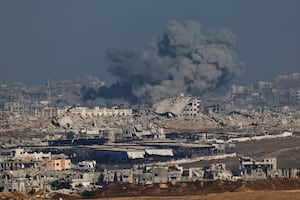
Israel launched a large-scale military offensive in Gaza in response, which has killed more than 57,500 Palestinians and reduced much of the enclave to rubble.

