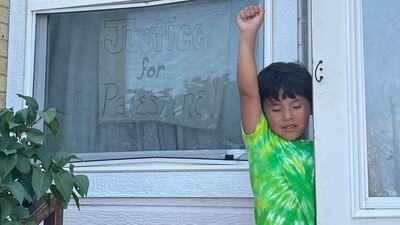
A gathering at Pine Ridge Reservation in solidarity with Palestinians under attack in Gaza. Photo: Wanahca Martinez

Meet the Native Americans standing up for Palestine


  • English
  • Arabic

For Davidica Little Spotted Horse, a member of the Oglala Lakota tribe in South Dakota, seeing the death and destruction in Gaza reminds her of her own people's past experiences.

“We know the true story, as grassroots people, of how the Palestinians have struggled and how they’ve been colonised and occupied for the past 75 years,” the recording artist and resident of the Pine Ridge Reservation says.

“To the masses it might seem like Israel was saying [Hamas] tried to pull off this attack for no reason, because people aren’t aware of what’s really going on in Palestine because of the media coverage.”

Online and in person, Ms Little Spotted Horse has been vocal in her opposition to Israel’s attacks on Gaza and the high civilian death toll. She says there has been widespread support among Lakota people for Palestinians during the war.

“In my housing [area], there’s a lot of people with Palestinian flags hanging from their window. I have one in my window, so does my neighbour,” she says.

“In indigenous country, this has been going full force since October.”

Indigenous Americans, themselves repressed, displaced and marginalised for centuries, are emerging as an important internal voice against the US government’s support for Israel amid the war in Gaza.

For months, Native American tribes and groups have held pro-Palestine demonstrations, and tribal members have been at the forefront of the campus protest movement that rocked dozens of universities this year. Some pro-Palestine Native American protests have been attacked by pro-Israel demonstrators.

“Every time we’ve stood up since the 1970s, as Lakota people, the Palestinians have been there for us. They showed up here in 1973, when we had a stand-off against the government at Wounded Knee,” Ms Little Spotted Horse says.

That year, about 200 Oglala Lakota and followers of the American Indian Movement occupied the town in South Dakota, which was the site of a brutal massacre by American soldiers in 1890.

“At Standing Rock [protests against a pipeline project in 2016 and 2017], they came to show us support and to stand with us to protect the water. We’ve been allies for a long time.”

For months, indigenous organisations such as NDN Collective and Honour the Earth have been at the forefront in leading awareness among indigenous communities of the campus protests.

Indigenous students and professors have played an important part in the protest movements at universities across the country.

In November, Native American activists tried to block a ship believed to have been carrying arms to Israel from leaving the Port of Tacoma in the state of Washington.

“The genocide in Gaza right now is fully backed by the United States and a lot of the soldiers in the [Israeli military] and the political leaders of Israel have been trained in the United States,” says Rain Metteba of K’e InfoShop, a queer and lesbian space in the Navajo Nation’s Window Rock community in Arizona.

“What’s essentially angering about the situation in Gaza is how long it’s been allowed to drag on. The carnage has only gotten worse. It gives us some insight into the kind of violence that was inflicted on indigenous people at the time of the westward expansion of the US.”

Metteba, who prefers not to use honorifics, says all K’e InfoShop’s public events involve distributing information about the history of the occupation of Palestine.

Last spring, the makers of the film, Spaces of Exception, were invited to the Navajo Nation for a screening and a question-and-answer session on the shared challenges facing indigenous and Palestinian communities.

But not all indigenous North American communities side with Palestinians. The Coushatta Tribe of Louisiana, an indigenous group of less than 1,000 people, established official ties with Israel in 2008, becoming the first tribe to do so. Since then, trade missions have been exchanged and the tribe has worked with several Israeli companies.

Last winter, Metteba and others called for the president of the Navajo Nation, Buu Nygren, to issue a proclamation calling for a permanent ceasefire in Gaza.

“We met him, provided reading material to him and his representatives to contextualise the siege in Gaza. We talked about why a ceasefire proclamation would be an important gesture to demonstrate that the Navajo Nation is growing popular support for Palestine,” says Metteba.

But he angered many by instead issuing a statement that called for an “end of hostilities in Gaza and Israel".

The Navajo Nation’s official stance on Gaza is complicated by the presence of a Raytheon facility in north-west New Mexico that employs a large number of indigenous workers. Raytheon supplies a host of military and defence weapons to Israel, including elements of its Iron Dome missile defence system.

“He did not once say the word ‘ceasefire'. It was only a general call for peace,” says Metteba. “Nothing has really happened since.”


Specs

Engine: 51.5kW electric motor

Range: 400km

Power: 134bhp

Torque: 175Nm

Price: From Dh98,800

Available: Now

The specs

Engine: 4.0-litre V8 twin-turbocharged and three electric motors

Power: Combined output 920hp

Torque: 730Nm at 4,000-7,000rpm

Transmission: 8-speed dual-clutch automatic

Fuel consumption: 11.2L/100km

On sale: Now, deliveries expected later in 2025

Price: expected to start at Dh1,432,000

Polarised public

31% in UK say BBC is biased to left-wing views

19% in UK say BBC is biased to right-wing views

19% in UK say BBC is not biased at all

Source: YouGov

The specs
Engine: 2.7-litre 4-cylinder Turbomax
Power: 310hp
Torque: 583Nm
Transmission: 8-speed automatic
Price: From Dh192,500
On sale: Now
Groom and Two Brides

Director: Elie Semaan

Starring: Abdullah Boushehri, Laila Abdallah, Lulwa Almulla

Rating: 3/5

The Sand Castle

Director: Matty Brown

Stars: Nadine Labaki, Ziad Bakri, Zain Al Rafeea, Riman Al Rafeea

Rating: 2.5/5

How to report a beggar

Abu Dhabi – Call 999 or 8002626 (Aman Service)

Dubai – Call 800243

Sharjah – Call 065632222

Ras Al Khaimah - Call 072053372

Ajman – Call 067401616

Umm Al Quwain – Call 999

Fujairah - Call 092051100 or 092224411

Try out the test yourself

Q1 Suppose you had $100 in a savings account and the interest rate was 2 per cent per year. After five years, how much do you think you would have in the account if you left the money to grow?
a) More than $102
b) Exactly $102
c) Less than $102
d) Do not know
e) Refuse to answer

Q2 Imagine that the interest rate on your savings account was 1 per cent per year and inflation was 2 per cent per year. After one year, how much would you be able to buy with the money in this account?
a) More than today
b) Exactly the same as today
c) Less than today
d) Do not know
e) Refuse to answer

Q4 Do you think that the following statement is true or false? “Buying a single company stock usually provides a safer return than a stock mutual fund.”
a) True
b) False
d) Do not know
e) Refuse to answer

The “Big Three” financial literacy questions were created by Professors Annamaria Lusardi of the George Washington School of Business and Olivia Mitchell, of the Wharton School of the University of Pennsylvania. 

Answers: Q1 More than $102 (compound interest). Q2 Less than today (inflation). Q3 False (diversification).

UAE currency: the story behind the money in your pockets
Email sent to Uber team from chief executive Dara Khosrowshahi

From: Dara

To: Team@

Date: March 25, 2019 at 11:45pm PT

Subj: Accelerating in the Middle East

Five years ago, Uber launched in the Middle East. It was the start of an incredible journey, with millions of riders and drivers finding new ways to move and work in a dynamic region that’s become so important to Uber. Now Pakistan is one of our fastest-growing markets in the world, women are driving with Uber across Saudi Arabia, and we chose Cairo to launch our first Uber Bus product late last year.

Today we are taking the next step in this journey—well, it’s more like a leap, and a big one: in a few minutes, we’ll announce that we’ve agreed to acquire Careem. Importantly, we intend to operate Careem independently, under the leadership of co-founder and current CEO Mudassir Sheikha. I’ve gotten to know both co-founders, Mudassir and Magnus Olsson, and what they have built is truly extraordinary. They are first-class entrepreneurs who share our platform vision and, like us, have launched a wide range of products—from digital payments to food delivery—to serve consumers.

I expect many of you will ask how we arrived at this structure, meaning allowing Careem to maintain an independent brand and operate separately. After careful consideration, we decided that this framework has the advantage of letting us build new products and try new ideas across not one, but two, strong brands, with strong operators within each. Over time, by integrating parts of our networks, we can operate more efficiently, achieve even lower wait times, expand new products like high-capacity vehicles and payments, and quicken the already remarkable pace of innovation in the region.

This acquisition is subject to regulatory approval in various countries, which we don’t expect before Q1 2020. Until then, nothing changes. And since both companies will continue to largely operate separately after the acquisition, very little will change in either teams’ day-to-day operations post-close. Today’s news is a testament to the incredible business our team has worked so hard to build.

It’s a great day for the Middle East, for the region’s thriving tech sector, for Careem, and for Uber.

Uber on,

Dara

Types of bank fraud

1) Phishing

Fraudsters send an unsolicited email that appears to be from a financial institution or online retailer. The hoax email requests that you provide sensitive information, often by clicking on to a link leading to a fake website.

2) Smishing

The SMS equivalent of phishing. Fraudsters falsify the telephone number through “text spoofing,” so that it appears to be a genuine text from the bank.

3) Vishing

The telephone equivalent of phishing and smishing. Fraudsters may pose as bank staff, police or government officials. They may persuade the consumer to transfer money or divulge personal information.

4) SIM swap

Fraudsters duplicate the SIM of your mobile number without your knowledge or authorisation, allowing them to conduct financial transactions with your bank.

5) Identity theft

Someone illegally obtains your confidential information, through various ways, such as theft of your wallet, bank and utility bill statements, computer intrusion and social networks.

6) Prize scams

Fraudsters claiming to be authorised representatives from well-known organisations (such as Etisalat, du, Dubai Shopping Festival, Expo2020, Lulu Hypermarket etc) contact victims to tell them they have won a cash prize and request them to share confidential banking details to transfer the prize money.

Semi-final fixtures

Portugal v Chile, 7pm, today

Germany v Mexico, 7pm, tomorrow

Updated: September 30, 2024, 9:22 PM