France's President Emmanuel Macron welcomes Lebanon's President Joseph Aoun during an official visit at the Elysee Presidential Palace in Paris. AFP

France's Macron offers help to shore up borders in talks with Lebanese President Joseph Aoun


Lemma Shehadi
  • English
  • Arabic

French President Emmanuel Macron received Lebanese President Joseph Aoun in Paris as he made his first state visit to a European country since taking office to break the country's long political deadlock.

They discussed the fragile US and French-backed ceasefire between Israel and the Iran-backed Lebanese militant group Hezbollah, just hours after air strikes hit Beirut.

During the meeting, Mr Macron also took a phone call with Syrian President Ahmad Al Shara to discuss the recent security clashes on the Syrian-Lebanese border between the newly formed Syrian army and Hezbollah, as well as the return of Syrian refugees after the toppling of former president Bashar Al Assad. Lebanon and Syria's defence ministers also met in Riyadh on Friday to discuss border security.

Mr Macron praised the "great clarity" from the Syrian interim president in "assuring the security of Lebanon’s borders". France offered to mediate and "facilitate" in any exchanges with regards to the border, as well as surveillance and monitoring support to "fight against traffickers and the movement of arms".

As Lebanon and Syria signed a deal on border demarcation in Riyadh, France would "play its role in accompanying and helping", through its knowledge of the area's history, Mr Macron said.

The leaders were joined at the Elysee by Greek Prime Minister Kyriakos Mitsotakis and Cypriot President Nikos Christodoulides to discuss "security, connectivity and energy" issues in the Eastern Mediterranean.

Among these issues, is the "safe and voluntary return" home of Syrian refugees, and the five leaders were expected to release a joint statement on Friday.

Air strikes hit Beirut

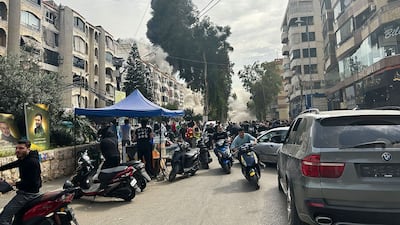
  • People rush for cover as smoke rises from the site of an Israeli strike in southern Beirut. AFP
    People rush for cover as smoke rises from the site of an Israeli strike in southern Beirut. AFP
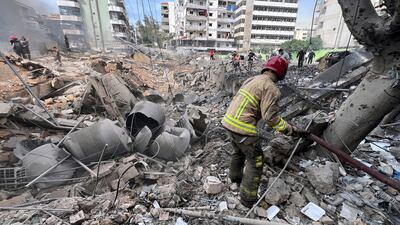
  • Firemen work on the site of a strike in the suburbs of Beirut. AP
    Firemen work on the site of a strike in the suburbs of Beirut. AP
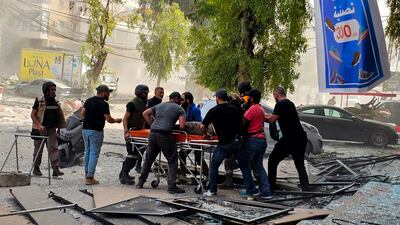
  • People place an injured man on a stretcher in southern Beirut. AFP
    People place an injured man on a stretcher in southern Beirut. AFP
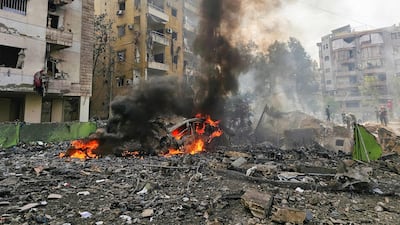
  • Fires burn at the site of an Israeli strike in southern Beirut. AFP
    Fires burn at the site of an Israeli strike in southern Beirut. AFP
  • Smoke rises following an Israeli air strike on Dahiyeh, in the southern suburbs of Beirut. AP
    Smoke rises following an Israeli air strike on Dahiyeh, in the southern suburbs of Beirut. AP
  • A child reacts after an Israeli air strike hit the nearby town of Hadath, in Beirut. AP
    A child reacts after an Israeli air strike hit the nearby town of Hadath, in Beirut. AP
  • A bomb dropped from an Israeli jet is pictured before hitting a building in Dahiyeh. AP
    A bomb dropped from an Israeli jet is pictured before hitting a building in Dahiyeh. AP
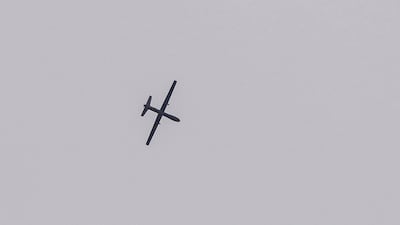
  • An Israeli drone flies over Dahiyeh. AP
    An Israeli drone flies over Dahiyeh. AP
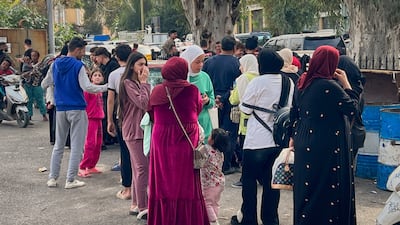
  • Residents stand in the street for safety in Beirut. AP
    Residents stand in the street for safety in Beirut. AP

Shortly before the meeting, Israeli warplanes struck Lebanon's capital following an Israeli eviction order, in the first attack on the capital since the ceasefire came into place, Lebanese state media reported.

The assault came after rockets were fired from Lebanon towards Israel earlier in the day. "Israeli warplanes struck the Hadath neighbourhood in Beirut's southern suburbs," Lebanon's state-run National News Agency said. Israel's military has yet to fully withdraw from Lebanese territory and is conducting near-daily air strikes.

Mr Macron condemned the "unacceptable" morning air strikes in Beirut, calling for the Israeli military to withdraw from Lebanon "as soon as possible". He expressed his solidarity with the people of Beirut who were "subjected to strikes in violation of the ceasefire agreement."

He praised the "real progress" that the Lebanese army had made in establishing its control of southern Lebanon and the government's efforts in "establishing a monopoly over arms".

"Today’s air strikes, the disrespect of the ceasefire were unilateral, they betray a promise and play into Hezbollah’s hands," he said, at a joint press conference with Mr Aoun.

"We believe in your agenda of sovereignty. We are by your side to ensure the success of your mandate," Mr Macron told the Lebanese President in a warm exchange.

Mr Aoun described the air strikes as a "heinous attempt to draw Lebanon back into this tornado of violence", and called on Paris and Washington to "act quickly" to protect the ceasefire agreement.

Lebanese authorities have reported more than 1,250 breaches of the ceasefire, in which 100 people have been killed and 330 wounded.

From left, Greek Prime Minister Kyriakos Mitsotakis, Lebanon's Prresident Joseph Aoun, French President Emmanuel Macron and Cyprus's President Nikos Christodoulides at the Elysee Palace in Paris. AP

Economic prosperity

The dialogue between Mr Macron and Mr Aoun was intended to show France’s commitment to Lebanon’s sovereignty and economic prosperity as it emerges from war and years of financial collapse, the Elysee Palace said. More meetings to help plan and implement Lebanon’s economic reforms are expected to take place in Washington in late April.

The pair discussed the Lebanese government’s plans for economic reforms to lift the country out of a financial crisis, now in its fifth year, and the support that the international community could bring to carry out a recovery programme quickly.

Mr Aoun was elected as President in January, and his new government faces the challenge of rebuilding the country after years of economic crisis and a year-long war between Israel and Hezbollah.

This is Mr Aoun’s second state visit, after Riyadh, and is symbolic of the historic "strong friendship" between the two nations and the French President’s "unrelenting support", the palace said.

After the meeting, Mr Aoun said: "Lebanon currently holds three unprecedented world records, the largest number of displaced people, the economic crisis, and the largest proportion of unstable borders."

Turning to Mr Macron, he said: "We are asking for your help in a laborious enterprise."

He said the "first steps" to get out of the financial crisis had been made in cooperation with the International Monetary Fund, and that proposed reforms on banking secrecy laws in Lebanon would soon been put through to Lebanese parliament.

A French delegation is expected to travel to Lebanon in the coming weeks to support the Lebanese courts in judicial reforms, Mr Macron said. France will also send industry experts and companies to support Lebanon's energy security.

"Lebanon needs a performing energy sector that makes it less vulnerable to regional stability, and kick-starts its economy, its industry and attracts investors. France is ready to send its expertise and all of its partners to contribute to grand strategic projects in this sector," Mr Macron said.

Mr Macron announced earlier this year that Paris will host an aid conference for Lebanon's recovery.


The biog

Name: Marie Byrne

Nationality: Irish

Favourite film: The Shawshank Redemption

Book: Seagull by Jonathan Livingston

Life lesson: A person is not old until regret takes the place of their dreams

PROFILE OF HALAN

Started: November 2017

Founders: Mounir Nakhla, Ahmed Mohsen and Mohamed Aboulnaga

Based: Cairo, Egypt

Sector: transport and logistics

Size: 150 employees

Investment: approximately $8 million

Investors include: Singapore’s Battery Road Digital Holdings, Egypt’s Algebra Ventures, Uber co-founder and former CTO Oscar Salazar

Ten tax points to be aware of in 2026

1. Domestic VAT refund amendments: request your refund within five years

If a business does not apply for the refund on time, they lose their credit.

2. E-invoicing in the UAE

Businesses should continue preparing for the implementation of e-invoicing in the UAE, with 2026 a preparation and transition period ahead of phased mandatory adoption. 

3. More tax audits

Tax authorities are increasingly using data already available across multiple filings to identify audit risks. 

4. More beneficial VAT and excise tax penalty regime

Tax disputes are expected to become more frequent and more structured, with clearer administrative objection and appeal processes. The UAE has adopted a new penalty regime for VAT and excise disputes, which now mirrors the penalty regime for corporate tax.

5. Greater emphasis on statutory audit

There is a greater need for the accuracy of financial statements. The International Financial Reporting Standards standards need to be strictly adhered to and, as a result, the quality of the audits will need to increase.

6. Further transfer pricing enforcement

Transfer pricing enforcement, which refers to the practice of establishing prices for internal transactions between related entities, is expected to broaden in scope. The UAE will shortly open the possibility to negotiate advance pricing agreements, or essentially rulings for transfer pricing purposes. 

7. Limited time periods for audits

Recent amendments also introduce a default five-year limitation period for tax audits and assessments, subject to specific statutory exceptions. While the standard audit and assessment period is five years, this may be extended to up to 15 years in cases involving fraud or tax evasion. 

8. Pillar 2 implementation 

Many multinational groups will begin to feel the practical effect of the Domestic Minimum Top-Up Tax (DMTT), the UAE's implementation of the OECD’s global minimum tax under Pillar 2. While the rules apply for financial years starting on or after January 1, 2025, it is 2026 that marks the transition to an operational phase.

9. Reduced compliance obligations for imported goods and services

Businesses that apply the reverse-charge mechanism for VAT purposes in the UAE may benefit from reduced compliance obligations. 

10. Substance and CbC reporting focus

Tax authorities are expected to continue strengthening the enforcement of economic substance and Country-by-Country (CbC) reporting frameworks. In the UAE, these regimes are increasingly being used as risk-assessment tools, providing tax authorities with a comprehensive view of multinational groups’ global footprints and enabling them to assess whether profits are aligned with real economic activity. 

Contributed by Thomas Vanhee and Hend Rashwan, Aurifer

The specs: 2018 Mercedes-Benz E 300 Cabriolet

Price, base / as tested: Dh275,250 / Dh328,465

Engine: 2.0-litre four-cylinder

Power: 245hp @ 5,500rpm

Torque: 370Nm @ 1,300rpm

Transmission: Nine-speed automatic

Fuel consumption, combined: 7.0L / 100km

What sanctions would be reimposed?

Under ‘snapback’, measures imposed on Iran by the UN Security Council in six resolutions would be restored, including:

  • An arms embargo
  • A ban on uranium enrichment and reprocessing
  • A ban on launches and other activities with ballistic missiles capable of delivering nuclear weapons, as well as ballistic missile technology transfer and technical assistance
  • A targeted global asset freeze and travel ban on Iranian individuals and entities
  • Authorisation for countries to inspect Iran Air Cargo and Islamic Republic of Iran Shipping Lines cargoes for banned goods

Mercer, the investment consulting arm of US services company Marsh & McLennan, expects its wealth division to at least double its assets under management (AUM) in the Middle East as wealth in the region continues to grow despite economic headwinds, a company official said.

Mercer Wealth, which globally has $160 billion in AUM, plans to boost its AUM in the region to $2-$3bn in the next 2-3 years from the present $1bn, said Yasir AbuShaban, a Dubai-based principal with Mercer Wealth.

Within the next two to three years, we are looking at reaching $2 to $3 billion as a conservative estimate and we do see an opportunity to do so,” said Mr AbuShaban.

Mercer does not directly make investments, but allocates clients’ money they have discretion to, to professional asset managers. They also provide advice to clients.

“We have buying power. We can negotiate on their (client’s) behalf with asset managers to provide them lower fees than they otherwise would have to get on their own,” he added.

Mercer Wealth’s clients include sovereign wealth funds, family offices, and insurance companies among others.

From its office in Dubai, Mercer also looks after Africa, India and Turkey, where they also see opportunity for growth.

Wealth creation in Middle East and Africa (MEA) grew 8.5 per cent to $8.1 trillion last year from $7.5tn in 2015, higher than last year’s global average of 6 per cent and the second-highest growth in a region after Asia-Pacific which grew 9.9 per cent, according to consultancy Boston Consulting Group (BCG). In the region, where wealth grew just 1.9 per cent in 2015 compared with 2014, a pickup in oil prices has helped in wealth generation.

BCG is forecasting MEA wealth will rise to $12tn by 2021, growing at an annual average of 8 per cent.

Drivers of wealth generation in the region will be split evenly between new wealth creation and growth of performance of existing assets, according to BCG.

Another general trend in the region is clients’ looking for a comprehensive approach to investing, according to Mr AbuShaban.

“Institutional investors or some of the families are seeing a slowdown in the available capital they have to invest and in that sense they are looking at optimizing the way they manage their portfolios and making sure they are not investing haphazardly and different parts of their investment are working together,” said Mr AbuShaban.

Some clients also have a higher appetite for risk, given the low interest-rate environment that does not provide enough yield for some institutional investors. These clients are keen to invest in illiquid assets, such as private equity and infrastructure.

“What we have seen is a desire for higher returns in what has been a low-return environment specifically in various fixed income or bonds,” he said.

“In this environment, we have seen a de facto increase in the risk that clients are taking in things like illiquid investments, private equity investments, infrastructure and private debt, those kind of investments were higher illiquidity results in incrementally higher returns.”

The Abu Dhabi Investment Authority, one of the largest sovereign wealth funds, said in its 2016 report that has gradually increased its exposure in direct private equity and private credit transactions, mainly in Asian markets and especially in China and India. The authority’s private equity department focused on structured equities owing to “their defensive characteristics.”

Tomb%20Raider%20I%E2%80%93III%20Remastered
%3Cp%3EDeveloper%3A%20Aspyr%0D%3Cbr%3EPublisher%3A%20Aspyr%0D%3Cbr%3EConsole%3A%20Nintendo%20Switch%2C%20PlayStation%204%26amp%3B5%2C%20PC%20and%20Xbox%20series%20X%2FS%0D%3Cbr%3ERating%3A%203%2F5%3C%2Fp%3E%0A
RESULTS

Bantamweight: Jalal Al Daaja (JOR) beat Hamza Bougamza (MAR)

Catchweight 67kg: Mohamed El Mesbahi (MAR) beat Fouad Mesdari (ALG)

Lightweight: Abdullah Mohammed Ali (UAE) beat Abdelhak Amhidra (MAR)

Catchweight 73kg: Mosatafa Ibrahim Radi (PAL) beat Yazid Chouchane (ALG)

Middleweight: Yousri Belgaroui (TUN) beat Badreddine Diani (MAR)

Catchweight 78KG: Rashed Dawood (UAE) beat Adnan Bushashy (ALG)

Middleweight: Sallah-Eddine Dekhissi (MAR) beat Abdel Enam (EGY)

Catchweight 65kg: Yanis Ghemmouri (ALG) beat Rachid Hazoume (MAR)

Lightweight: Mohammed Yahya (UAE) beat Azouz Anwar (EGY)

Catchweight 79kg: Souhil Tahiri (ALG) beat Omar Hussein (PAL)

Middleweight: Tarek Suleiman (SYR) beat Laid Zerhouni (ALG)

SPEC%20SHEET%3A%20APPLE%20IPHONE%2014%20PRO%20MAX
%3Cp%3E%3Cstrong%3EDisplay%3A%3C%2Fstrong%3E%206.7%22%20Super%20Retina%20XDR%20OLED%2C%202796%20x%201290%2C%20460ppi%2C%20120Hz%2C%202000%20nits%20max%2C%20HDR%2C%20True%20Tone%2C%20P3%2C%20always-on%3C%2Fp%3E%0A%3Cp%3E%3Cstrong%3EProcessor%3A%3C%2Fstrong%3E%20A16%20Bionic%2C%206-core%20CPU%2C%205-core%20GPU%2C%2016-core%20Neural%20Engine%3C%2Fp%3E%0A%3Cp%3E%3Cstrong%3EMemory%3A%3C%2Fstrong%3E%206GB%3C%2Fp%3E%0A%3Cp%3E%3Cstrong%3ECapacity%3A%3C%2Fstrong%3E%20128%2F256%2F512GB%20%2F%201TB%3C%2Fp%3E%0A%3Cp%3E%3Cstrong%3EPlatform%3A%3C%2Fstrong%3E%20iOS%2016%3C%2Fp%3E%0A%3Cp%3E%3Cstrong%3EMain%20camera%3A%3C%2Fstrong%3E%20Triple%2048MP%20main%20(f%2F1.78)%20%2B%2012MP%20ultra-wide%20(f%2F2.2)%20%2B%2012MP%20telephoto%20(f%2F2.8)%2C%206x%20optical%2C%2015x%20digital%2C%20Photonic%20Engine%2C%20Deep%20Fusion%2C%20Smart%20HDR%204%2C%20Portrait%20Lighting%3C%2Fp%3E%0A%3Cp%3E%3Cstrong%3EMain%20camera%20video%3A%3C%2Fstrong%3E%204K%20%40%2024%2F25%2F30%2F60fps%2C%20full-HD%20%40%2025%2F30%2F60fps%2C%20HD%20%40%2030fps%2C%20slo-mo%20%40%20120%2F240fps%2C%20ProRes%20(4K)%20%40%2030fps%3B%20night%2C%20time%20lapse%2C%20cinematic%2C%20action%20modes%3B%20Dolby%20Vision%2C%204K%20HDR%3C%2Fp%3E%0A%3Cp%3E%3Cstrong%3EFront%20camera%3A%3C%2Fstrong%3E%2012MP%20TrueDepth%20(f%2F1.9)%2C%20Photonic%20Engine%2C%20Deep%20Fusion%2C%20Smart%20HDR%204%2C%20Portrait%20Lighting%3B%20Animoji%2C%20Memoji%3C%2Fp%3E%0A%3Cp%3E%3Cstrong%3EFront%20camera%20video%3A%3C%2Fstrong%3E%C2%A04K%20%40%2024%2F25%2F30%2F60fps%2C%20full-HD%20%40%2025%2F30%2F60fps%2C%20slo-mo%20%40%20120%2F240fps%2C%20ProRes%20(4K)%20%40%2030fps%3B%20night%2C%20time%20lapse%2C%20cinematic%2C%20action%20modes%3B%20Dolby%20Vision%2C%204K%20HDR%3C%2Fp%3E%0A%3Cp%3E%3Cstrong%3EBattery%3A%3C%2Fstrong%3E%204323mAh%2C%20up%20to%2029h%20video%2C%2025h%20streaming%20video%2C%2095h%20audio%3B%20fast%20charge%20to%2050%25%20in%2030min%3B%20MagSafe%2C%20Qi%20wireless%20charging%3C%2Fp%3E%0A%3Cp%3E%3Cstrong%3EConnectivity%3A%3C%2Fstrong%3E%20Wi-Fi%2C%20Bluetooth%205.3%2C%20NFC%20(Apple%20Pay)%3C%2Fp%3E%0A%3Cp%3E%3Cstrong%3EBiometrics%3A%3C%2Fstrong%3E%20Face%20ID%3C%2Fp%3E%0A%3Cp%3E%3Cstrong%3EI%2FO%3A%3C%2Fstrong%3E%20Lightning%3C%2Fp%3E%0A%3Cp%3E%3Cstrong%3EDurability%3A%3C%2Fstrong%3E%20IP68%2C%20dust%2Fsplash%2Fwater%20resistant%20up%20to%206m%20up%20to%2030min%3C%2Fp%3E%0A%3Cp%3E%3Cstrong%3ECards%3A%3C%2Fstrong%3E%20Dual%20eSIM%20%2F%20eSIM%20%2B%20eSIM%20(US%20models%20use%20eSIMs%20only)%3C%2Fp%3E%0A%3Cp%3E%3Cstrong%3EColours%3A%3C%2Fstrong%3E%20Deep%20purple%2C%20gold%2C%20silver%2C%20space%20black%3C%2Fp%3E%0A%3Cp%3E%3Cstrong%3EIn%20the%20box%3A%3C%2Fstrong%3E%20iPhone%2014%20Pro%20Max%2C%20USB-C-to-Lightning%20cable%2C%20one%20Apple%20sticker%3C%2Fp%3E%0A%3Cp%3E%3Cstrong%3EPrice%3A%3C%2Fstrong%3E%20Dh4%2C699%20%2F%20Dh5%2C099%20%2F%20Dh5%2C949%20%2F%20Dh6%2C799%3C%2Fp%3E%0A
Company%20profile
%3Cp%3E%3Cbr%3E%3Cstrong%3EName%3A%3C%2Fstrong%3E%20Khodar%3Cbr%3E%3Cstrong%3EBased%3A%3C%2Fstrong%3E%20Cairo%20and%20Alexandria%2C%20in%20Egypt%3Cbr%3E%3Cstrong%3EFounders%3A%3C%2Fstrong%3E%20Ayman%20Hamza%2C%20Yasser%20Eidrous%20and%20Amr%20El%20Sheikh%3Cbr%3E%3Cstrong%3ESector%3A%3C%2Fstrong%3E%20agriculture%20technology%3Cbr%3E%3Cstrong%3EFunding%3A%3C%2Fstrong%3E%20%24500%2C000%3Cbr%3E%3Cstrong%3EInvestors%3A%3C%2Fstrong%3E%20Saudi%20Arabia%E2%80%99s%20Revival%20Lab%20and%20others%3Cbr%3E%3Cstrong%3EEmployees%3A%3C%2Fstrong%3E%2035%3C%2Fp%3E%0A
Updated: March 28, 2025, 2:12 PM