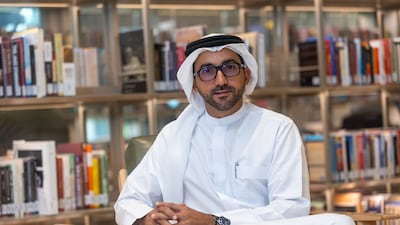
Khor Fakkan Port is poised to play a major role in the UAE's trade network, with Sharjah planning to more than double the port's container capacity. The expansion comes as Sharjah accelerates its transport and logistics infrastructure, Sheikh Fahim bin Sultan Al Qasimi said.
Situated outside the Strait of Hormuz, the port has drawn increased attention as an alternative route for goods entering the UAE during disruption linked to the US-Iran war.
Sharjah aims to increase the port's annual container capacity from about 3.5 million to five million, with a longer-term ambition of reaching 10 million.

“We are not only serving as a key artery for the country today,” Sheikh Fahim, chairman of Sharjah’s Department of Government Relations, told The National in an interview.
He said that a future rail connection is expected to strengthen the port's role, while investor interest in surrounding logistics infrastructure has grown.
“My phone has been ringing every week for the last six months, specifically with investors interested in building out our logistics infrastructure to serve the country in the region,” he said.
The government is working to ensure land, infrastructure and investment opportunities are available to support that growth.
Sharjah's geographical position also gives it an important economic role, Sheikh Fahim said, as the only emirate bordering all six other emirates.
That's a "huge economic opportunity," Sheikh Fahim said, and a "very large national responsibility" to provide the infrastructure needed.
Rail links shaping transport

The UAE's expanding network is integral to Sharjah's infrastructure development plans. Sheikh Fahim said the rail network could change how people travel for work, education, and leisure.
He hopes Etihad Rail’s passenger service will become a preferred option for inter-emirate journeys, easing road congestion while offering environmental benefits.
A station near Sharjah's University City is scheduled to open on March 30, 2027. About 45,000 students attend institutions in the area.
"I certainly hope that the new train station close to University City that will open in 2027 will be the primary choice for students to use, not only for the environment but also for their safety and the enjoyment of getting on the train,” he said.
The connection to Al Dhaid could also make it easier for visitors to reach Sharjah Safari, which Sheikh Fahim enjoys visiting with his children.
“I think the founding fathers of this country would be extremely proud,” he said of the railway network.
For commuters and businesses, the rail "offers an opportunity for people to make a more conscious choice", he said, amid rising energy prices and unpredictable road networks due to congestion.
Airport expansion
Sharjah Airport is another major infrastructure project, with annual passenger capacity expected to reach about 25 million in 2027.
Sheikh Fahim said the expansion would offer opportunities beyond a larger terminal, as longer-range aircraft enable Air Arabia to serve destinations previously beyond its network.
He highlighted the airline's Airbus A321 long-range aircraft and its plans to launch flights to London Gatwick before the end of the year.
He also recalled joining the inaugural flight to Bergamo, Italy, and said the return service was fully booked.
“I was pleasantly surprised that the first flight back there wasn’t a seat free,” he said.
Together, investments in rail, roads, ports and aviation are expected to reshape the emirate.
“We’re going to see a huge amount of investment in infrastructure, and that’s just going to change the urban fabric of the emirate,” Sheikh Fahim said.
Enhancing quality of life
He is also chairman of Sharjah's Supreme Committee for Economic Integration and said development was being directed beyond Sharjah city to communities including Al Dhaid, Al Madam, Dibba Al Hisn, Khor Fakkan and Kalba.
He said projects included food-processing centres on the east coast and tourism developments.
He added that Sharjah's development is intended to support a growing population while enhancing the emirate's quality of life.
The emirate's population has grown from 1.4 million to 2.1 million since he joined the government in 2014.
“I don’t think affordability is the predominant driver for Sharjah,” he said, pointing instead to predictability, established communities, schools and cultural factors.
He highlighted the emirate’s three-year rent freeze programme and residential developments including Aljada, Masaar and Al Mamsha.
Sheikh Fahim said he often spends weekends at Aljada, enjoying its restaurants and social life.
“Sharjah is definitely growing. We're no longer, you know, a small city,” he said.
“Quality of life for us is probably the number one KPI that we need to protect.”
Protecting the environment

Known as the 'Turtle Sheikh' for his work in protecting marine wildlife, conservation remains a personal commitment for Sheikh Fahim alongside his government responsibilities.
“I think there isn't an interview where somebody doesn't highlight the fact that I have this responsibility and being the voice for sea turtles,” he said.
Despite the scale of the emirate’s development plans, his favourite escape remains the sea.
When he has an hour to himself, Sheikh Fahim heads to Khor Fakkan to free-dive in a marine protected area.

