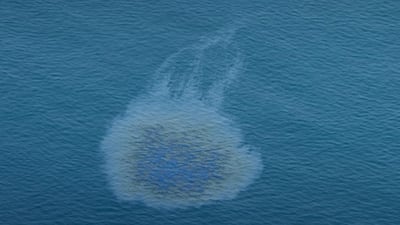

Rapid containment of an oil spill off Umm Al Quwain is essential to limit potential damage to the UAE’s marine ecosystems, experts have warned after authorities confirmed the spill off its coast.
The Ministry of Climate Change and Environment confirmed the spill on Friday after residents in Dubai and the Northern Emirates reported a strong fuel-like smell earlier this week.
Rob Mortimer, chief executive of Dubai-based Fuelre4m, which supplies substances used to disperse oil slicks, said the initial priority should be “to keep it all together” using floating barriers known as booms, allowing as much as possible to be recovered from the sea surface.

“It’s reasonably easy to do it while it’s all together,” he said.
“Once it’s spreading and moving around, it’s more difficult. Even with the dispersant, you have to cover a greater distance … The longer you leave it, the more the oil gets dispersed.”
Another early measure, Mr Mortimer said, is to use dispersants, substances that break oil into tiny droplets.
Dispersants break oil into tiny droplets, making it easier for naturally occurring microorganisms to break it down into simpler compounds, including carbon dioxide, water, and other harmless products.
However, using these substances requires careful assessment because some can harm marine organisms, including corals, fish, crustaceans and plankton.
“You have got to look at how toxic these dispersants are themselves,” Mr Mortimer said. “Some of the chemicals that are used, they’re not very nice. You have to weigh up whether the treatment is better. Sometimes it’s quite marginal.”
When dealing with oil slicks, preventing pollution from reaching the coast is typically a top priority.
If that happens, clean-up becomes harder, and habitats can suffer lasting harm.
“Once it hits the shoreline, you have to do a lot of clean-up and remediation,” Mr Mortimer said.
Clean-up operation
Prof Richard Thompson, director of the Marine Institute at the University of Plymouth, said cleaning a wide, sandy beach would typically be a less complex task than dealing with a rocky shoreline.
“If you have intertidal habitats with a large range of organisms, it’s going to make it more difficult to clean than if you can capture it [the oil] at the sea surface,” he said.
“If it’s among rocks or mangroves or seagrass, it’s going to be very difficult to clean … Ideally what you’re trying to do is catch it before you get the encounters between the creatures and the oil.”
The US National Oceanic and Atmospheric Administration has highlighted the trade-offs in using dispersants, including the benefits of removing oil from the sea surface and reducing the risk of shoreline contamination, weighed against potential effects on plankton and other organisms in the water column.
“Part of the work of planning the response to potential oil spills is the difficult task of evaluating these trade-offs, which requires careful consideration of the resources and issues involved,” the agency said in an online briefing document.
Mr Mortimer said Fuelre4m supplied vegetable-based substances intended to disperse oil and was seeking approval from UAE authorities to use them.
The risks associated with some oil-spill treatment chemicals were highlighted after the Torrey Canyon tanker ran aground off south-west England in 1967 while transporting oil from Kuwait to Wales. Some of the chemicals used to disperse the resulting slick were reported to have been more toxic to marine life than the oil itself.
Taking action

Umm Al Quwain Municipality said on Friday it was working to contain the pollution and to reduce any harm to marine and coastal environments.
The source of the oil has not been officially confirmed. This oil spill is the latest in a series of incidents that have raised concern about the “unprecedented” environmental effects of this year’s US-Iran war.
In response to the spill, beaches and coastal areas in Umm Al Quwain were closed, while Sharjah’s Al Hamriya Beach was also shut.
Inesaf Benzaki, campaigns lead at Greenpeace Mena, said timely containment was particularly important because the Gulf’s semi-enclosed geography limited the exchange of water with the open ocean, potentially allowing pollutants to persist.
“We acknowledge the UAE authorities’ ongoing efforts to contain the reported oil spill off Umm Al Quwain and address its immediate effects,” she said.
“As these efforts continue, understanding the potential environmental impact will be important to protecting the area’s marine ecosystems.”
Ms Benzaki said the coastline formed part of a wider marine environment where shallow coastal waters, mangroves, seagrass meadows and lagoons provided important habitats for marine life and supported coastal livelihoods.
She warned that even after visible oil was removed, residues could remain in coastal sediments and sensitive habitats, prolonging the spill's effects.
If oil reached the UAE coastline, it could “threaten sensitive marine and coastal ecosystems”, she said.

Continued environmental monitoring and assessment would help establish the extent of any damage, identify areas requiring further attention and guide recovery measures, she added.
Protecting these ecosystems matters not only for marine biodiversity but also for coastal communities that depend on healthy seas.
Prof John Burt, director of New York University Abu Dhabi’s Mubadala Arabian Centre for Climate and Environmental Sciences, previously warned that if oil reached the coastline, remediation could be expensive and a full recovery could take years.
Millions of barrels of oil were released into the northern Arabian Gulf during the 1990-91 Gulf War. Prof Burt said submerged habitats, including coral reefs and seagrass beds, were not as severely affected in some areas because oil generally floats on the water’s surface.
However, coastal areas in the northern Gulf that oil reached suffered considerable damage.
Mangroves and mudflats used by feeding birds were among the affected habitats, while footage from the period showed birds covered in oil.
The latest incident has renewed attention on the importance of rapid containment, careful selection of clean-up methods and sustained environmental monitoring to limit potential damage to the Gulf’s marine and coastal ecosystems.

