

The severe floods that hit the UAE in April 2024 have been used by meteorologists to test a model that forecasts rapid and extreme rainfall.
Researchers at the UK’s Met Office, the country’s weather service, and Newcastle University have found that a model they created to explain how extreme rain develops in temperate regions also works when applied to the floods in the UAE.
As a result, they now hope their framework for how rapid, extreme rainfall develops could make it easier to forecast such events in regions such as the Arabian Peninsula, enabling emergency services and residents to be better prepared.
Dr David Flack, a scientist at the Met Office and a co-author of the study, said the model could offer better advanced warning of extreme rain. “We’re exploring how this model can enhance scientific understanding of how extreme rainfall develops and whether it could be turned into a technique that can complement existing forecasting techniques,” he added.
The study, to be published in the March edition of the Weather and Climate Extremes journal and currently available online, tests what is known as the Davies model for the formation of potentially life-threatening rainfall. Details of the project – named after Prof Paul Davies, a former chief meteorologist at the Met Office who formulated the model – were first published in 2024.
Aftermath of April 2024 floods – in pictures
-
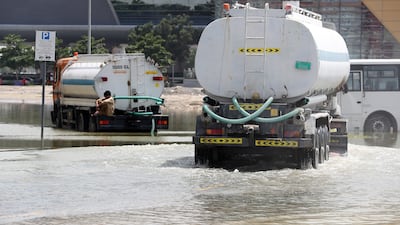
Tankers clearing waterlogged roads near Discovery Gardens metro station in Dubai on April 22. Pawan Singh / The National -

Many roads in Dubai have been flooded since last week's torrential rainfall. Pawan Singh / The National -
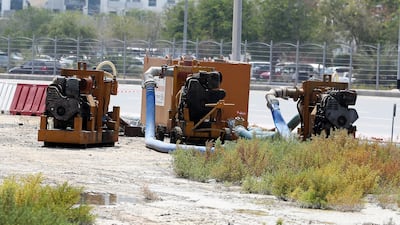
The tankers are pumping the water from the roads. Pawan Singh / The National -

School buses on hand to drive pupils through the water after the flood. Antonie Robertson / The National -

Pupils are returning to school after many were closed due to the heavy rain and flooding. Antonie Robertson / The National -

The clean-up is under way in District 5, Jumeirah Park. Antonie Robertson / The National -
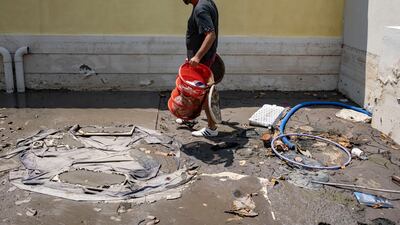
District 5 residents deal with the aftermath of the flooding one week on. Antonie Robertson / The National


It was developed by analysing extreme rainfall that takes place over just a few hours in the UK. A key element of the model is what are known as moist absolute unstable layers (MAULs) – saturated layers of air that rise rapidly because they are warmer than their surroundings.
In the Davies model, a moist unstable layer is sandwiched between stable or near-stable layers and, when these three layers are lifted, the unstable layer develops into a MAUL.
“So if they’re moist and absolutely unstable, and if there’s a thunderstorm going on, that will give the thunderstorm a bit more energy,” Dr Flack said. “That energy will help drive the precipitation and intense precipitation. If we can release that energy we’ll very likely get very strong, very localised heavy precipitation.”
Raining strategies
The researchers found that this model applied to the downpours that affected the UAE and Oman in April 2024. The lifting of the unstable layer can happen, for example, from a low pressure system over the Red Sea and this draws in moist air from the Arabian Sea so that it is above the Arabian Peninsula.
“That lifting helped produce the MAULs … and shortly after they were produced, we were seeing that the rainfall intensity was increasing,” Dr Flack said. “After the energy was released, we then saw it transition back to slightly lighter rainfall. It [was] still fairly intense rainfall, but it wasn’t as strong as when the MAULs were in process.”
One of the reasons areas flooded as heavily as they did was because there were several thunderstorms coming and going, Dr Flack said.
“All of them were going through these lifting events, creating more intense rainfall,” he added. “Because of that chain of storms going through, that helped lead to the situation being bad and all the flooding taking place.”
In April 2024, Al Ain received as much rainfall in one day as it normally gets in two years, with 254mm falling on the area. There was severe flooding in many other parts of the UAE, including Dubai.
Looking into the future
The hope is forecasters will be able to identify that a weather system has the properties of the Davies model and so may cause a surge in rainfall in a short period.
“We can predict them fairly well at the moment,” Dr Flack said. “They’re always going to be a bit of a challenge, but we are working to improve the forecasts of thunderstorms. With these environment qualities that we’re looking at, we can potentially help improve that prediction.”
He said that could enable improved warnings for the public, the emergency services and airports.
Because of climate change, sub-daily extreme rain – events that last less than a day – of the kind that hit the UAE in 2024 are expected “to increase both in frequency and intensity”, Dr Flack said.
Separate research by Khalifa University and the National Centre of Meteorology, released late last year, indicated that the number of stormy days affecting the country has increased because of climate change. As reported in The National, there are now about two extra stormy days a year compared with 2000, and that rising trend is set to continue, the scientists said.
As well as potentially benefitting from better forecasting, in future the UAE should be more able to cope with extreme downpours because its drainage has improved. Following the April 2024 floods, Sheikh Mohammed bin Rashid, Vice President and Ruler of Dubai, approved the Dh30 billion ($8.16 billion) Tasreef programme, which will improve drainage capacity in the emirate by 700 per cent.
Parts of the initiative have been completed, including a Dh277 million sewerage and rainwater drainage network stretching 24km. Sharjah is also to improve its drainage, with hundreds of millions of dirhams of spending announced in late 2024.

