An ancient desert landscape in Sharjah recognised by the UN has been hailed as an example of “human resilience” after sustaining life as civilisation was gripped by an ice age.
The Faya palaeolandscape won Unesco World Heritage status in July and includes one of the oldest uninterrupted records of archaic human habitation, dating back more than 210,000 years.
The National took a tour in the company of experts who have told of its significance not only to the story of the Gulf region, but the wider world.

“This is one of the oldest sites of human settlement outside Africa,” said Eisa Yousif, director general of the Sharjah Archaeology Authority.
“It shows not only early dispersal, but sustained human presence, even during dry periods. That continuity is what makes the site exceptional.”
The Faya palaeolandscape refers broadly to the Faya range, a chain of limestone outcrops, and the surrounding desert.

The striking landscape holds the secrets to how early humans adapted, returned and survived across the Paleolithic and Neolithic periods, despite upheavals in climate.
Paleolithic refers to the earliest Stone Age, when humans lived as hunter-gatherers using simple stone tools, while the Neolithic marks a later period characterised by more settled communities, evolving technologies and early social organisation.
Evidence from caves, rock shelters and open-air sites shows that early humans did not pass through Arabia, they settled here, finding ways to live in an environment shaped by cycles of rainfall and extreme aridity.

Tools of progress
At the heart of Al Faya’s story are its stone tools – tens of thousands of artefacts that trace the evolution of human technology and creativity.
At Faya 1, a rock shelter within the site’s core zone, archaeologists have documented about 35,000 stone tools, including elongated flakes and blades.
“These tools are important because they help us understand migration routes,” said Dr Osama Khalil, World Heritage expert at the Sharjah Archaeology Authority.
“The elongated flakes and blades support a southern dispersal route into Arabia, where people settled because there was water, shelter and a landscape that supported life.”

Other excavations reinforce that picture. At Faya 10, researchers identified about 650 stone tools, while Faya 15 yielded approximately 6,000, along with animal bones and the remains of three people, one of whom was cremated – unique discoveries in the archaeology of the Arabian Peninsula.
From hunters to settlers
During the Middle Paleolithic period, tools were generally simple flakes used for immediate needs. Over time, they became smaller and more refined, reflecting a maturing and more sophisticated society.
“What makes Al Faya remarkable is that we see this entire sequence preserved within one landscape,” Dr Khalil said. “From early hunter-gatherers to later communities, adapting again and again as the environment changed.”
Adapting to a shifting climate
One of the most unexpected findings at Al Faya is evidence of human occupation during periods when the site was thought to have been uninhabited.
Climate records show that the region alternated between wet and dry phases about every 20,000 years, with some periods marked by extreme aridity.
“About 20,000 years ago, during a glacial maximum elsewhere in the world, this region was hyper-arid,” Dr Khalil said. “We did not expect to find evidence of occupation from this period – but we did. That tells us something fundamental about human resilience.”
-

Faya, an archeological site of huge significance in Sharjah, secured Unesco World Heritage status this year. All photos: Chris Whiteoak / The National -
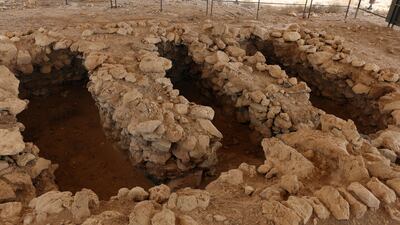
The historic area is believed to have been home to humans more than 210,000 years ago -
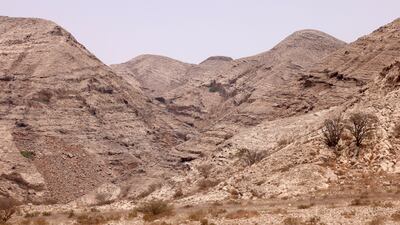
The mountainous terrain of the Faya area, which was one of 30 sites being considered by the UN cultural body -
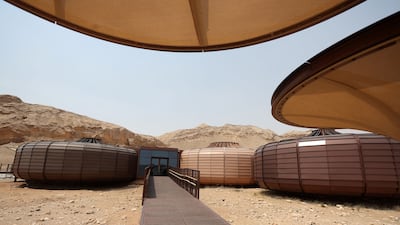
Buhais Geology Park is based in the heart of the sprawling Faya palaeolandscape -
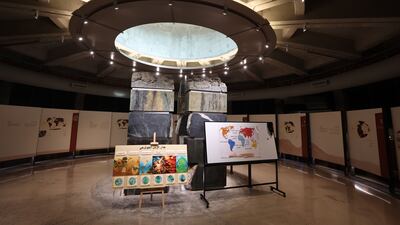
The Buhais Geology Park helps shine a light on the rich history of the ancient area -
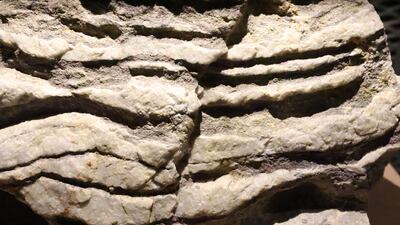
The Faya palaeolandscape features a chain of limestone outcrops called jebels stretching 20 kilometres, formed more than 90 million years ago -

Plans are in place to protect the palaeolandscape and recognise its important role in the region's history


Uncovering the past
Beyond its archaeological significance, Al Faya also preserves evidence of a more distant past. Within the landscape are fossil-rich rock formations that reveal a time when parts of the region lay beneath a shallow sea.
Embedded in the limestone are well-preserved marine fossils – shells and other sea creatures – dating back millions of years.
Today, Al Faya palaeolandscape spans approximately 95,000 hectares, comprising a core zone of about 30,000 hectares and a buffer zone of about 65,000 hectares.
The core zone contains the site’s main archaeological, geological and hydrological attributes, while the buffer zone protects them from development.
The site is protected under Sharjah law and managed by the Sharjah Archaeology Authority. Conservation, research and tourism are governed by a long-term management plan, which is regularly reported to Unesco's World Heritage Centre in Paris.

Preserving heritage
While much of Al Faya is preserved for research and conservation, public access is possible through a managed visiting system designed to protect the site’s heritage.
Visitors can explore parts of the landscape through programmes co-ordinated by the Sharjah Archaeology Authority and the Mleiha Visitor Centre, which serves as the main gateway to the area. Guided visits introduce visitors to the site’s archaeology, geology and environmental history, while ensuring sensitive areas remain protected.
“Any World Heritage site can be visited,” Dr Khalil said. “But it must be done responsibly. Visitors should always begin at the visitor centre, where access is organised and managed.”
A full scientific exploration of the site would take several days – a reflection of the scale and complexity of a landscape that continues to yield more discoveries.
For Sharjah, Al Faya is both a scientific treasure and a cultural landmark – one that connects the UAE to the earliest chapters of human history.
“These discoveries remind us that resilience, adaptation and innovation are deeply human traits,” Mr Yousif said. “Al Faya tells a shared story – not only of this land, but of humanity itself.”

