
Sheikh Mohamed bin Zayed Road is one of three motorways to be upgraded under the major transport projects. The National

How UAE's Dh170bn transport plan can 'future-proof' infrastructure amid population surge


John Dennehy
  • English
  • Arabic

The UAE’s Dh170 billion ($46.2 billion) plan to upgrade the country’s roads and transport sector is being viewed as a move to “future-proof” the country's infrastructure amid surging economic growth and a booming population.

Experts told The National that adding lanes to motorways would help in the short-term with the development of major transport networks such as Etihad Rail, which are critical for the long-term.

“This federal transport investment highlights the UAE’s commitment to future-proofing its infrastructure amid rapid population growth and economic expansion,” said Pierre Santoni, president for infrastructure in Europe, the Middle East and Africa at Parsons Corporation.

The company has been involved in some of Dubai’s most high-profile projects including the Dubai Metro Blue Line and the Infinity Bridge that spans Dubai Creek.

“Federal highway expansions will enhance long-distance connectivity, while high-speed rail and metro developments within each emirate will improve urban mobility," he added. "Together, these projects form a holistic, future-ready strategy that reflects the UAE’s vision of becoming one of the world’s most connected, sustainable and liveable nations."

UAE authorities introducing projects to help ease congestion on the roads. Chris Whiteoak / The National

What are the plans?

The announcement on Wednesday seeks to directly tackle congestion on the roads and boost public transport. Under the plans, major upgrades will made be made to the three main inter-emirate motorways – Al Ittihad Road, Sheikh Mohamed bin Zayed Road (E311) and Emirates Road (E611) – while a fourth route could be built.

The three current motorways are key arteries passing through the heart of the UAE’s cities, connecting business districts, allowing access to major residential neighbourhoods and boosting tourism. Sheikh Mohamed bin Zayed Road, for example, is a crucial route stretching from Abu Dhabi to Ras Al Khaimah, connecting key areas along the way such as Expo City Dubai and Al Maktoum International Airport, as well as the Northern Emirates.

Emirates Road allows motorists to travel between the Northern Emirates and Abu Dhabi without going through central Dubai, but that has become far more congested at peak times that it was a decade ago.
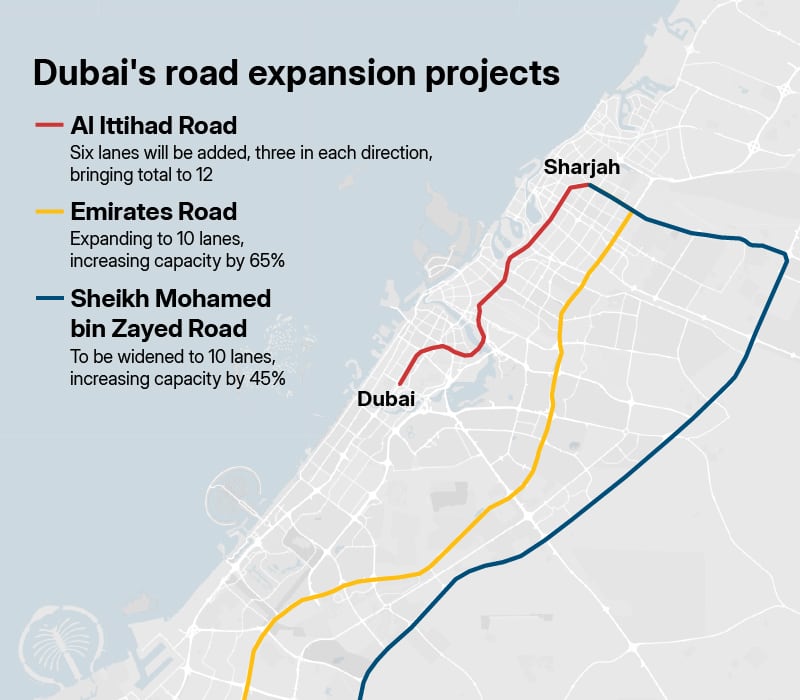
The upgrades are "extremely significant, both strategically and economically," Ahmed Al Suwaidi, chairman of Dubai-based real estate developer and design consultancy Asico, said.

"This is not just a maintenance programme: it is transformative infrastructure intended to support continued population and economic growth while improving freight and commuter flows."

“The E311 and E611 roads are the backbone of the UAE’s national road network, connecting industry, logistics and people,” said Martin Tillman, a transport expert in Dubai and founder of TMP Consult. “Improving capacity on these routes will further improve inter-emirate connectivity and help enable future growth. The key is to align these improvements with existing and emerging public transport systems to keep the UAE connected and moving efficiently.”

Suhail Al Mazrouei, Minister of Energy and Infrastructure, said addressing traffic congestion was a national priority.

Population surge has impact

The announcement comes as the population of the UAE swells, with both Abu Dhabi and Dubai passing the four million mark this year. This has a knock-on effect on the roads. Dubai’s toll operator, Salik, said in May that the number of registered active vehicles, including motorcycles, increased 9.3 per cent year-on-year to 4.47 million.

A study commissioned this year by Road Safety UAE and Al Wathba Insurance found that 91 per cent of Dubai residents experience traffic congestion daily. Almost half of the respondents (49 per cent) said they feel frustrated, annoyed, very stressed or anxious as a result.

Mr Al Mazrouei said federal road efficiency would be boosted by 73 per cent over the next five years as the population increases. Further details about when the works would start were not revealed, but the projects are scheduled to be completed by 2030.

Etihad Rail's passenger service is to launch in 2026. Photo: Wam

The plans also include moves to bolster public transport, with the launch of Etihad Rail’s passenger service next year eagerly anticipated by commuters.

The first route has not yet been announced, but four passenger stations have been confirmed and more are expected.

Mr Tillman said the rapid population increase and economic growth in the UAE justifies major investment in transport infrastructure, with a clear focus on enabling people to move around efficiently. The UAE was doing so with mega-projects such as Etihad Rail and the Dubai Metro Blue Line extension.

“While highway widening will provide short-term congestion relief, sustainable results depend on behavioural change and providing strong alternatives to private car use,” he said.

“The next phase of the UAE’s mobility strategy should prioritise mode shift through higher quality, more frequent and faster public transport, investment in active travel such as walking and cycling and deeper integration across all modes to deliver seamless end to end journeys.”

Challenges ahead

Mr Al Suwaidi said challenges of the project include right of way and relocation of utilities, traffic management and diversions while works progress; building complex interchanges; co-ordination across agencies and Emirates; and cost pressures given global construction markets are volatile.

“All this can be mitigated by strong programme governance, modular delivery packages to attract multiple contractors, intelligent traffic modelling up front, and pre-emptive utility programmes. The announcement signals a multi-year, multi-project rollout to 2030, so the government can sequence works to reduce risk," he said.

“Building roads alone will not sustainably solve congestion. Roads increase capacity in the short term, but long-term congestion requires a multi-pronged approach,” he said, pointing to the UAE’s rail and bus plans.

Mr Al Suwaidi also said it was important to address pinch points in the roads, use data and “digital twins” so the actual new road will operate efficiently and ensure procurement and contracts allocate risk sensibly.


Company%20Profile
%3Cp%3E%3Cstrong%3EName%3A%3C%2Fstrong%3E%20Neo%20Mobility%3Cbr%3E%3Cstrong%3EStarted%3A%3C%2Fstrong%3E%20February%202023%3Cbr%3E%3Cstrong%3ECo-founders%3A%3C%2Fstrong%3E%20Abhishek%20Shah%20and%20Anish%20Garg%3Cbr%3E%3Cstrong%3EBased%3A%3C%2Fstrong%3E%20Dubai%3Cbr%3E%3Cstrong%3EIndustry%3A%3C%2Fstrong%3E%20Logistics%3Cbr%3E%3Cstrong%3EFunding%3A%3C%2Fstrong%3E%20%2410%20million%3Cbr%3E%3Cstrong%3EInvestors%3A%3C%2Fstrong%3E%20Delta%20Corp%2C%20Pyse%20Sustainability%20Fund%2C%20angel%20investors%3C%2Fp%3E%0A
The specS: 2018 Toyota Camry

Price: base / as tested: Dh91,000 / Dh114,000

Engine: 3.5-litre V6

Gearbox: Eight-speed automatic

Power: 298hp @ 6,600rpm

Torque: 356Nm @ 4,700rpm

Fuel economy, combined: 7.0L / 100km

<html><head><meta http-equiv="Content-Type" content="text/html" charset="UTF-8" /></head><body><!--PSTYLE=* Labels%3aFH Label 18 Sport--><p>Beach soccer</p><!--PSTYLE=BY Byline--><p>Amith Passela</p><p /></body></html>
Results

4.30pm Jebel Jais – Maiden (PA) Dh60,000 (Turf) 1,000m; Winner: MM Al Balqaa, Bernardo Pinheiro (jockey), Qaiss Aboud (trainer)

5pm: Jabel Faya – Maiden (PA) Dh60,000 (T) 1,000m; Winner: AF Rasam, Tadhg O’Shea, Ernst Oertel

5.30pm: Al Wathba Stallions Cup – Handicap (PA) Dh70,000 (T) 2,200m; Winner: AF Mukhrej, Tadhg O’Shea, Ernst Oertel

6pm: The President’s Cup Prep – Conditions (PA) Dh100,000 (T) 2,200m; Winner: Mujeeb, Richard Mullen, Salem Al Ketbi

6.30pm: Abu Dhabi Equestrian Club – Prestige (PA) Dh125,000 (T) 1,600m; Winner: Jawal Al Reef, Antonio Fresu, Abubakar Daud

7pm: Al Ruwais – Group 3 (PA) Dh300,000 (T) 1,200m; Winner: Ashton Tourettes, Pat Dobbs, Ibrahim Aseel

7.30pm: Jebel Hafeet – Maiden (TB) Dh80,000 (T) 1,400m; Winner: Nibraas, Richard Mullen, Nicholas Bachalard

Ten tax points to be aware of in 2026

1. Domestic VAT refund amendments: request your refund within five years

If a business does not apply for the refund on time, they lose their credit.

2. E-invoicing in the UAE

Businesses should continue preparing for the implementation of e-invoicing in the UAE, with 2026 a preparation and transition period ahead of phased mandatory adoption. 

3. More tax audits

Tax authorities are increasingly using data already available across multiple filings to identify audit risks. 

4. More beneficial VAT and excise tax penalty regime

Tax disputes are expected to become more frequent and more structured, with clearer administrative objection and appeal processes. The UAE has adopted a new penalty regime for VAT and excise disputes, which now mirrors the penalty regime for corporate tax.

5. Greater emphasis on statutory audit

There is a greater need for the accuracy of financial statements. The International Financial Reporting Standards standards need to be strictly adhered to and, as a result, the quality of the audits will need to increase.

6. Further transfer pricing enforcement

Transfer pricing enforcement, which refers to the practice of establishing prices for internal transactions between related entities, is expected to broaden in scope. The UAE will shortly open the possibility to negotiate advance pricing agreements, or essentially rulings for transfer pricing purposes. 

7. Limited time periods for audits

Recent amendments also introduce a default five-year limitation period for tax audits and assessments, subject to specific statutory exceptions. While the standard audit and assessment period is five years, this may be extended to up to 15 years in cases involving fraud or tax evasion. 

8. Pillar 2 implementation 

Many multinational groups will begin to feel the practical effect of the Domestic Minimum Top-Up Tax (DMTT), the UAE's implementation of the OECD’s global minimum tax under Pillar 2. While the rules apply for financial years starting on or after January 1, 2025, it is 2026 that marks the transition to an operational phase.

9. Reduced compliance obligations for imported goods and services

Businesses that apply the reverse-charge mechanism for VAT purposes in the UAE may benefit from reduced compliance obligations. 

10. Substance and CbC reporting focus

Tax authorities are expected to continue strengthening the enforcement of economic substance and Country-by-Country (CbC) reporting frameworks. In the UAE, these regimes are increasingly being used as risk-assessment tools, providing tax authorities with a comprehensive view of multinational groups’ global footprints and enabling them to assess whether profits are aligned with real economic activity. 

Contributed by Thomas Vanhee and Hend Rashwan, Aurifer

Mercer, the investment consulting arm of US services company Marsh & McLennan, expects its wealth division to at least double its assets under management (AUM) in the Middle East as wealth in the region continues to grow despite economic headwinds, a company official said.

Mercer Wealth, which globally has $160 billion in AUM, plans to boost its AUM in the region to $2-$3bn in the next 2-3 years from the present $1bn, said Yasir AbuShaban, a Dubai-based principal with Mercer Wealth.

Within the next two to three years, we are looking at reaching $2 to $3 billion as a conservative estimate and we do see an opportunity to do so,” said Mr AbuShaban.

Mercer does not directly make investments, but allocates clients’ money they have discretion to, to professional asset managers. They also provide advice to clients.

“We have buying power. We can negotiate on their (client’s) behalf with asset managers to provide them lower fees than they otherwise would have to get on their own,” he added.

Mercer Wealth’s clients include sovereign wealth funds, family offices, and insurance companies among others.

From its office in Dubai, Mercer also looks after Africa, India and Turkey, where they also see opportunity for growth.

Wealth creation in Middle East and Africa (MEA) grew 8.5 per cent to $8.1 trillion last year from $7.5tn in 2015, higher than last year’s global average of 6 per cent and the second-highest growth in a region after Asia-Pacific which grew 9.9 per cent, according to consultancy Boston Consulting Group (BCG). In the region, where wealth grew just 1.9 per cent in 2015 compared with 2014, a pickup in oil prices has helped in wealth generation.

BCG is forecasting MEA wealth will rise to $12tn by 2021, growing at an annual average of 8 per cent.

Drivers of wealth generation in the region will be split evenly between new wealth creation and growth of performance of existing assets, according to BCG.

Another general trend in the region is clients’ looking for a comprehensive approach to investing, according to Mr AbuShaban.

“Institutional investors or some of the families are seeing a slowdown in the available capital they have to invest and in that sense they are looking at optimizing the way they manage their portfolios and making sure they are not investing haphazardly and different parts of their investment are working together,” said Mr AbuShaban.

Some clients also have a higher appetite for risk, given the low interest-rate environment that does not provide enough yield for some institutional investors. These clients are keen to invest in illiquid assets, such as private equity and infrastructure.

“What we have seen is a desire for higher returns in what has been a low-return environment specifically in various fixed income or bonds,” he said.

“In this environment, we have seen a de facto increase in the risk that clients are taking in things like illiquid investments, private equity investments, infrastructure and private debt, those kind of investments were higher illiquidity results in incrementally higher returns.”

The Abu Dhabi Investment Authority, one of the largest sovereign wealth funds, said in its 2016 report that has gradually increased its exposure in direct private equity and private credit transactions, mainly in Asian markets and especially in China and India. The authority’s private equity department focused on structured equities owing to “their defensive characteristics.”

57%20Seconds
%3Cp%3E%3Cstrong%3EDirector%3A%3C%2Fstrong%3E%20Rusty%20Cundieff%0D%3Cbr%3E%3Cstrong%3EStars%3A%20%3C%2Fstrong%3EJosh%20Hutcherson%2C%20Morgan%20Freeman%2C%20Greg%20Germann%2C%20Lovie%20Simone%0D%3Cbr%3E%3Cstrong%3ERating%3A%20%3C%2Fstrong%3E2%2F5%0D%3Cbr%3E%0D%3Cbr%3E%3C%2Fp%3E%0A
%20Ramez%20Gab%20Min%20El%20Akher
%3Cp%3E%3Cstrong%3ECreator%3A%3C%2Fstrong%3E%20Ramez%20Galal%3C%2Fp%3E%0A%3Cp%3E%3Cstrong%3EStarring%3A%3C%2Fstrong%3E%20Ramez%20Galal%3C%2Fp%3E%0A%3Cp%3E%3Cstrong%3EStreaming%20on%3A%20%3C%2Fstrong%3EMBC%20Shahid%3C%2Fp%3E%0A%3Cp%3E%3Cstrong%3ERating%3A%20%3C%2Fstrong%3E2.5%2F5%3C%2Fp%3E%0A
Brief scores

Day 1

Toss England, chose to bat

England, 1st innings 357-5 (87 overs): Root 184 not out, Moeen 61 not out, Stokes 56; Philander 3-46

The%20Specs
%3Cp%3E%3Cstrong%3EEngine%3A%20%3C%2Fstrong%3E3.6-litre%20twin%20turbocharged%20V6%3Cbr%3E%3Cstrong%3ETransmission%3A%20%3C%2Fstrong%3E10-speed%20automatic%3Cbr%3E%3Cstrong%3EPower%3A%3C%2Fstrong%3E%20472hp%3Cbr%3E%3Cstrong%3ETorque%3A%3C%2Fstrong%3E%20603Nm%3Cbr%3E%3Cstrong%3EPrice%3A%20%3C%2Fstrong%3Efrom%20Dh290%2C000%20(%2478%2C9500)%3Cbr%3E%3Cstrong%3EOn%20sale%3A%3C%2Fstrong%3E%20now%3C%2Fp%3E%0A
Stree

Producer: Maddock Films, Jio Movies
Director: Amar Kaushik
Cast: Rajkummar Rao, Shraddha Kapoor, Pankaj Tripathi, Aparshakti Khurana, Abhishek Banerjee
Rating: 3.5

Company profile

Company name: Nestrom

Started: 2017

Co-founders: Yousef Wadi, Kanaan Manasrah and Shadi Shalabi

Based: Jordan

Sector: Technology

Initial investment: Close to $100,000

Investors: Propeller, 500 Startups, Wamda Capital, Agrimatico, Techstars and some angel investors

The specs

Engine: 2.0-litre 4cyl turbo

Power: 261hp at 5,500rpm

Torque: 405Nm at 1,750-3,500rpm

Transmission: 9-speed auto

Fuel consumption: 6.9L/100km

On sale: Now

Price: From Dh117,059

Updated: November 06, 2025, 5:56 PM