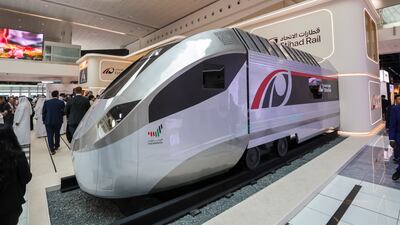

Etihad Rail’s agreement with taxi company Yango Group is being seen as a step towards bolstering access to passenger stations once the train service begins in 2026.
Signed at the Global Rail conference in Abu Dhabi on Wednesday, it sets out how Etihad Rail could harness Yango’s ride-hailing service around stations. It aims to support passenger pick-up and drop-off points, streamline vehicle entry and exit procedures, and help reduce congestion, a press release about the agreement said.
Both sides also agreed to examine integrating the two companies’ digital platforms, meaning passengers could buy rail tickets through the Yango app or reserve Yango rides through Etihad Rail’s digital channels.

"The introduction of ride hailing in partnership with rail services is a win-win situation as it provides an additional option for onward travel, as well as feeding the rail station with passengers," said UAE-based transport expert Martin Tillman on Thursday.
"This is particularly the case for lower density or suburban areas to ensure all have access to the wider rail network," said Mr Tillman, who is also the founder of TMP Consult.
-
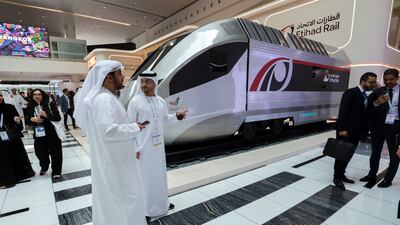
Day one of the Global Rail conference at Adnec. All Photos: Victor Besa / The National -

An Omani visitor at the Etihad Rail display -

Azza Al Suwaidi, deputy chief executive of Etihad Rail Mobility -

An Etihad Rail Mobility station master -

A model of a train is displayed at Adnec -
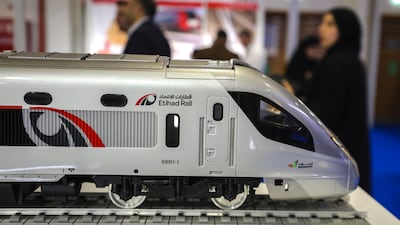
Part of the Etihad Rail display -

The IMI kiosk at Adnec -
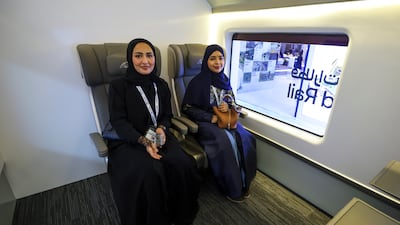
Etihad Rail Mobility station masters take visitors on a tour -
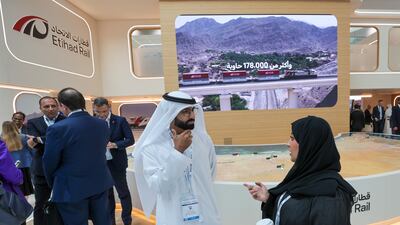
The Etihad Rail display at Adnec -

Organisers hope the event in Abu Dhabi will attract government ministers, delegations and up to 200 exhibitors


Building on existing infrastructure
It is not the first such deal – Etihad Rail in 2023 also signed a similar agreement with Uber – but it marks another step forward in the railway operator’s plans to launch its passenger service next year.
Four stations have been announced so far and while more are expected, questions of how easy it will be for passengers to access them and reach their final destination have persisted in what is known as first and last-mile travel.
Etihad Rail has not confirmed the precise locations of the first stations. However, in Dubai, a station is expected to be located behind the Jumeirah Golf Estates Metro station on the Red Line.
Etihad Rail: read more
- 'Top notch' Etihad Rail passenger service on track for 2026 launch
- Etihad Rail signs deal with Dubai Metro operator to run passenger services
- UAE to expand Etihad Rail's freight capacity as business grows
In Abu Dhabi, there is expected to be one station near Mussafah Industrial Area. A station is also being built near the University City of Sharjah, and a fourth will be in Fujairah's Al Hilal City development.
"Rail stations are the front door to a city and are only as useful as the ease with which people can get to and from them," said Mr Tillman.
"This is the last mile issue which requires a multi-modal solution [several types of transport] to resolve. Station forecourt planning is critical to ensure a safe and seamless environment for passengers transferring from rail to other modes such as ride hailing, with walkways, signage, shading, queuing areas for taxis and bus waiting areas."
Etihad Rail confirmed during the three-day conference that ended on Thursday that the passenger service is still on track to launch in 2026.
Making new connections
Azza Al Suwaidi, deputy chief executive of Etihad Rail Mobility (passenger services division) said the partnership with the Yango Group “reflected the “commitment to delivering an integrated and sustainable mobility ecosystem”.
In an interview with The National on Tuesday, Ms Al Suwaidi said Etihad Rail was built around giving the best passenger experience to all”.
“In Dubai we need to make sure we're connected to the Metro and we need to also make sure we have public transport available within our stations so people will have that seamless experience once they get off our trains and they immediately have a route that would take them to their final destination.
“We're working very closely with all our partners – whether local governments or private companies – to ensure that we secure that first and last mile for the passenger.”
Islam Abdul Karim, regional head of Yango Group Middle East, said the tie-up allows it to bring “advanced mobility technology to one of the region’s most ambitious transport projects”.
“By enabling a shift towards rail and shared mobility, the collaboration supports integrated travel and enhanced point-to-point connectivity between emirates for residents and visitors alike.”
The Dubai-headquartered company launched ride-hailing operations in Dubai in 2022 and it is currently available across Abu Dhabi, Dubai, Sharjah and Ajman.
It was also announced at the event, meanwhile, that Etihad Rail has teamed up with Keolis International to operate the passenger trains. The French company is experienced in the field company and, as Keolis MHI, also operates the Dubai Metro.

