

Christianity is thought to have reached the Gulf as early as the 5th century, but for many years knowledge of its presence was mostly restricted to ancient texts.
That changed in 1992 when the remains of a church and monastery were discovered on Sir Bani Yas Island by the Abu Dhabi Islands Archeological Survey (Adia), headed by the late Peter Hellyer.
The site has proved to be a treasure trove of finds over the years. The discovery this week of a 1,400-year-old Christian cross on a stucco plaque is just the latest.
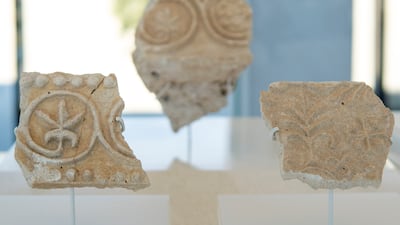
The cross was probably placed on a wall as an object of veneration for what we now know was a thriving community of up to 40 monks, who made Sir Bani Yas their home for perhaps well over a century.
What is the oldest evidence of Christianity in the Gulf?
Digs over the past 30 years have unearthed buildings including the foundations of a church, kitchen and dormitory in a series of courtyard buildings, along with a burial ground.
The monastery at Sir Bani Yas, though, is not the oldest evidence gathered so far about Christianity in the Gulf. Old stories of a Christian community at Samahij on Bahrain’s north coast were confirmed last year with the discovery of what may have been a bishop’s palace.
Dating from the 4th century – and therefore preceding the Sir Bani Yas Monastery by at least a century – the team from the Bahrain Authority for Culture and Antiquities and the University of Exeter have so far found the remains of several buildings, including a dining area and three living rooms.

These early Christians were followers of what is known as the Nestorian branch of the church, which split from the main Eastern church in the 5th century in a dispute over the true nature of Christ that opponents saw as heresy.
Despite these controversies, the Nestorian church continued to thrive in the east, reaching modern-day Iraq, as far as Sri Lanka, and even China, where Nestorian stone crosses have been found in a district of Beijing and Inner Mongolia.
The palace in Bahrain seems to have been occupied by the Bishop of Meshmahig, the old name for Samahil. The bishops had a difficult relationship with the main body of the church with one excommunicated in 410 BCE, around the time of the founding of the Bahrain community.
Nestorian missionaries continued to spread through the Gulf and across the Arabian Sea. In 2022 remains of another monastery were discovered on Al Sinniya, an island off the coast of Umm Al Quwain, along with chalices and a cistern possibly used for baptisms.
That discovery, and the one in Bahrain, brings the total number of Christian communities found in the Gulf to seven, with a stone cross unearthed in Qatar, and a church and bronze crosses near Jubail in eastern Saudi Arabia.
On the Iranian side of the Gulf, tombs with Nestorian crosses have been found on Kharg island, along with a church and monastery.
What about Islam?
These communities existed until the arrival of Islam and the teachings of the Prophet Mohammed in the 7th century. Islam reached what is now the UAE when envoys arrived around the time of the Prophet’s death in 632.
As populations accepted Islam, the monasteries and churches fell into decline and were eventually abandoned, with no evidence of violence. A mosque was built over the bishop’s palace in Bahrain. It would be over a thousand years before the palace was revealed again.
Memories remained of Christian presence in the Gulf, however. Christians were sometimes referred to simply as Nestorians, and Muslims knew of the feast of Eid al Milad, or the Festival of the Birth, when referring to Christmas.
Rulers of Abu Dhabi, including UAE Founding Father, the late Sheikh Zayed bin Sultan Al Nahyan, showed religious tolerance by supporting Christians arriving to work and live in setting up churches and places to worship.
It was in the same spirit that the monastery on Sir Bani Yas was uncovered, with Mohamed Khalifa Al Mubarak, chairman of the Abu Dhabi Department of Culture and Tourism, saying the new discovery of the cross “stirs within us a deep sense of pride and honour and reminds us that peaceful coexistence is not a modern construct but a principle woven into the very fabric of our region’s history”.
The monastery on Sir Bani Yas Island – in pictures
-

The ancient Christian cross found on Sir Bani Yas Island. All photos: Ahmed Ramzan for The National -
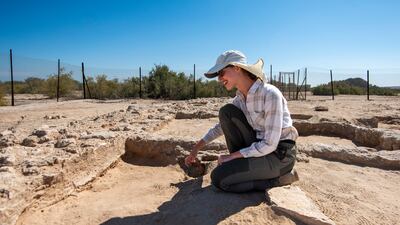
Maria Gajewska, archaeologist at the Department of Culture and Tourism – Abu Dhabi, showing the spot where the cross was found -

Hajer Al Menhali, an Emirati archaeologist who worked at the site, said it was a significant discovery -
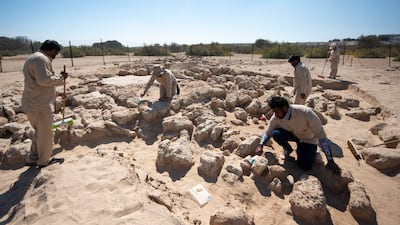
Archaeologists at the ancient monastery on Sir Bani Yas Island. Photo: Ahmed Ramzan for The National -

The plaster cross bears traditional motifs and it could have been placed on a wall as an object of veneration -
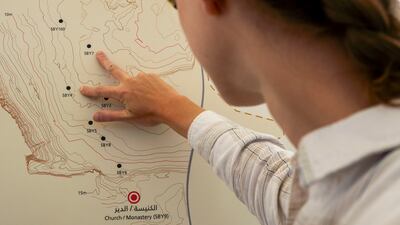
This year's dig focused on an area to the north of the existing monastery site -
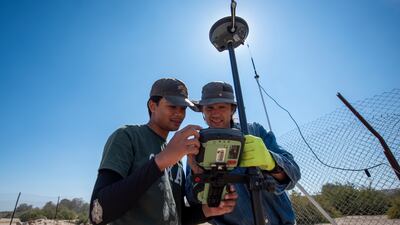
Work at the site took place over the winter season -
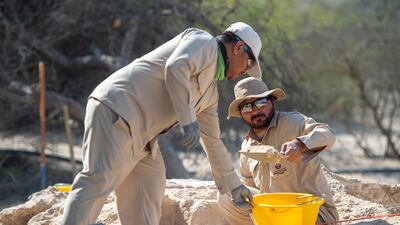
Painstaking excavation work also unearthed shards of pottery and glass at the site -
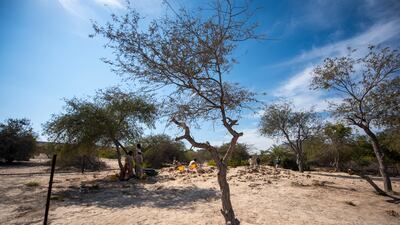
The find draws back the curtain on a lost world and offers new theories about who lived here and why -
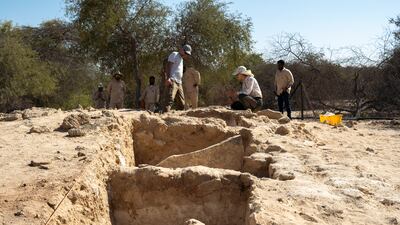
Senior monks could have lived in the buildings excavated this year for solitude. Another theory is that these buildings functioned as an ancient retreat for wealthy Christians -
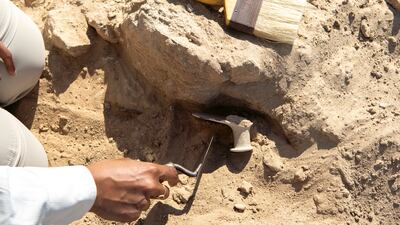
Ms Al Menhali excavates an artefact at the site -
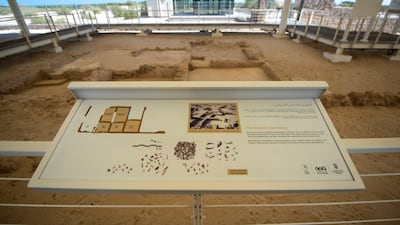
A visitor centre at the existing site is open to the public -
People can visit the island and learn about Abu Dhabi's rich and varied history



