


The power of artificial intelligence is extraordinary. It can, among much else, help to diagnose diseases, make investments and create pictures, songs, novels and university essays.
It is no wonder then that the UAE authorities are keen to harness its potential through a wide-scale roll-out.
As reported last week, Sheikh Mohammed bin Rashid, Prime Minister and Ruler of Dubai, said that from January, the National Artificial Intelligence System will be an advisory member of the UAE Cabinet, the Ministerial Development Council and the boards of government firms and federal bodies.
It is the latest move to promote AI. In 2017, the UAE became the first country in the world to have a Minister of State for Artificial Intelligence, and it also has a national AI strategy and an AI university.
-

Mohamed bin Zayed University of Artificial Intelligence commencement of class 2023 ceremony at the Abu Dhabi Energy Centre on June 4, 2023. All photos: Khushnum Bhandari / The National -

The ceremony was attended by Sheikh Hamed bin Zayed, director of Abu Dhabi Investment Authority, and Dr Sultan Al Jaber, Minister of Industry and Advanced Technology -

Guests in the audience during the Mohamed bin Zayed University of Artificial Intelligence commencement of class 2023 ceremony. -
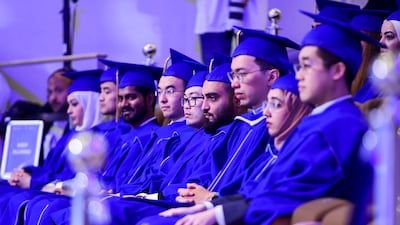
A commencement ceremony on Sunday saw 59 students receive their postgraduate degrees -

It is estimated that AI could contribute $320 billion to the Middle East economy in 2030, with the UAE seeing the greatest gain. -

Family and friends take photos with the graduates at the Mohamed bin Zayed University of Artificial Intelligence commencement of class 2023 ceremony. -
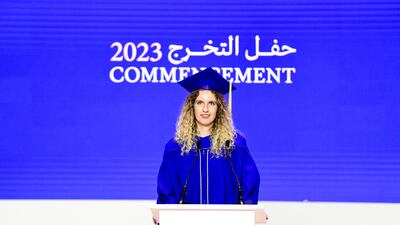
Klea Ziu, Master of Science in Machine Learning, Class of 2023 Valedictorian the Mohamed bin Zayed University of Artificial Intelligence commencement of class 2023 ceremony. -

The graduating class comes from 25 different countries, including the UAE, China, Africa and other parts of the Middle East.


New AI era
Ashley Braganza, professor of organisational transformation at London's Brunel University, says governments globally “are on the threshold” when it comes to adopting AI.
“Governments in many countries are talking about the use of AI to provide services for citizens,” he says. “If we were to have this conversation as early as a year to 18 months from now, we’d be talking about AI in a wide range of the delivery of public sector services in different parts of the world.”
Prof Braganza, who hosts The AI Adoption Podcast, says the technology will change how public sector employees interact, and how citizens engage with public services. It will, he says, “be transformative”.
“If you are a civil servant, you can say: ‘In this situation, with this kind of citizen that I’m dealing with, what should be the course of action, or what are the forms that need to be completed, or what information do we need to get from this individual?’” he says.
“It brings all this together and that, I think, is where the transformation is going to be seen. It will change working practices within the public sector.”

Widespread adoption of AI by governments worldwide in the future should come as no surprise as it is “very much a general-purpose technology”, says Prof Mark Daley, the chief AI officer at Western University in Canada.
“It is a technology that allows some degree of cognitive offloading,” he says. “Tasks that needed direct human supervision can, more and more as the models get better, be offloading to a machine assistant.
“It still has to be verified by a human, but it increases the capacity of each individual human to carry out work. The exact nature of that is totally dependent on the job function and the preferences of those individual humans.”
It can make people “significantly more productive and happier”, he says, by carrying out “intellectual drudgery”, such as going through 500 emails to find any mention of a particular topic.
Complementing not replacing
For now, Prof Daley says, AI can carry out what might be seen as more mundane intellectual tasks, such as answering routine emails, but is not ready to completely replace many job functions.
“We’re not quite there yet,” he says. “The technology is remarkable and when it works it’s fantastic, but it’s still very brittle and there’s still a lot of failure modes that require human oversight.”
Using a word he coined, Prof Braganza sees AI as being likely to cause the “gigification” of work, taking out the less demanding tasks within any particular job and leaving people to undertake the most difficult functions.
“What you end up with is people being employed for that last 20 to 30 per cent [of a job], where people are able to look at that very complicated issue and be able to deal with that,” he says.
“You will see over time a paring down of working roles, as opposed to AI coming in and the entire organisation’s workforce collapsing.”
The technology is advancing rapidly and Prof Daley says that it is not hard to imagine a future where agentic AI – a form of the technology where AI “agents” carry out functions independently – does eventually completely take over many human roles.
AI is not just a technology for governments in high-income nations: it allows advances in developing countries too.
A parallel can be drawn, Prof Daley says, with the way that African nations rapidly increased mobile phone penetration, “leapfrogging” the widespread dependence on landlines.
“We’re probably going to see the same thing play out here,” he says. “Nimble, fast-moving developing countries are going to say, ‘Let’s just integrate AI into our processes as we are evolving them.’”
Safeguards in place

With AI – as with people – there are concerns about bias, and it may not even be obvious that such biases are lurking within algorithms, Prof Braganza says.
“If you’re talking about AI being used by police, health, social security, childcare – in those situations, some of those decisions can have very deep, very wide effects if they go wrong,” he says.
Prof Braganza notes that a human caseworker or call centre employee may deal with, say, a few dozen customers in a day – but over the same time period, an AI model may adjudicate in thousands of cases.
“Somebody applying for a loan, for example, if that algorithm is biased, then 10,000 applications in the last one hour may well have been affected,” he says.
Yet Prof Daley says that as the technology becomes more sophisticated, bias can be removed.
“With the frontier AI we have right now, with the reasoning models … you can actually explain in English what criteria you’re looking for, what biases it should watch for, and you can construct a system that is essentially less biased than any human would be,” he said.
“You can require it to explicitly state how it is making decisions against all these possible sources of bias,” he says.
“There’s a possibility to use these models in a way that actually increases procedural fairness, but you have to be really mindful about how you’re using them.”
For all the concerns relating to AI in government or business, the technology’s adoption is going to continue. Its use is likely to become existential for companies.
“If a productivity enhancer is invented and you decline to adopt it, you as a firm or an individual will be outcompeted by those who do adopt it. There seems little question to me [that] AI is a productivity enhancer across a broad range of domains,” Prof Daley says.

