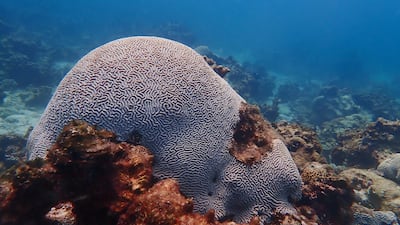
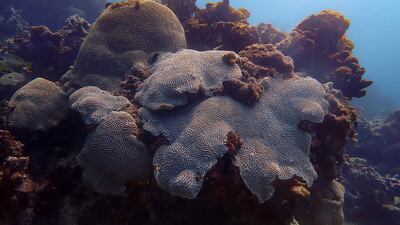
Coral reefs, which are crucial to the health of marine ecosystems, are under severe threat from climate change. Photo: Getty Images

Most corals in the Arabian Gulf could be lost this century to climate change, study suggests


Daniel Bardsley
  • English
  • Arabic

Most corals in the Arabian Gulf could be wiped out this century because of the continued warming of the seas, a new global analysis has indicated.

According to the research, coral cover in the Gulf between 2090 and 2099 is expected to be between 75 and 100 per cent less than it was between 2010 and 2019.

While the forecasts vary according to future greenhouse gas emission levels, the study calculates that under a “middle-of-the-road” scenario, coral cover globally will decline by about 58 per cent by the end of the century.

The study also found that corals in the hottest parts of the world will not be able to expand fast enough into cooler areas to cope with the damage they will experience from the warming of the oceans.

Writing in Science Advances, the scientists said that “the most severe declines in coral cover will likely occur within 40 to 80 years”, but that large-scale expansion of coral reefs into cooler waters to compensate for this “requires centuries”.

Some regions, such as the southern coast of Australia, are forecast to see increases in coral cover, but most will see a decline, with the Arabian Gulf among the hardest hit.

The study’s first author, Dr Noam Vogt-Vincent, of the University of Hawaii at Manoa, told The National that it was “well-established that coral reefs are facing a precipitous decline over the coming decades” and this is being observed in multiple “bleaching” events, where high temperatures make coral expel algae that live inside them.

Corals face growing threat

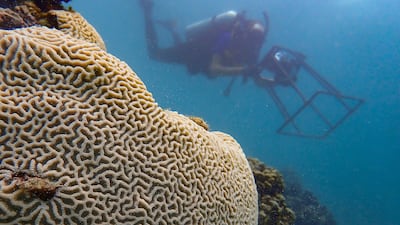
  • Corals in the south Gulf and on the UAE's east coast have been affected. All photos: Rebekka Pentii / NYUAD
    Corals in the south Gulf and on the UAE's east coast have been affected. All photos: Rebekka Pentii / NYUAD
  • There is total bleaching in some parts although there is still a chance of recovery.
    There is total bleaching in some parts although there is still a chance of recovery.
  • Bleaching happens when heat stress forces a coral lose their algae - which provides colour and most of their energy
    Bleaching happens when heat stress forces a coral lose their algae - which provides colour and most of their energy
  • Corals can stay alive after bleaching but if cooler temperatures do not return they will die
    Corals can stay alive after bleaching but if cooler temperatures do not return they will die
  • Coral reefs support the well-being and livelihoods of close to 1 billion people
    Coral reefs support the well-being and livelihoods of close to 1 billion people
  • Corals in the Arabian Gulf have proved to be able to survive at significantly higher temperatures but they are operating at the edge of their limits
    Corals in the Arabian Gulf have proved to be able to survive at significantly higher temperatures but they are operating at the edge of their limits

“As the ocean warms, conditions suitable for reef formation will shift away from the tropics,” he added. “It was previously thought that parts of the subtropics and temperate seas might be able to act as ‘refugia’ for tropical coral species, possibly allowing them to avoid extinction as they experience catastrophic losses in the tropics.

“Our study suggests that, although coral range expansion will eventually occur, it will probably take centuries, which is far too slow for these new higher latitude environments to act as refugia, given that they’re already threatened.”

He said that the problem was not that coral larvae could not reach new environments, but that their growth in numbers was too small for them to develop into larger populations that could sustain themselves.

While the study forecasts that most coral in the Arabian Gulf will be lost this century, Dr Vogt-Vincent said caution should be exercised when interpreting the finding, partly because the model looks at global-scale changes and as the area has extremely high temperatures, the corals are not typical of the Indo-Pacific region.

The new study, Anthropogenic climate change will likely outpace coral range expansion, is also written by scientists from the University of New Hampshire in the US and Victoria University of Wellington in New Zealand.

The Arabian Gulf is “very likely to continue warming as a result of climate change”, said Dr Diana Francis, an assistant professor and head of the environmental and geophysical sciences lab at Khalifa University in Abu Dhabi.

“Recent studies have shown that the Gulf has warmed by approximately 1.0 to 1.5 °C over the past 40 to 50 years,” she said.

She said that the rate of warming in the Arabian Gulf was faster than the global average because it was shallow, semi-enclosed and received much sunlight.

As well as making seas warmer, climate change is also causing them to rise, through expansion of the water and the melting of ice sheets and glaciers.

Prof John Burt of New York University Abu Dhabi, who was not involved in the latest study, but who researches corals around the UAE, said that the more that range expansion of corals was studied, the more it became apparent that “these were this was “not sufficient to keep pace with the impacts of climate change in the tropics”.

He said that only a limited range of coral species, typically more “generalist” types adapted to a wider range of environments, could make the leap to new environments.

“We are not replacing the diversity or functioning of these amazing tropical ecosystems through range expansion,” he said.

“The present paper adds a further nail in the coffin for this line of thought by showing the rates of expansion are only a fraction of what is needed just to replace the total amount of live coral that will be lost on tropical reefs under climate change, not even considering species diversity.”

He said that while Arabian Gulf corals were the most heat-tolerant in the world, they “are not immune to climate change”.

“Recent marine heatwaves and global-scale bleaching events have caused the loss of over 80 per cent of corals from many regional reefs in the past decade alone,” he said.

Taking action

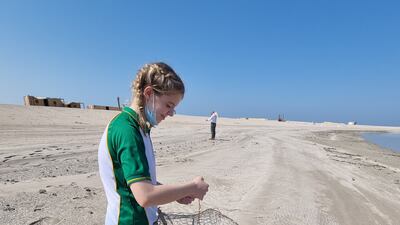
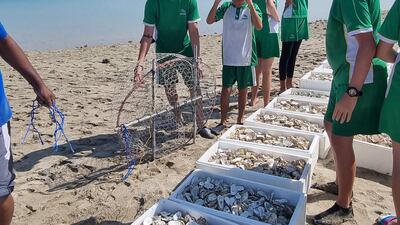
  • The shells will help to form biological building blocks to create artificial reefs. All photos: Dubai Oyster Project
    The shells will help to form biological building blocks to create artificial reefs. All photos: Dubai Oyster Project
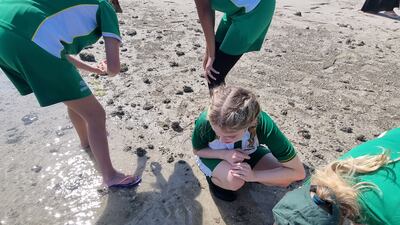
  • Pupils from The Arbor School in Dubai have teamed up with a restaurant group for the Dubai Oyster Project.
    Pupils from The Arbor School in Dubai have teamed up with a restaurant group for the Dubai Oyster Project.
  • They are using used oyster shells from The Maine restaurants in Dubai, which are usually just thrown out and end up in landfills, to create artificial reefs.
    They are using used oyster shells from The Maine restaurants in Dubai, which are usually just thrown out and end up in landfills, to create artificial reefs.
  • They placed more than 250,000 of the used shells near the Ghantoot border.
    They placed more than 250,000 of the used shells near the Ghantoot border.
  • They used illegal fishing nets seized by authorities to help transport the shells to the water's edge.
    They used illegal fishing nets seized by authorities to help transport the shells to the water's edge.
  • The project will also help to reduce the amount of food waste.
    The project will also help to reduce the amount of food waste.

Efforts are being made to protect corals, with Abu Dhabi having recently revealed plans to plant millions of coral colonies across more than 900 hectares.

The initiative is led by the Environment Agency Abu Dhabi, which said its efforts had seen it restore more than one million colonies.

Dr Burt and his colleagues are looking at selective breeding to produce heat-tolerant coral larvae, an approach that could lead to the production, he said, of millions of offspring better able to cope with higher temperatures.

“However, unless we get CO2 emissions under control, the long-term vulnerability of even these robust individuals in the wild remains an open question,” he said.

Researchers say that reducing other factors that stress corals, such as pollution and overfishing, can have a positive effect on reefs, but Dr Vogt-Vincent said that such measures alone were not enough to protect these ecosystems.


If you go

The flights
Etihad (etihad.com) flies from Abu Dhabi to Luang Prabang via Bangkok, with a return flight from Chiang Rai via Bangkok for about Dh3,000, including taxes. Emirates and Thai Airways cover the same route, also via Bangkok in both directions, from about Dh2,700.
The cruise
The Gypsy by Mekong Kingdoms has two cruising options: a three-night, four-day trip upstream cruise or a two-night, three-day downstream journey, from US$5,940 (Dh21,814), including meals, selected drinks, excursions and transfers.
The hotels
Accommodation is available in Luang Prabang at the Avani, from $290 (Dh1,065) per night, and at Anantara Golden Triangle Elephant Camp and Resort from $1,080 (Dh3,967) per night, including meals, an activity and transfers.

The burning issue

The internal combustion engine is facing a watershed moment – major manufacturer Volvo is to stop producing petroleum-powered vehicles by 2021 and countries in Europe, including the UK, have vowed to ban their sale before 2040. The National takes a look at the story of one of the most successful technologies of the last 100 years and how it has impacted life in the UAE. 

Read part four: an affection for classic cars lives on

Read part three: the age of the electric vehicle begins

Read part two: how climate change drove the race for an alternative 

Who has lived at The Bishops Avenue?
  • George Sainsbury of the supermarket dynasty, sugar magnate William Park Lyle and actress Dame Gracie Fields were residents in the 1930s when the street was only known as ‘Millionaires’ Row’.
  • Then came the international super rich, including the last king of Greece, Constantine II, the Sultan of Brunei and Indian steel magnate Lakshmi Mittal who was at one point ranked the third richest person in the world.
  • Turkish tycoon Halis Torprak sold his mansion for £50m in 2008 after spending just two days there. The House of Saud sold 10 properties on the road in 2013 for almost £80m.
  • Other residents have included Iraqi businessman Nemir Kirdar, singer Ariana Grande, holiday camp impresario Sir Billy Butlin, businessman Asil Nadir, Paul McCartney’s former wife Heather Mills. 
Hunting park to luxury living
  • Land was originally the Bishop of London's hunting park, hence the name
  • The road was laid out in the mid 19th Century, meandering through woodland and farmland
  • Its earliest houses at the turn of the 20th Century were substantial detached properties with extensive grounds


MATCH INFO

Uefa Champions League semi-final, first leg
Bayern Munich v Real Madrid

When: April 25, 10.45pm kick-off (UAE)
Where: Allianz Arena, Munich
Live: BeIN Sports HD
Second leg: May 1, Santiago Bernabeu, Madrid

SCORES IN BRIEF

Lahore Qalandars 186 for 4 in 19.4 overs
(Sohail 100,Phil Salt 37 not out, Bilal Irshad 30, Josh Poysden 2-26)
bt Yorkshire Vikings 184 for 5 in 20 overs
(Jonathan Tattersall 36, Harry Brook 37, Gary Ballance 33, Adam Lyth 32, Shaheen Afridi 2-36).

Moral education needed in a 'rapidly changing world'

Moral education lessons for young people is needed in a rapidly changing world, the head of the programme said.

Alanood Al Kaabi, head of programmes at the Education Affairs Office of the Crown Price Court - Abu Dhabi, said: "The Crown Price Court is fully behind this initiative and have already seen the curriculum succeed in empowering young people and providing them with the necessary tools to succeed in building the future of the nation at all levels.

"Moral education touches on every aspect and subject that children engage in.

"It is not just limited to science or maths but it is involved in all subjects and it is helping children to adapt to integral moral practises.

"The moral education programme has been designed to develop children holistically in a world being rapidly transformed by technology and globalisation."

TOUR DE FRANCE INFO

Dates: July 1-23
Distance: 3,540km
Stages: 21
Number of teams: 22
Number of riders: 198

MATCH INFO

Liverpool v Manchester City, Sunday, 8.30pm UAE

Top 10 most polluted cities
  1. Bhiwadi, India
  2. Ghaziabad, India
  3. Hotan, China
  4. Delhi, India
  5. Jaunpur, India
  6. Faisalabad, Pakistan
  7. Noida, India
  8. Bahawalpur, Pakistan
  9. Peshawar, Pakistan
  10. Bagpat, India
What is a robo-adviser?

Robo-advisers use an online sign-up process to gauge an investor’s risk tolerance by feeding information such as their age, income, saving goals and investment history into an algorithm, which then assigns them an investment portfolio, ranging from more conservative to higher risk ones.

These portfolios are made up of exchange traded funds (ETFs) with exposure to indices such as US and global equities, fixed-income products like bonds, though exposure to real estate, commodity ETFs or gold is also possible.

Investing in ETFs allows robo-advisers to offer fees far lower than traditional investments, such as actively managed mutual funds bought through a bank or broker. Investors can buy ETFs directly via a brokerage, but with robo-advisers they benefit from investment portfolios matched to their risk tolerance as well as being user friendly.

Many robo-advisers charge what are called wrap fees, meaning there are no additional fees such as subscription or withdrawal fees, success fees or fees for rebalancing.

Take Me Apart

Kelela

(Warp)

Key findings of Jenkins report
  • Founder of the Muslim Brotherhood, Hassan al Banna, "accepted the political utility of violence"
  • Views of key Muslim Brotherhood ideologue, Sayyid Qutb, have “consistently been understood” as permitting “the use of extreme violence in the pursuit of the perfect Islamic society” and “never been institutionally disowned” by the movement.
  • Muslim Brotherhood at all levels has repeatedly defended Hamas attacks against Israel, including the use of suicide bombers and the killing of civilians.
  • Laying out the report in the House of Commons, David Cameron told MPs: "The main findings of the review support the conclusion that membership of, association with, or influence by the Muslim Brotherhood should be considered as a possible indicator of extremism."
Updated: June 12, 2025, 3:54 AM