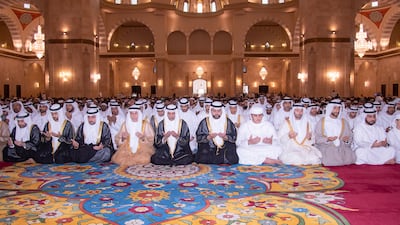
President Sheikh Mohamed celebrates Eid Al Fitr with his grandchildren at the Sea Palace in Abu Dhabi. Photo: UAE Presidential Court

President Sheikh Mohamed shares family portrait to celebrate Eid


  • English
  • Arabic

President Sheikh Mohamed hailed Eid Al Fitr as "an occasion to be cherished and enjoyed" as he shared a joyful family portrait on the first day of the religious festival on Wednesday.

The UAE leader emphasised the importance of spending time with loved ones during the holiday period in an uplifting message on social media.

He posted a picture of himself sitting alongside his grandchildren at the Sea Palace in Abu Dhabi on Instagram.

"I extend my sincere best wishes to everyone celebrating Eid Al Fitr and those spending precious time with family, friends and loved ones," Sheikh Mohamed wrote in the post, which has already garnered more than 75,000 likes on the online platform.

"Opportunities such as these are a blessing from God and an occasion to be cherished and enjoyed."

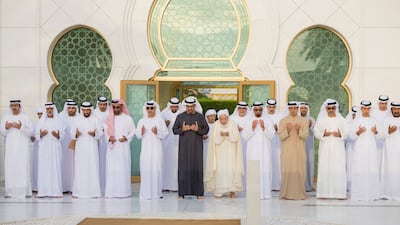
  • President Sheikh Mohamed prays at the tomb of UAE Founding Father, the late Sheikh Zayed bin Sultan Al Nahyan, alongside senior officials including Sheikh Mansour bin Zayed, Vice President, Deputy Prime Minister and Chairman of the Presidential Court. Photo: UAE Presidential Court
    President Sheikh Mohamed prays at the tomb of UAE Founding Father, the late Sheikh Zayed bin Sultan Al Nahyan, alongside senior officials including Sheikh Mansour bin Zayed, Vice President, Deputy Prime Minister and Chairman of the Presidential Court. Photo: UAE Presidential Court
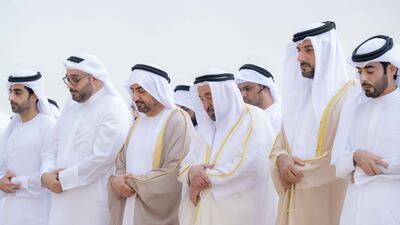
  • Sheikh Hamdan bin Mohammed, Crown Prince of Dubai, Sheikh Maktoum bin Mohammed, Deputy Prime Minister, Minister of Finance and First Deputy Ruler of Dubai, and Sheikh Ahmed bin Mohammed, Second Deputy Ruler of Dubai, pray at Zabeel Grand Mosque. Photo: Dubai Media Office
    Sheikh Hamdan bin Mohammed, Crown Prince of Dubai, Sheikh Maktoum bin Mohammed, Deputy Prime Minister, Minister of Finance and First Deputy Ruler of Dubai, and Sheikh Ahmed bin Mohammed, Second Deputy Ruler of Dubai, pray at Zabeel Grand Mosque. Photo: Dubai Media Office
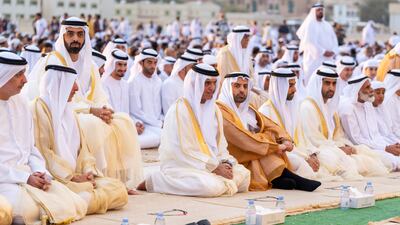
  • Sheikh Dr Sultan bin Muhammad Al Qasimi, Ruler of Sharjah, performs Eid Al Fitr prayers at Al Badee Musalla. Wam
    Sheikh Dr Sultan bin Muhammad Al Qasimi, Ruler of Sharjah, performs Eid Al Fitr prayers at Al Badee Musalla. Wam
  • Sheikh Saud bin Saqr Al Qasimi, Ruler of Ras Al Khaimah, performs Eid Al Fitr prayers at the Grand Eid Musalla in Khuzam. Wam
    Sheikh Saud bin Saqr Al Qasimi, Ruler of Ras Al Khaimah, performs Eid Al Fitr prayers at the Grand Eid Musalla in Khuzam. Wam
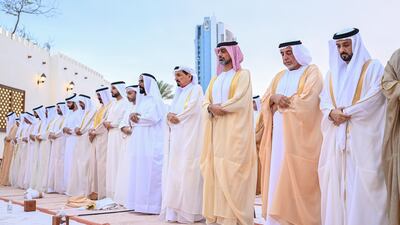
  • Sheikh Humaid bin Rashid Al Nuaimi, Ruler of Ajman, offers Eid prayers at Al Zaher Palace. Wam
    Sheikh Humaid bin Rashid Al Nuaimi, Ruler of Ajman, offers Eid prayers at Al Zaher Palace. Wam
  • Sheikh Hamad bin Mohammed Al Sharqi, Ruler of Fujairah, performs Eid prayers at the Sheikh Zayed Grand Mosque in the emirate. Wam
    Sheikh Hamad bin Mohammed Al Sharqi, Ruler of Fujairah, performs Eid prayers at the Sheikh Zayed Grand Mosque in the emirate. Wam

Earlier, Sheikh Mohamed performed Eid Al Fitr prayers alongside worshippers at Sheikh Zayed Grand Mosque in Abu Dhabi.

During the sermon, Dr Omar Al Darei, director general of the Fatwa Council, emphasised the importance of family bonds.

Following the prayer, Sheikh Mohamed exchanged greetings with worshippers before visiting the tomb of UAE Founding Father, the late Sheikh Zayed bin Sultan Al Nahyan.

Sheikh Mansour bin Zayed, Vice President, Deputy Prime Minister and Chairman of the Presidential Court, also performed prayers at the mosque.

Sheikh Mohamed wrote on X: “I congratulate my brothers the Rulers of the Emirates, the people of the UAE and Muslims around the world on the occasion of Eid Al Fitr.

“We pray that God continues to bestow his blessings on our nation and grants peace and harmony to the people of the world.”




TCL INFO

Teams:
Punjabi Legends 
Owners: Inzamam-ul-Haq and Intizar-ul-Haq; Key player: Misbah-ul-Haq
Pakhtoons Owners: Habib Khan and Tajuddin Khan; Key player: Shahid Afridi
Maratha Arabians Owners: Sohail Khan, Ali Tumbi, Parvez Khan; Key player: Virender Sehwag
Bangla Tigers Owners: Shirajuddin Alam, Yasin Choudhary, Neelesh Bhatnager, Anis and Rizwan Sajan; Key player: TBC
Colombo Lions Owners: Sri Lanka Cricket; Key player: TBC
Kerala Kings Owners: Hussain Adam Ali and Shafi Ul Mulk; Key player: Eoin Morgan

Venue Sharjah Cricket Stadium
Format 10 overs per side, matches last for 90 minutes
When December 14-17

Mercer, the investment consulting arm of US services company Marsh & McLennan, expects its wealth division to at least double its assets under management (AUM) in the Middle East as wealth in the region continues to grow despite economic headwinds, a company official said.

Mercer Wealth, which globally has $160 billion in AUM, plans to boost its AUM in the region to $2-$3bn in the next 2-3 years from the present $1bn, said Yasir AbuShaban, a Dubai-based principal with Mercer Wealth.

Within the next two to three years, we are looking at reaching $2 to $3 billion as a conservative estimate and we do see an opportunity to do so,” said Mr AbuShaban.

Mercer does not directly make investments, but allocates clients’ money they have discretion to, to professional asset managers. They also provide advice to clients.

“We have buying power. We can negotiate on their (client’s) behalf with asset managers to provide them lower fees than they otherwise would have to get on their own,” he added.

Mercer Wealth’s clients include sovereign wealth funds, family offices, and insurance companies among others.

From its office in Dubai, Mercer also looks after Africa, India and Turkey, where they also see opportunity for growth.

Wealth creation in Middle East and Africa (MEA) grew 8.5 per cent to $8.1 trillion last year from $7.5tn in 2015, higher than last year’s global average of 6 per cent and the second-highest growth in a region after Asia-Pacific which grew 9.9 per cent, according to consultancy Boston Consulting Group (BCG). In the region, where wealth grew just 1.9 per cent in 2015 compared with 2014, a pickup in oil prices has helped in wealth generation.

BCG is forecasting MEA wealth will rise to $12tn by 2021, growing at an annual average of 8 per cent.

Drivers of wealth generation in the region will be split evenly between new wealth creation and growth of performance of existing assets, according to BCG.

Another general trend in the region is clients’ looking for a comprehensive approach to investing, according to Mr AbuShaban.

“Institutional investors or some of the families are seeing a slowdown in the available capital they have to invest and in that sense they are looking at optimizing the way they manage their portfolios and making sure they are not investing haphazardly and different parts of their investment are working together,” said Mr AbuShaban.

Some clients also have a higher appetite for risk, given the low interest-rate environment that does not provide enough yield for some institutional investors. These clients are keen to invest in illiquid assets, such as private equity and infrastructure.

“What we have seen is a desire for higher returns in what has been a low-return environment specifically in various fixed income or bonds,” he said.

“In this environment, we have seen a de facto increase in the risk that clients are taking in things like illiquid investments, private equity investments, infrastructure and private debt, those kind of investments were higher illiquidity results in incrementally higher returns.”

The Abu Dhabi Investment Authority, one of the largest sovereign wealth funds, said in its 2016 report that has gradually increased its exposure in direct private equity and private credit transactions, mainly in Asian markets and especially in China and India. The authority’s private equity department focused on structured equities owing to “their defensive characteristics.”

Company%20profile
%3Cp%3E%3Cstrong%3ECompany%3A%20%3C%2Fstrong%3EWafeq%3Cbr%3E%3Cstrong%3EStarted%3A%20%3C%2Fstrong%3EJanuary%202019%3Cbr%3E%3Cstrong%3EFounder%3A%20%3C%2Fstrong%3ENadim%20Alameddine%3Cbr%3E%3Cstrong%3EBased%3A%20%3C%2Fstrong%3EDubai%2C%20UAE%3Cstrong%3E%3Cbr%3EIndustry%3A%20%3C%2Fstrong%3Esoftware%20as%20a%20service%3Cbr%3E%3Cstrong%3EFunds%20raised%3A%20%3C%2Fstrong%3E%243%20million%3Cbr%3E%3Cstrong%3EInvestors%3A%20%3C%2Fstrong%3ERaed%20Ventures%20and%20Wamda%2C%20among%20others%3C%2Fp%3E%0A
Ten tax points to be aware of in 2026

1. Domestic VAT refund amendments: request your refund within five years

If a business does not apply for the refund on time, they lose their credit.

2. E-invoicing in the UAE

Businesses should continue preparing for the implementation of e-invoicing in the UAE, with 2026 a preparation and transition period ahead of phased mandatory adoption. 

3. More tax audits

Tax authorities are increasingly using data already available across multiple filings to identify audit risks. 

4. More beneficial VAT and excise tax penalty regime

Tax disputes are expected to become more frequent and more structured, with clearer administrative objection and appeal processes. The UAE has adopted a new penalty regime for VAT and excise disputes, which now mirrors the penalty regime for corporate tax.

5. Greater emphasis on statutory audit

There is a greater need for the accuracy of financial statements. The International Financial Reporting Standards standards need to be strictly adhered to and, as a result, the quality of the audits will need to increase.

6. Further transfer pricing enforcement

Transfer pricing enforcement, which refers to the practice of establishing prices for internal transactions between related entities, is expected to broaden in scope. The UAE will shortly open the possibility to negotiate advance pricing agreements, or essentially rulings for transfer pricing purposes. 

7. Limited time periods for audits

Recent amendments also introduce a default five-year limitation period for tax audits and assessments, subject to specific statutory exceptions. While the standard audit and assessment period is five years, this may be extended to up to 15 years in cases involving fraud or tax evasion. 

8. Pillar 2 implementation 

Many multinational groups will begin to feel the practical effect of the Domestic Minimum Top-Up Tax (DMTT), the UAE's implementation of the OECD’s global minimum tax under Pillar 2. While the rules apply for financial years starting on or after January 1, 2025, it is 2026 that marks the transition to an operational phase.

9. Reduced compliance obligations for imported goods and services

Businesses that apply the reverse-charge mechanism for VAT purposes in the UAE may benefit from reduced compliance obligations. 

10. Substance and CbC reporting focus

Tax authorities are expected to continue strengthening the enforcement of economic substance and Country-by-Country (CbC) reporting frameworks. In the UAE, these regimes are increasingly being used as risk-assessment tools, providing tax authorities with a comprehensive view of multinational groups’ global footprints and enabling them to assess whether profits are aligned with real economic activity. 

Contributed by Thomas Vanhee and Hend Rashwan, Aurifer

Updated: April 11, 2024, 1:04 PM