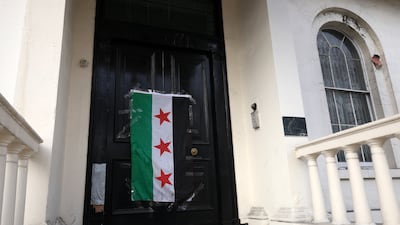

Syria has lined up candidates to fill key positions at its diplomatic missions abroad in January, a Syrian Foreign Ministry source told The National.
Diplomats appointed during Bashar Al Assad's rule have continued working in a caretaker capacity at many of Syria's embassies since he was ousted from the presidency by rebels in December 2024.
Former commanders of Hayat Tahrir Al Sham, the militant group that led the rebel offensive, hold top posts in the new government, including President Ahmad Al Shara and Foreign Minister Asaad Al Shibani.

The appointment of new diplomatic staff had been delayed partly because the recruits needed training, while some countries had objected to candidates proposed by the Foreign Ministry earlier this year, the source said.
“Their history was problematic,” the source said, without elaborating.
The delay underlines the difficult balancing act the new authorities face between catering to supporters and former cadres of HTS, a group once affiliated with Al Qaeda, and presenting a moderate image.
Some HTS members and newly appointed diplomats linked to the group have already been sent to embassies abroad as charges d'affaires, attaches and secretaries. The authorities have also reinstated experienced diplomats who defected from the former regime and have connections abroad, although very few were ambassadors.
Syria is only appointing charges d’affaires, rather than the more senior rank of ambassador, for the time being because the country is in a phase of political transition, and Mr Al Shibani wants to “test the diplomats” first, the source said. Once they prove themselves, it will be easier to promote them to ambassador, especially since the host countries will have become “familiar” with them.
Among the most sensitive postings is the charge d’affaires in Jordan, which has been given to Saleh Muslet. He was a senior figure in the former western-recognised political opposition to the Assad regime from which HTS was excluded.
Mr Muslet led the National Coalition of Syrian Revolutionary and Opposition Forces, headquartered in Istanbul, from 2021 to 2023. He is a member of the Shammar tribe in eastern Syria, which is also present across the border in Jordan.
“The tribal connection was key to the choosing of Muslet,” the Foreign Ministry source said.
Syria and Jordan have been discussing the removal of trade and other barriers as they seek to establish themselves as an alternative trade route to the Strait of Hormuz, which has effectively been blocked since March following the start of the Iran war.
However, relations have been strained by Jordan's deadly air strike in Syria's Deraa governorate in October, in response to a terror attack on a church. Jordanian security forces continue to intercept attempts to smuggle drugs from Syria – a major cause of tensions during Mr Al Assad’s rule – although the volumes have dropped since his removal.
Ahmad Tumeh, another exiled senior figure in the former opposition, will head the embassy in Bahrain, the source said.
Twenty of the 25 diplomats who defected during Syria's civil war and were reinstated this year have been appointed to positions abroad, the source said. Among them is Ahmad Al Hariri, who will be charge d’affaires at the embassy in Morocco. Mr Al Hariri was a member of Syria’s UN delegation in New York and defected in 2011, the year the war began.
Hussam Hafez, another diplomat who defected, appears to be heading to Madrid to become charge d'affaires there, the source said. However, no decision appears to have been made yet on the postings for Moscow, Paris and London.
Among the leading candidates for London is Jihad Makdesi, a former Foreign Ministry spokesman who left Syria in 2012 and is one of the country's few Christian diplomats. Mr Al Shibani appointed Mr Makdesi as a ministry adviser for American affairs in June.
The former regime tended to appoint a Christian to head the embassy in Paris, but this appears unlikely to continue, the source said.
The embassy in Washington, the most powerful supporter of the post-Assad state, has been overseen since January by Mohammed Qanatri, who handled HTS political communications under Mr Al Shibani. Now one of the most powerful men in the new order, and regarded as a major figure among the younger generation of Syrian diplomats, he is expected to remain in his position.
One diplomat said Mr Qanatri had held meetings in Washington with Syrian critics of HTS, suggesting he is more open to other views than the former HTS cadres who run the government in Damascus.