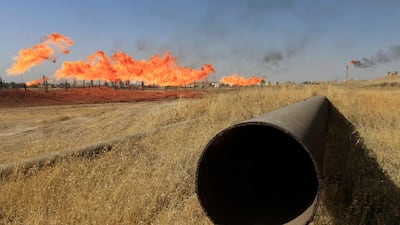

Iraqi crude oil from Kirkuk is being smuggled to Iran, mixed with Iranian oil and sold onwards to Afghanistan, while a second stream is funnelled to Turkey with falsified documents, according to a government report.
That is the core allegation of a new classified intelligence report prepared by the Geospatial Intelligence Department of Iraq's Federal Intelligence and Investigations Agency. The report, seen by The National, has been verified by a senior security official.
The report formed the basis for the most sweeping federal action against the Kurdistan region since the 2003 US-led invasion, as well as punitive measures against security and oil officials in the oil-rich province of Kirkuk and the state-run North Oil Company.

The Kurdistan Regional Government has been ordered not to grant approval for the export of crude oil and petroleum products except through the federal Oil Ministry “to prevent overlap of powers”, a statement from Prime Minister Ali Al Zaidi's office said.
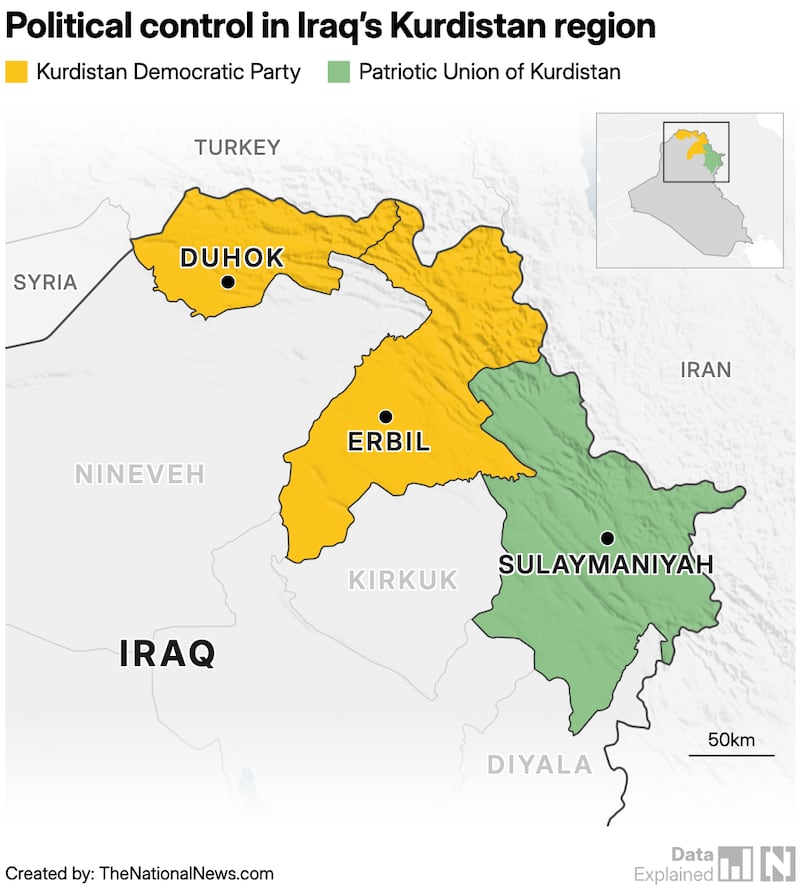
It also directed the federal Border Ports Authority to take over all border crossings in the Kurdistan region, and the Iraqi Oil Ministry to manage all oilfields in disputed territories within Diyala, Kirkuk, Salahaddin and Nineveh provinces that are under Kurdish security control.
Oil smuggling networks have grown beyond simple theft into an “integrated international operations for changing the origin of oil to re-export it to international markets, using border areas and border crossings with Turkey and Iran outside the control of the central government”,” the report said.
According to the report, the “eastern route” begins at the North Oil Company fields in Kirkuk, from where crude is shipped under official quotas to Sulaymaniyah province in the Kurdistan region, diverted on to small and medium-sized tanker lorries and moved into Iran through the Bashmakh and Parwezkhan crossings. Lower prices make Iraqi crude “more attractive for smuggling and re-export”, it said.
Satellite imagery from 2024 to 2026 shows tanker gathering points near Bashmakh and Parwezkhan, and newly constructed buildings and storage sites near Bashmakh that the report links to transport and storage of petroleum products.

The report calls blending “the most important step”. Smuggled Iraqi oil is mixed with large quantities of Iranian petroleum products. The mix is then documented as Iraqi product to evade export sanctions on Iran.
Iranian tankers carry the mixed fuel through the Mahirud crossing in Khorasan province or other crossings to Afghanistan, where private importers sell it to fuel stations for domestic use rather than re-exporting it, according to the report. Storage sites near Herat and Farah are identified as unloading points.
On the “northern route”, crude oil from Iraq’s Tawke and Fishkhabour fields are sold to local buyers, bypassing the federal State Oil Marketing Organisation. The buyers then send the oil in tankers towards the border with Turkey, where shipping documents are “re-issued or falsified” in preparation for export to Turkish territory.
Satellite images taken between June 2023 and 2026 show waiting areas at the Ibrahim Khalil crossing in Dohuk province, according to the report.
These networks exploit border areas near Turkey and Iran, “pose a complicated security and economic challenge”, and “threaten the state's sovereign revenues”, the report said.
It is the second such leaked document in a week. The first gave details of alleged oil theft in Jurf Al Sakhar, south of Baghdad, an area controlled by the Iran-backed Kataib Hezbollah militia. Hundreds of millions of dollars’ worth of state oil had been siphoned from the area, which Kataib Hezbollah has controlled since it was retaken from ISIS in 2014.
The report prompted the government to send security forces into Jurf Al Sakhar last week after ordering Kataib Hezbollah to withdraw. A joint force comprising the army, federal police, Popular Mobilisation Forces and energy police has established a new command headquarters in the town.
Constitutional argument
Tuesday's directives have angered the Kurds, with local reports on Wednesday saying that Kurdish Peshmerga forces were being sent to the region's borders with federal territory.
Kurdish leaders said Baghdad's move was “unconstitutional and unacceptable”. Masoud Barzani, a former president of the region and the leader of Kurdistan Democratic Party, described the decision as “unsound and reckless”.
“We see that problems are not addressed through erroneous campaigns, baseless accusations and unilateral decisions,” Mr Barzani said in a statement.
“As we co-operated with the Iraqi Prime Minister in uprooting corruption, we will co-operate to the same extent in preventing unlawful acts and the phenomenon of smuggling, but through legal and constitutional means.”
Late on Tuesday, the state-run Iraqi News Agency published the constitution articles that justify the Iraqi government's actions, as well as a 2022 Federal Supreme Court ruling to scrap the regional law regulating the industry, calling it unconstitutional. The court ordered the region to hand over all oil-sector activities to Baghdad, including exports.
Drafted rapidly under intense political pressure and approved in 2005, the constitution contains grey areas on many issues that frequently cause political deadlocks and disputes, mainly between Baghdad and regional authorities.
It stands as the country’s legal foundation but also a source of persistent political tension. Parliament and political parties have failed to approve important laws related to articles of the constitution, including a federal oil and gas law.
For many Iraqis, the constitution promises rights on paper but leaves too many questions unanswered in practice. Critics say it has become one of the country's deepest fault lines and a means for political parties to cling to power.
In a statement on Wednesday, the Prime Minister's Office rejected any suggestion that Baghdad's measures against oil smuggling were taken at the behest of a foreign power.
“The Republic of Iraq is a fully sovereign, democratic, federal state that derives its authority and the legitimacy of its institutions from the Constitution and the will of its people,” the office said.
“Its government exercises its constitutional responsibilities and powers with full independence, in accordance with the law and the country's highest national interests.”
All measures undertaken by the government are “based solely on its constitutional authority and legal responsibilities – not on encouragement, demands, or directives from any foreign authority”, it added.
In a sign of support for the government, the Supreme Judiciary Council said Iraq is “one independent federal state with a federal, parliamentary and democratic system” and that the guarantor is the constitution.
It called on Baghdad and Erbil to “abide by what is stipulated by the constitution”.

