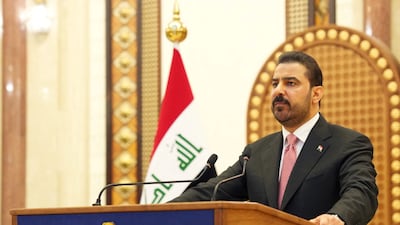

Iraqi Prime Minister Ali Al Zaidi has shaken up his team five months after taking power, dismissing several officials including the head of intelligence and chief of staff.
An order signed by Mr Al Zaidi’s new chief of staff Rashad Khalaf Hashim removed intelligence chief Hamid Al Shatri without giving a reason. No replacement has yet been named.
Mr Hashim assumed the chief of staff role on Monday, succeeding Ihsan Al Awadi. The order dated October 26 said the changes were to take effect immediately.

Mr Al Shatri had been appointed intelligence chief in December 2024 by former prime minister Mohammed Shia Al Sudani, after previously running the National Security Service.
After the Iraqi general election last November, Mr Al Shatri’s name circulated as a potential candidate for the prime minister's position during protracted coalition talks that ultimately led to Mr Al Zaidi's appointment. As intelligence chief he had led several security delegations to Syria to discuss counter-terrorism and border security.
A letter leaked on social media showed 69 advisers were also being dismissed from Mr Al Zaidi's office.
The changes come as Mr Al Zaidi faces a rebellion from a provincial council over the closure of a border crossing with Iran. A Baghdad court on Monday ordered an investigation into the head of Maysan province, Mustafa Duair Abdulhassan.
Mr Al Zaidi had called for a probe over the official's calls for civil disobedience if the Al Sheeb border crossing was not reopened. Iraq closed the crossing last week over security concerns at the border, escalating tensions with Iran and pro-Tehran Iraqi politicians.
In September, Iraq closed the Shalamcheh crossing as a precautionary security measure after drone attacks on Saudi Arabia.
The shutdown has disrupted trade and daily activity in the province. It was expected to impact the prices of basic goods, especially fresh produce and Iranian building materials that dominate southern markets.
Mr Al Zaidi, who took office in May, has sought to maintain balanced ties with both Iran and the US while moving to bring armed factions under state control. Some Iran‑aligned groups have complied, while others have resisted.