Regional and European powers on Friday urged parties to war in the Middle East to avoid further military escalation, amid fears of renewed US-Israeli strikes on Iran and continuing attacks on Saudi Arabia by Yemen’s Houthi rebels.
“Military intervention is not a solution, and nobody approves this at the moment,” Turkish Foreign Minister Hakan Fidan told journalists in Istanbul after a meeting with counterparts from across the region and Europe.
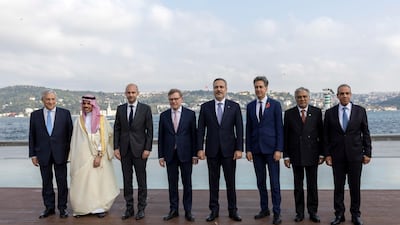
Foreign ministers from the UK, France, Germany and Italy met with counterparts from Turkey, Saudi Arabia, Pakistan and Egypt at a hotel alongside the Bosphorus strait on Friday afternoon, in the first meeting of its kind between all the ministers.

The countries represented had agreed to “give the message to all parties” that diplomacy needed to prevail over more war, Mr Fidan said.
“A repeated attack on Iran could spread the war and conflict in the region further,” said Mr Fidan, who maintains dialogue with both the US and Iran. “On the other hand, the opening of the Strait of Hormuz is needed, and the attacks on Saudi Arabia shall also stop.”
A new escalation between Tehran and Washington “would create nothing but losers”, French Foreign Minister Jean-Noel Barrot told journalists after the talks on Friday.
Ministers from the eight countries discussed the “urgent need” for diplomacy to resolve regional challenges, Pakistan’s Foreign Ministry said in a statement. Foreign Minister Ishaq Dar briefed his counterparts on Pakistan’s diplomatic efforts to de-escalate tensions and prevent a resumption of hostilities, it added.

Ministers discussed the “parameters” for preventing the conflict from spreading across the Middle East, Mr Fidan said, declining to elaborate.
The US and Israel have reportedly discussed launching a new major military operation against Iran, potentially involving strikes on missile and nuclear sites as well as oil installations, although US President Donald Trump said earlier this month that he would not strike again before the US midterm elections on November 3.
Iranian officials have vowed an even more widespread response to any new attack than the strikes Tehran launched across the region after US-Israeli military operations began on February 28. Cables, data centres and artificial intelligence facilities could all be attacked by Tehran, Iran's National Security Council chief Maj Gen Mohsen Rezaei told Iranian media this week.
The US continues to impose a military blockade on Iran’s seaports, while Tehran regularly attacks ships that attempt to navigate the Strait of Hormuz without its authorisation.
'Constructive discussions'
After “very constructive discussions”, the eight countries around the table had decided to meet regularly, “to address issues related to a lasting resolution of the Iranian regime’s actions”, Mr Barrot said.
They are also seeking to ensure freedom of navigation in Hormuz, the Red Sea and the Black Sea, where suspected Russian drone attacks have struck ships near Bulgaria and Romania in recent weeks, raising fears of another chokepoint on global maritime transport.
A ceasefire and peace agreement in Ukraine were also needed “as soon as possible”, Mr Fidan added.
Attacks by the Iran-backed Houthi rebels on Saudi Arabia were also a central agenda item, and Mr Fidan said he had discussed them in a meeting with the foreign ministers of Pakistan, Saudi Arabia and Egypt before the talks with their European counterparts.
Three of those nations – Pakistan, Saudi Arabia and Turkey – signed a collective defence pact in August, and Islamabad and Ankara have vowed to defend Saudi Arabia. Turkish officials have made it clear they draw a line at offensive actions against the Houthis in Yemen, whose fatal attacks on Saudi Arabia have prompted the kingdom to cancel major events and furthered the turmoil in global energy markets.
Saudi Arabia confirmed Foreign Minister Faisal bin Farhan’s attendance at the Istanbul meetings but did not provide details. Mr Dar held a bilateral meeting with Mr Farhan, in which he expressed Pakistan’s “full support” for Saudi Arabia’s sovereignty and territorial integrity, according to a post on X from Islamabad's Foreign Ministry.
The talks in Istanbul also come against a backdrop of growing unrest in Europe, partly over a cost-of-living crisis exacerbated by rising fuel prices resulting from the Middle East war. France has been buffeted by weeks of protests that began around education but which have expanded to encompass demands over the high cost of living, while Italians have taken to the streets over soaring fuel prices and living costs.
Mr Barrot underlined efforts to secure energy supplies during President Emmanuel Macron's tour of the Gulf this week, which included a surprise stop in Saudi Arabia. France has also confirmed it was sending military capabilities to protect the key Yanbu oil export terminal in western Saudi Arabia.
Violations of freedom of navigation, whether in the Black Sea or Gulf region, have “extremely concrete consequences for us”, Mr Barrot said. “They significantly drive up transportation costs, which ultimately leads to inflation – that is, rising prices – and thus a reduction in the purchasing power of French citizens.”

