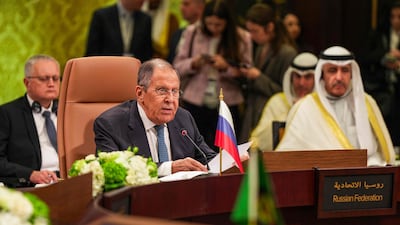

The Gulf Co-operation Council has urged Russia to use its position on the UN Security Council to press Iran to halt attacks on Gulf states, at a meeting with Russian Foreign Minister Sergey Lavrov in Bahrain.
Speaking at a Gulf-Russia foreign ministers' meeting in Manama on Sunday, GCC Secretary General Jasem Al Budaiwi said member states faced unprecedented attacks as well as risks to shipping and energy supplies.
The GCC called on Moscow to “play an active role in pressing Tehran” to comply with UN resolutions, cease its attacks and engage in “serious dialogue” with Gulf states.

Mr Lavrov said Russia supports diplomatic efforts to prevent a return to full-scale war as he presented an updated Russian concept for collective security in the Gulf.
On Ukraine, where Russia has waged war for almost five years, Mr Al Budaiwi said the bloc continues to support dialogue and diplomacy aimed at a peaceful, comprehensive political settlement.
He said Iranian attacks on GCC states since February 28, when the US and Israel began their war against Iran, had involved more than 7,000 ballistic missiles and drones, striking airports, ports, power stations, water desalination plants and oil and gas facilities.
Mr Al Budaiwi also condemned Houthi attacks on Saudi Arabia, singling out the October 10 attack on King Khalid International Airport in Riyadh, which killed 12 people and injured more than 300.
He reaffirmed the GCC’s full solidarity with Saudi Arabia, calling on the international community to adopt a firm stance against attacks on the kingdom.
Mr Al Budaiwi said Iran’s disruption of maritime navigation in the Strait of Hormuz and threats to shipping in the Red Sea and Bab Al Mandeb strait posed risks to global energy and food security and international supply chains. He called for maritime traffic through Hormuz to return to its status before February 28.
The proposal envisages direct dialogue among the Gulf’s coastal states and neighbouring countries, including Iraq and Jordan, with possible support from the Arab League, the Organisation of Islamic Co-operation and permanent members of the UN Security Council.
Mr Lavrov said the Gulf states themselves should have the decisive voice in determining the region’s security arrangements.
“Our concept is specifically designed to foster conditions for direct dialogue among the Gulf’s coastal states and their neighbours, such as Iraq and Jordan,” he said.
He also described ties with GCC states as a priority of Russia's foreign policy, noting that trade between Russia and the bloc’s member states rose by 45 per cent in 2025.
He said the crisis in the region had been triggered by an “unprovoked act of aggression” by the US and Israel against Iran.
The meeting, chaired by Bahrain’s Foreign Minister Abdullatif bin Rashid Al Zayani, also addressed the Palestinian cause, Syria and the Russia-Ukraine war.
Mr Al Budaiwi reiterated the GCC’s support for an independent Palestinian state along the borders of 1967, with East Jerusalem as its capital. He called for the consolidation of the Gaza ceasefire and the enactment of its second phase, securing a full Israeli withdrawal and ensuring unhindered humanitarian aid.
On Syria, he reaffirmed the GCC’s support for the country’s sovereignty, independence and territorial integrity. The ministers also discussed expanding co-operation in trade, energy, education, health, agriculture and other sectors under the GCC-Russia Joint Action Plan for 2023-2028.

