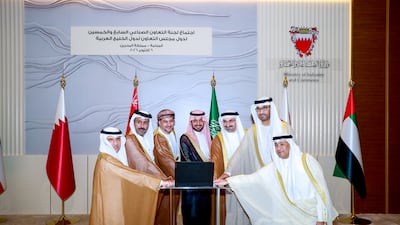

The UAE is seeking to boost industrial integration with Gulf states, as the region explores ways to strengthen supply chain resilience at high-level meetings in Bahrain.
A UAE delegation led by Dr Sultan Al Jaber, Minister of Industry and Advanced Technology, is participating at the GCC Industrial Co-operation Committee and the Ministerial Committee for Standardisation Affairs meeting being held in Bahrain.
The UAE’s participation focuses on “strengthening industrial integration among GCC countries, building more resilient and competitive Gulf supply chains, accelerating the deployment of advanced technology and artificial intelligence in the industrial sector, and enhancing the role of the private sector in building partnerships and joint industrial opportunities”, the Ministry of Industry and Advanced Technology said in a statement on Wednesday.
The meetings, which began Tuesday and will continue until Thursday, highlighted the need for co-ordination in standards.
Dr Al Jaber emphasised the importance of advancing joint efforts to develop a more advanced industrial sector that supports the diversification of national economies and strengthens the GCC's position as a global hub for industry and innovation.

“Industrial integration is a cornerstone of Gulf competitiveness,” he added.
The meetings took place on the sidelines of the inaugural Made in GCC Forum and Exhibition 2026 being held in Manama. The event is aimed at boosting collaboration and partnerships across investment, manufacturing, supply chains and technology.
Key outcomes of the meetings include the launch of the Gulf Centre for the Fourth Industrial Revolution and its digital platform aimed at enhancing the digital maturity of factories and supporting industrial transformation, the GCC Council said in a statement.
The evaluation period for the amended rules on exempting industrial inputs from customs duties was extended until the end of 2027.
UAE manufacturing push
The UAE’s participation comes amid a strong push towards domestic manufacturing in the country.
The industrial sector plays a key role in the national economy, with its contribution having reached Dh200 billion ($54.45 billion) – an increase of 70 per cent.
Its industrial exports reached Dh260 billion last year, including Dh92 billion in medium-and high-technology industrial exports.
The Emirates also launched its industrial strategy, Operation 300bn, in 2021, to position itself as a global industrial hub by 2031.
The UAE’s overarching agenda is focused on priority industries including chemicals, electrical, construction, machinery and equipment, food, transport, metals, pharmaceuticals, rubber, plastic and fibreglass, and wood and paper.
The Emirates has in recent years also invested heavily in advance technology and AI, with multibillion-dollar projects being built.
In May, the UAE launched the Dh1 billion National Industrial Resilience Fund to support the industrial sector and announced a national strategy to secure supply chains and boost local food, medicine and industrial production.
Meanwhile, the country's National In-Country Value (ICV) programme has redirected more than Dh473 billion into the national economy.
The UAE is pushing for deeper industrial co-operation across the Gulf as countries seek to localise supply chains and reduce their reliance on imports following disruption exposed by the Covid-19 pandemic and other global shocks, Dr Farah Al Zarouni, assistant undersecretary for the Standardisation Affairs sector at the ministry, told The National.
“We need to benefit from all the resources available across the GCC countries,” she said.
The Made in GCC event is expected to involve the signing of a number of initial pacts between UAE entities and Gulf companies, the ministry said.
The UAE is participating with 23 Emirati companies spanning sectors including basic industries, pharmaceuticals, defence and spare parts.
“We no longer look at industry as simply traditional manufacturing. We are moving our national industry towards more advanced manufacturing,” Ms Al Zarouni said. “Technology is a very important and fundamental component of our national industrial sector.”
The experience of the six years since the pandemic has highlighted the vulnerability created when countries depend heavily on overseas suppliers for relatively small components for manufacturing.
“If I had been able to source that small component locally, the component that enabled me to produce the final product, I would not have been affected to the same extent,” she said.
The priority now should be to identify which raw materials and components can be produced within the UAE or elsewhere in the GCC, she said. “Supply chains are long, so you need to benefit from all the resources available across the GCC countries.”

