
Leaders of Palestinian factions were gathering in Egypt on Wednesday for a renewed bid for reconciliation, after legislative elections scheduled for next month were postponed by President Mahmoud Abbas, sources told The National.
They said the talks were scheduled to begin Thursday and will continue until the end of the month, but not necessarily at leadership level.
The gathering in Egypt represents eight factions, including Hamas, Islamic Jihad, a pro-reform faction of Fatah, and the Popular Front for the Liberation of Palestine.
The talks will be the latest in a long-running series of attempts to narrow the gap between Palestinian factions divided over policies, ideology and the way forward for Palestine.
Egypt has been trying to reconcile Palestinian factions for years, without success. Officials from its spy agency have led efforts, taking responsibility for key foreign policy files traditionally handled by the Foreign Ministry.

The sources said Khalil Al Hayya, the political leader of Hamas, and Mohammed Dahlan, who leads the pro-reform faction within Fatah, were among those taking part in the talks. Also participating are Jebril Rajoub, a top official of the Palestine Liberation Organisation, and Mohammed Ashtiyah, a former Palestinian prime minister and top Fatah official.
Among the main topics to be discussed are how to narrow ideological gaps between their factions, the inclusion of Hamas and Islamic Jihad in the Palestine Liberation Organisation, and charting a political role for armed groups like Hamas and Islamic Jihad.
“These are preliminary contacts that will precede negotiations that bring together everyone in the same room, which is expected to happen towards the end of the month,” said one source.
The talks in Egypt will take place at a time when prospects for the Palestinian cause are looking dimmer than at any time perhaps since the mass displacement of Palestinians around the time of Israel's creation in 1948.

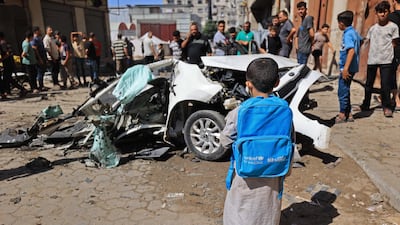
A year since a US-sponsored Gaza ceasefire was announced to pause two years of fighting, the strip lies in ruins, Israel's military controls more than 60 per cent of the enclave and shows no intention of withdrawing as provided by American President Donald Trump's peace plan.
Palestinians in the Israeli-occupied West Bank are facing frequent violent attacks on their homes and farmland in what increasingly looks like a concerted, state-backed campaign to displace them.
Mr Abbas, head of the Palestinian Authority, announced last weekend that the legislative vote would be postponed until next September next, when the presidential election is also due to take place. Sources from various factions have told The National the delay was primarily intended to address what has been described as “Palestinian divisions” before the elections take place.
The executive committee of the Palestine Liberation Organisation has approved the postponement. It said the delay was due to the lack of security in the Gaza Strip and the West Bank.
The last election for the Palestinian Legislative Council, or parliament, was held in 2006 and won by Hamas, triggering a split between the group and Fatah, the dominant faction in the Palestinian Authority. Mr Abbas, 90, who is also Fatah's leader, has remained in office 17 years beyond the end of his original term.
The deeply unpopular president, according to recent polls, has been ruling by decree amid growing discontent over his policies and reports of widespread corruption. An opinion poll run by the Palestinian Centre for Policy and Survey Research in August found 79 per cent of the 1,270 people surveyed wanted him to step down.

Hamas described the postponement as a “step in the right direction,” saying political and security conditions were not suitable for holding a free election. The delay, its statement said, “must lead to a serious, fruitful and comprehensive national dialogue”.
However, Mr Dahlan's pro-reform faction responded to Mr Abbas's decision in markedly different terms. It said the postponement was an “attack on democracy” and a threat to younger generations of Palestinians, who have been deprived of their right to choose their representatives.
“The absence of elections deepens the crisis of legitimacy and weakens the Palestinian domestic front,” it explained in a statement on Saturday. “The leadership [Mr Abbas] is enshrining fiscal, political and administrative corruption, and pushes institutions away from the national track.”
The group also called for broad dialogue between Palestinian factions to establish a “popular front” capable of exerting pressure.

