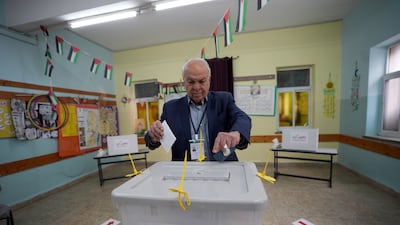
Under intense pressure to reform, President Mahmoud Abbas vowed 2026 would be the year of diplomacy, announcing that Palestine would hold legislative elections in November and Presidential elections next year.
Many doubted they would happen, given past experience. Their fears became reality this week, with sources telling The National that the elections are to be delayed again. The last time this happened was in 2021, when Mr Abbas announced that legislative elections were cancelled after hope had been ignited that the Palestinian government might be revived.
“This was not a postponement, this was a cancellation,” said Palestinian-Canadian lawyer Dania Buttu, who is the former spokeswoman for the Palestinian Liberation Organisation (PLO). Mr Abbas, who was elected in 2005, has overstayed his term by 17 years and now rules by decree. “This is called authoritarian rule,” she added.

This time, the postponement comes at a crucial period, weakening the Palestinian Authority's credibility in the face of a mountain of challenges, including a right-wing Israeli drive to make it impossible to establish statehood, a war that has not stopped in Gaza, and international obligations that have not been fulfilled.
Israel has occupied more than half of the Gaza Strip, and its army has killed 70,000 Palestinians there over the course of the three-year war since the Hamas attacks of October 7, 2023. In the occupied West Bank, settler attacks have become more rampant and intense, and conditions inside Israeli prisons are described as torture by Israeli and international rights groups.
The conditions for free and fair elections are unlikely to be met in Palestine in the near future, particularly if Benjamin Netanyahu's government survives Israel's own vote set to take place at the end of this month. However, Mr Abbas has also not secured any type of future for Palestine.

“When Abu Ammar [Yasser Arafat] was alive, we knew what would happen after he was gone. There would be elections, and Abbas would win. Today, we have no idea,” Ms Buttu said.
Palestine's parliament has not met since 2007, the last time since legislative elections, and Mr Abbas has issued at least “three times” more decrees than parliament has passed laws, she added. Despite creating the role of Vice President, Mr Abbas has also bolstered the position of his own son, and a clear plan of action is not in place for when the 90-year-old President dies.
Sources from different factions said the roots of the delay are mainly tied to holding a national dialogue in Egypt and ending “Palestinian division” before going to the polls. But attempts to unite notorious factions within the Palestinian political scene have often failed, stemming from disagreements about the way forward for Palestine.
Systemic and endemic problems mean that Palestine has lacked the right environment for elections for decades. Under an occupation that has become more fierce and deadly in recent decades, state institutions, finances and the political scene have all but collapsed.
Unpopular leader
High-level meetings and tactical alliances between factions looking to unseat Mr Abbas and his ruling Fatah party have been taking place, causing anxiety in the President's dwindling support circle.
Mr Abbas has become increasingly unpopular in Palestine. An August opinion poll by the Palestinian Centre for Policy and Survey Research (PSR) surveyed 1,270 people and showed that 79 per cent wanted him to resign.
This confirms “the persistence of exceptionally high dissatisfaction with his leadership”, the PSR said in its findings.
Driven by what seemed like a crucial moment for change after Mr Abbas's announcement earlier this year that elections would be held, momentum began to build, preparations were set in place and alliances began to form.
Inside Fatah
First, municipal elections were held in the West Bank and in one area of Gaza, Deir Al Balah, because the remainder of the strip is simply too destroyed to host an organised vote.
The vote went ahead, and despite some criticism, was viewed as a step forward towards larger elections. Then, he held elections in Fatah's Central Committee, where the cracks began to form. Several sources told The National that the vote was clearly “rigged”. People who once seemed to be guaranteed winners were sidelined, while others, like Mr Abbas's son Yasser, gained enough votes to secure a seat on the committee.
“In my estimation, this is one of the most significant reasons [for the postponement],” an official with Palestinian Islamic Jihad told The National. “There is internal disarray within the Fatah movement regarding the formation of its electoral list and the distribution of power centres following the movement's Eighth Conference.”
Additionally, Fatah is not viewed as a single party. Splits over the years from the group's main members by people who can, in today's political climate, play a significant role, such as Mohammad Dahlan and Nasser Al Kidwa, mean that Fatah no longer represents one single vision.
Mr Dahlan, the head of a breakaway faction of Fatah called the Democratic Reform Party, was the Fatah representative in Gaza before being exiled from the group. Similarly, Mr Al Kidwa, who is the nephew of former Palestinian President Yasser Arafat, was expelled from the Fatah party and joined forces with one of Palestine's most prominent political figures, Marwan Al Barghouti, for the elections in 2021 that Mr Abbas also “postponed”.

New alliances
Mr Dahlan recently met the head of Hamas's politburo, Khalil Al Hayya, in Cairo. Both Mr Dahlan's party and Hamas issued a statement confirming that they had met, cementing further what many had suspected before: that efforts were probably being made to unite against Mr Abbas in upcoming elections.
There were also talks that Mr Barghouti himself would join one of the parties running against Mr Abbas – causing the chances of the President's political survival in a poll to shrivel. Only 14 per cent of people would vote for him if Mr Barghouti and Mr Al Hayya ran against him.
“New alignments have emerged over the past few months, including a rapprochement between Hamas, Islamic Jihad and the faction led by Mohammed Dahlan. This creates the possibility of an electoral map reshaped in a way that makes it difficult for the current leadership to control the outcome,” the PIJ official added. “Thus, postponement becomes a means to realign alliances before heading to the polls.”
The future of Palestine
A lot of this was expected, and did not come as a surprise for many. In fact, the same public opinion poll showed that 44 per cent of Palestinians did not believe the elections would take place on time. So did many Palestinian experts and watchers.
Mr Abbas postponed the 2021 elections under the pretext that Israel would not allow people to cast their vote in occupied East Jerusalem, after it became increasingly apparent that he would lose. Today, the circumstances are significantly more dire.

The framework within which the November vote will be postponed is important. In 2021 there was simply an announcement, but if Mr Abbas issues a decree, this should make it legally binding.
Additionally, pressure from Europe may also mean that a vote is not “postponed” indefinitely, but takes place later, within a set timeframe. Eyes will now be on France and other European countries that have made reform a condition of their provision of assistance to the Palestinian Authority, now that the decision to postpone has been made but not officially announced.