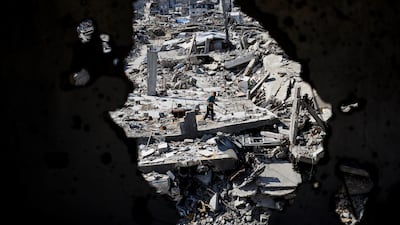

A Google Earth update has offered the world a stark view of the destruction around Gaza, but for most people in the war-ravaged enclave it has underscored a more urgent question: where are we supposed to live?
With neighbourhoods reduced to rubble before winter, for some, the answer is a tent. For others, a damaged building. For many, there is no safe option at all.
Israeli bombardment has turned densely built Gazan neighbourhoods into expanses of rubble and bare earth, leaving millions of Palestinians with few options for shelter as winter approaches.
A ceasefire that began on October 10 last year brought the worst of Israel’s two-year war on Gaza to an end, after the October 7, 2023 attacks led to the conflict. But the deaths did not stop. More than 1,400 Palestinians have since been killed in near-daily Israeli attacks, while Israeli forces still occupy large parts of the narrow coastal strip.
For Amani Abu Jalhoum, 35, winter is measured not in falling temperatures, but in memories of water pouring into her tent.
“I go to sleep and wake up thinking about winter,” she told The National. “Will we be flooded like we were last winter? How will the situation be? And what about illnesses such as colds and flu? Will my husband, my children and I get sick again this winter like we did last time?”
It will be the second winter her family has spent in a tent since their home in Sheikh Radwan, northern Gaza city, was destroyed during Israel’s Operation Gideon’s Chariots in 2025.
They had fled believing their displacement would be temporary. When they eventually returned, there was no home left.
Last winter, while Ms Abu Jalhoum was displaced in Deir Al Balah, rainwater repeatedly entered her family's tent, soaking clothes and belongings. Her son Ayham, 4, was sick for much of the season.
“He spent the entire winter with the flu and a runny nose because I was unable to provide him with the care and protection he needed during the cold winter months,” she said.
This year, she is trying to prepare. But there is little with which to do so. “There are no tarpaulins or other materials available to reinforce our tents and make the situation better,” Ms Abu Jalhoum said.

Google Earth comparisons between prewar and more recent imagery show how the loss of housing has reshaped Gaza’s urban landscape, particularly in areas of Rafah, Khan Younis, Gaza city and northern Gaza.
The images provide a stark backdrop to a problem confronting families there. With so much housing destroyed or damaged, the choice is no longer one between adequate and inadequate accommodation. For some, it is between a tent exposed to winter weather and a damaged building that may not be safe to occupy.
Basel Abu Eish, 41, chose the building.
His family of four is living in a house that, he says, authorities have warned could collapse during heavy wind and rain.
“I am afraid of winter because I fear that our house could collapse on top of us,” Mr Abu Eish told The National. “All the relevant authorities have warned us that with the winter weather and strong winds, the house could collapse at any moment.”
The building survived relatively intact until May 2025, he said, when Israeli forces detonated explosive-laden vehicles in the surrounding area. The blasts badly damaged the house and its foundations.
The family stayed on someone else’s land in central Gaza. But after the ceasefire began, the owner asked for the land back.
Nowhere to go
With nowhere else to go, Mr Abu Eish returned with his family to the damaged house.
“The reason we are living in this house is that we have no alternative,” he said. “I have tried several times to find shelter for myself and my family of four, but each time I failed.”
Now his thoughts turn repeatedly to his children and what would happen if the building collapsed.
“Sometimes I say, ‘God, if it does collapse on us, let us all die together'.”
For Mr Abu Eish, winter will magnify a danger already present every day.
“Every night will feel like a nightmare,” he said. “You imagine death could come at any moment.”

The Norwegian Refugee Council has warned that 1.65 million Palestinians in Gaza are expected to spend a fourth winter in worn-out tents and war-damaged buildings.
About 284,250 families will require shelter assistance this winter, according to the NRC-led Palestinian Shelter Cluster. Existing stocks and supplies in the pipeline are enough to provide shelter and household assistance to only about 52,200 families, the NRC says.
The problem is not simply a shortage of homes. Materials needed to make tents more weather-resistant or damaged buildings safer are also severely restricted.
The NRC says Israeli authorities classify essential shelter materials, including tents, tarpaulins, timber, cement, tools and other supplies, as “dual use” items.
According to the organisation, only 15 lorries carrying Israeli-designated dual-use goods from Jordan are currently allowed to enter Gaza each week. At least 500 lorryloads of such shelter materials are already in the pipeline or under procurement.
At the current rate, the NRC says, getting them into Gaza would take more than seven months, even under the best conditions.
Israel says restrictions are necessary because items with civilian purposes can also be diverted for military use. The NRC argues that restrictions on basic shelter materials are preventing humanitarian organisations from adequately protecting civilians from winter weather.
Funding presents another obstacle. The minimum shelter response for winter requires $283 million, according to the NRC, while donors have provided or pledged $96.2 million, leaving a $186.8 million gap.
For Taysir Abu Hani, 32, winter once meant something entirely different. Before the war, his family lived in Rafah in a large house where heavy rain was something they could watch from the windows.
“No matter how heavily it rained, it never affected us,” he told The National. “We enjoyed warm, pleasant family times together.”
That changed after the Israeli military operation in Rafah forced the family into displacement and eventually into a tent in Al Mawasi, Khan Younis.
Last winter, Mr Abu Hani's father, 75, left the tent in the middle of a rainy night to use the bathroom.
He slipped.
“My father fell on his back,” Mr Abu Hani said. “To this day, he is still suffering from the effects of the fracture and can barely hold his head upright without difficulty.”
The accident transformed the family’s relationship with winter. After seeing what happened to their grandfather, Mr Abu Hani’s children became afraid to leave the tent at night to use the bathroom, fearing they might also slip and break a bone.
“Winter used to be something we welcomed and enjoyed,” he said. “But now it has become a nightmare that both adults and children fear.”
The NRC estimates that about 950,000 Palestinians are living in displacement sites considered to be at medium or high risk of flooding. Severe shortages of heavy machinery, engine oil and fuel have hampered work to prepare sites and drainage systems before the rains.
For Mr Abu Hani, the prospect of another winter brings memories of flooded tents, soaked mattresses and ruined clothes.
“I hope for this winter to be better for us than last winter,” he said. “Because we can’t endure the same experience again.”