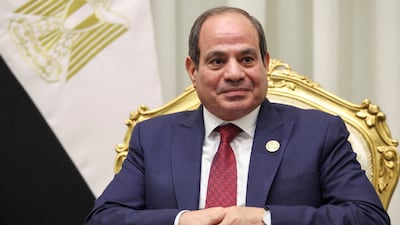

Egyptian President Abdel Fattah El Sisi insisted on Saturday that he would not seek another term when his current mandate ends in 2030, as he outlined a plan to prepare a new generation of leaders to succeed him.
"My term in office ends in 2030 and this is a total given and will not be debated," Mr El Sisi told a military ceremony marking the graduation of new cadets. "But I will not abandon the state of Egypt before it's rich with its sons who can shoulder the responsibility after me."
He said the military academy would invite up to 1,000 candidates with doctorates from Egyptian or foreign universities to attend a 30-month course to teach them "what is a nation and how to protect it".
The armed forces are to sponsor the course. Those who finish it will be the next generation of the country's leaders, he said.
"The academy will prepare people to know what a nation is and how to protect it ... Egypt is not sterile. It's capable of producing a leader better than me. I need the Egyptian people to support this idea," he added.
He said applicants must be between the ages of 40 and 50 and will be interviewed and vetted before they are enrolled. He did not say whether civilians and military candidates can apply, leaving the door open for another army officer like him to seek election in 2030.
He also called on parliament to pass legislation enshrining a constitutional provision that designates the armed forces as the protector of the state, democracy and the country’s territorial integrity. The proposal points to his desire for the military, from which he emerged, to retain its powerful position at the heart of Egypt’s political system.
No constitution change
Mr El Sisi surprised Egyptians this week when he announced that there would be no changes to the constitution to allow him to stay at the helm beyond 2030.
His announcement sparked a wave of social media posts, some in accounts known to be linked to the government or security agencies, urging him to stay in power.
Mr El Sisi, 71, has repeatedly warned in recent days against attempts to undermine the state, arguing that Egypt would be unable to recover if it collapsed.
By the time Mr El Sisi's current term ends in 2030, he would have served as president for 16 years. He owes his current term in office to constitutional amendments in 2019, which were adopted in a national referendum.

Before the changes were adopted, the constitution stipulated that no president could serve more than two four-year terms. The amendments kept the two-term cap, but extended the term to six years.
In a clause added for Mr El Sisi's benefit, the amendments considered the first of his two terms in office to have begun in 2018, not 2014 when he was first elected.
Egypt's constitution is a relatively progressive document adopted in a nationwide referendum in 2014, three years after Hosni Mubarak was removed from power in an uprising.
Many Egyptians regard Mr El Sisi as a safe pair of hands at a time when the Middle East is embroiled in conflict, with wars in Gaza, Egypt's neighbour to the east, Sudan, to the south, and political instability in Libya, on the western border.
The fallout from the Iran war, including Houthi attacks on Saudi Arabia, has affected Egypt's economy, increasing its already high energy import bills and hitting Suez Canal revenue.
Supporters of Mr El Sisi credit his government with maintaining stability amid these challenges. Critics, however, argue that government policies have contributed to the country’s economic difficulties. They point to heavy domestic and foreign borrowing and spending on large-scale infrastructure projects that may take years to generate meaningful returns.
They also fault the government for failing to resolve a decade-old dispute with Ethiopia over the Nile, warning that the country’s vital water supply could be threatened by the dispute over the Grand Ethiopian Renaissance Dam.
Mr El Sisi rejects such criticism, arguing that billions of dollars spent on infrastructure and modern transport – including a Cairo monorail, an advanced electric train network and a new administrative capital – will help position Egypt to attract substantial foreign investment.
He has also accused Ethiopia of exploiting the turmoil that followed Mubarak’s removal in 2011 to begin construction of the massive dam on the Blue Nile, the river's main tributary and the source of more than 80 per cent of the water flowing downstream.

