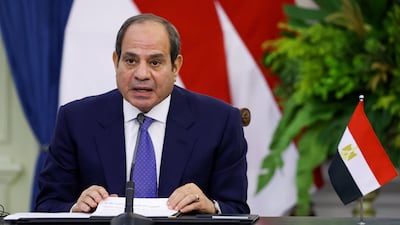

Egyptian President Abdel Fattah El Sisi said on Wednesday there were no plans to change Egypt's constitution, after calls by some supporters for him to stay in office after the end of his final term in 2030.
But Mr El Sisi appeared to leave the door open for a possible amendment to allow him to stay at the helm, saying Egyptians were the only ones who would decide on any initiative.
"The nation has a constitution that we adopted. No one can touch it, no one can touch it," he told a televised gathering of cabinet members and army officers.
"So, don't let anyone mess with your heads. The people alone will decide the success or lack thereof of anything that's done."
Calls for Mr El Sisi to stay in office beyond 2030 have been made publicly by loyal politicians and social media accounts linked to the government.
The campaign has picked up steam in recent months as opposition figures abroad intensified criticism of his policies. Mr El Sisi's comments on Wednesday were his first on the question of constitutional amendments.
In office since 2014, the Egyptian leader's final term ends in 2030, by which time he would have served for 16 years.
Egypt's constitution is a relatively progressive document adopted in a nationwide referendum in 2014, three years after autocratic president Hosni Mubarak was removed by a popular uprising after nearly 30 years in office.
Mr El Sisi owes his current term in office to previous constitutional amendments in 2019, which were adopted in a national referendum.
Before the changes, the constitution stipulated that no president could serve more than two four-year terms. The amendments kept the two-term cap but extended the term to six years and, in a clause added for Mr El Sisi's benefit, considered the first of his two terms in office to have begun in 2018, not 2014 when he was first elected.

And as was the case in 2018, when he ran against an obscure politician, Mr El Sisi – the latest in a line of military men who ruled Egypt since the monarchy was overthrown in the 1950s – ran again in 2023 against three little-known politicians, winning 89.6 per cent of the vote.
Many Egyptians see him as a safe pair of hands at a time when the Middle East is roiled in conflict, with unresolved wars in Gaza, Egypt's neighbour to the east, Sudan, its southern neighbour, and political instability in Libya, on its western border.
The fallout from the Iran war – from the on-and-off closure of the Strait of Hormuz, attacks on Tehran's Arab neighbours and strikes on Saudi Arabia by Yemen's Iranian-backed Houthis – has affected Egypt's economy, increasing its already high energy import bills and badly blocking revenue from the Suez Canal.
Supporters of Mr El Sisi praise the stability of Egypt during those challenges, while he repeatedly urges Egyptians to endure their economic hardship and praises their resilience.
But critics insist the government's policies are at the root of the country's economic woes, due to what they regard as excessive foreign and domestic borrowing and spending on infrastructure projects that will take years to generate revenue.
They also blame the government for not dealing effectively with a decade-old water dispute with Ethiopia that could reduce the country's vital share of the Nile waters.
Mr El Sisi rejects the criticism, saying the billions of dollars spent on infrastructure and modern transport, such as a Cairo monorail, a cutting-edge electric train and a new capital, prepare the nation to attract sizable foreign investments.
He says Ethiopia saw in the turmoil in Egypt that followed the removal of Mubarak in 2011 a chance to start construction of a massive dam on the Blue Nile, the river's main tributary and source of more than 80 per cent of the water reaching downstream.

