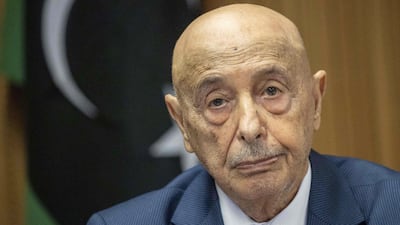

Libya's eastern-based parliament has ousted its long-serving speaker Aguila Saleh after 12 years at the helm, amid tensions within the House of Representatives over his tenure.
He was replaced by Al Salhin Abdulnabi, who comes from the same tribe as Mr Saleh, 82, and represents the eastern city of Tobruk.
“Libya is greater than our differences and more precious than our individual interests, and the future of its sons is a shared responsibility that falls on all our shoulders,” Mr Abdulnabi said in a speech on assuming the post.
Mr Saleh was replaced a day after 98 of the chamber's 190 MPs approved limiting the speaker and deputy speakers to a single 12-month term, ending a system that had been in place since he was elected in 2014. He denounced the session as “not official” and one that “does not have any legal effect”.
“The magic backfired on the magician,” said a Benghazi-based politician, referring to the power Mr Saleh accumulated over the years, as well as his ability to remain at the forefront of Libyan politics for more than a decade.
Mr Saleh has been one of the most prominent Libyan figures since the 2011 uprising that ended with the killing of long-time ruler Muammar Qaddafi.
He grew close to and helped raise the profile of the Haftar family, which dominates eastern Libya. It is led by Field Marshal Khalifa Haftar, the military commander of the eastern region.
FM Haftar's son, Lt Gen Saddam Haftar, generally regarded as his likely successor, said after the new speaker's election that Libya's path towards a stable and unified state “begins with building effective national institutions capable of renewing and assuming their responsibilities”.
Libya, a major oil and gas producer, remains deeply divided, with effectively two seats of power in the east and west – the internationally recognised Government of National Unity is based in the capital Tripoli.
In August, rival factions signed an agreement calling for presidential and parliamentary elections within 24 months and seeking to settle disputes over electoral laws and restructure the country's election commission.
However, it follows a long list of failed attempts to unify the country and optimism remains muted that it will succeed.