
Oil prices eased on Friday but were still headed for another weekly increase on lingering Middle East supply concerns and as global efforts to boost crude stockpiles continue.
Brent, the benchmark for two thirds of the world's oil, declined 0.77 per cent to $105.10 a barrel at 12.59pm UAE time. WTI, the gauge that tracks US crude, retreated nearly 1 per cent to $97.04.
For the week, Brent is set to add 0.32 per cent, while WTI is on track to jump by more than 5.6 per cent.
Global energy prices remain volatile and elevated as the war in Iran, now in its eighth month, continues to choke energy supplies. That has prompted moves to ensure ample supplies globally.
On Thursday, the International Energy Agency said its March pledge to release crude oil stocks will exceed its target. It will accelerate the release of the remaining supplies as global efforts to tame soaring energy prices continue.
The Paris-based agency also pointed out that exports out of the Middle East have recovered to pre-crisis levels and that oil storage globally is not tight.
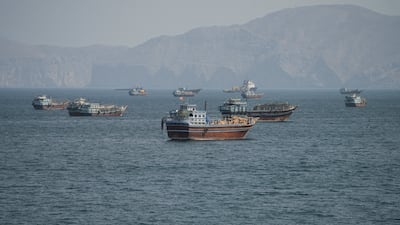
Gulf oil producers, meanwhile, have pushed tanker transfers as far as India’s coast and slashed prices to keep crude flowing to Asia, as the makeshift export network around the Strait of Hormuz buckles under congestion and persistent attacks.
There were 82 Ship-to-ship transfers in India's Gulf of Kutch last month, equivalent to about 680,000 barrels per day, shipping analytics company Vortexa said. Refined products accounted for about 65 per cent of the volume, with crude making up the remainder.
Current oil market levels “still seem to be somewhat lofty compared to market realities … [but] we are not running out of oil, as flows out of the Middle East have largely recovered. Instead of tilting the oil market into a deficit, the Iran war has mainly erased the surplus that had been built in 2025", said Norbert Rucker, head of economics and next-generation research at Swiss lender Julius Baer.
G7 leaders pledged this month to accelerate the IEA's co-ordinated emergency stock release by releasing 100 million barrels of diesel and other reserves to help stabilise markets.
And in a surprise move last week, US President Donald Trump's administration lifted sanctions to enable Russia to supply millions of barrels of diesel to global markets.
The IEA on Wednesday warned that the global diesel shortage triggered by the Iran war is set to persist well into next year, with depleted inventories not expected to recover until the second half of 2027.
Meanwhile, questions have been raised over the validity of Mr Trump's declaration of an “energy ceasefire” between Russia and Ukraine, after Moscow offered no confirmation of such a truce and Russian strikes hit Ukrainian power plants within hours of the announcement.

