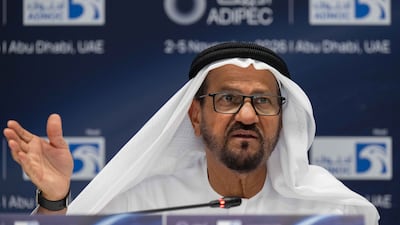

State-owned Adnoc began preparing for major disruption to energy supplies 10 to 15 years ago, building contingency plans and backup infrastructure that helped it maintain oil production throughout the Iran war.
“We actually prepared for this scenario in our playbooks 10 years ago, 15 years ago,” Abdulmunim Al Kindy, a board director at Adnoc and chairman of Abu Dhabi energy event Adipec, said on Thursday.
Mr Al Kindy, who previously served as executive director of Adnoc's upstream directorate, said the company invested heavily in backup facilities and interconnections that allowed it to switch supply sources and delivery destinations.

“[We] built projects at great expense, even though at the time they didn’t make any commercial sense,” he said. “When the time came, we actually kept the lights on.”
The company's preparedness extended beyond physical infrastructure to years of emergency drills and scenario planning, giving employees “almost muscle memory” when the crisis struck, he said.
Adnoc has increased its oil production capacity by almost 75 per cent over the past decade to 4.85 million barrels per day and is targeting five million bpd by 2027.
Last November, Adnoc approved a Dh551 billion ($150 billion) spending plan for 2026 to 2030 to maintain operations and expand production capacity to meet rising global energy demand.
Adipec to draw record Asian participation
Mr Al Kindy was speaking at a press conference ahead of Adipec 2026, which Adnoc will host in Abu Dhabi from November 2 to 5, as energy security takes on greater urgency following months of disruption to global oil and gas flows. “2026 has demonstrated a fundamental truth – energy security is economic stability,” he said.
The event will draw its largest Asian participation yet, with 353 companies and six national pavilions representing China, India, Japan, Malaysia, Singapore and South Korea.
Organisers expect more than 239,000 visitors from at least 170 countries, with international visitors accounting for 56 per cent of the total attendance. Three quarters of the 2,250 exhibiting companies are expected to come from outside the UAE.
The conference will feature more than 16,500 delegates and 1,800 speakers across 13 programmes.
Rising electricity demand from artificial intelligence and industrial growth is bringing “energy security, economic stability and competitiveness” closer together, said Thomas Loffler, executive vice president at organiser dmg events.
Demand for exhibition space has prompted organisers to move the opening ceremony to the Abu Dhabi Energy Centre and expand the exhibition's AI and robotics zone.
Confirmed speakers include Suhail Al Mazrouei, Minister of energy and Infrastructure; Katherina Reiche, Germany's Minister for Economic Affairs and Energy; Meg O'Neill, chief executive of BP; Richard Jackson, president and chief executive of Occidental Petroleum; Wael Sawan, chief executive of Shell; and Roland Busch, chief executive of Siemens.
Last year's Adipec generated $53 billion in business deals across 49,131 transactions, the first time organisers tracked the value of agreements reached during the event. It also contributed $420 million to Abu Dhabi's hospitality and tourism economy, Mr Loffler said.

