
Oil prices remained broadly stable on Friday after rallying more than 4 per cent in the previous session, as traders weighed the possibly of renewed Iran war hostilities against surging supplies from the Strait of Hormuz.
Brent, the benchmark for two thirds of the world's oil, fell 0.05 per cent to $102.10 a barrel at 9.07am UAE time. West Texas Intermediate, the gauge that tracks US crude, was trading 0.31 per cent lower at $92.58 a barrel.
“Shipping-related reassurance around the Strait of Hormuz and a possible opening on Iranian nuclear inspections weighed on prices, but renewed US military deployments to the region kept the risk premium alive,” said Daniel Richards, senior economist at Emirates NBD.

Brent remained volatile on Thursday, opening lower but rallying more than 4 per cent intraday before closing down 1.2 per cent at $102.3 per barrel on supply improvement signals from the Middle East.
The two benchmarks are heading towards different price trajectories, with Brent projected to post a weekly loss while WTI is set for a weekly gain.
Oil flows through the Strait of Hormuz rose to their highest level last month since the Iran war began, as Saudi Arabia was forced to send more crude through the contested waterway after Houthi attacks restricted its Red Sea route.
Saudi shipments through Hormuz jumped to 2.9 million barrels per day in September from around one million bpd in August, preliminary Kpler data showed.
The kingdom sent 7.3 million bpd to global markets in February, which plummeted to 1.3 million bpd in March following US-Israel strikes on Iran.
Saudi Arabia, Opec’s biggest producer, is boosting supplies through Hormuz after the East-West pipeline that runs from Abqaiq in the eastern province to Yanbu oil terminal on the Red Sea coast was shut following Houthi drone attacks on September 10. The pipeline, with its seven million bpd capacity, was partially reopened on September 22.
Houthi rebels also announced a maritime embargo on Saudi shipping in July that is restricting the kingdom's flow of oil through the Bab Al Mandeb strait.
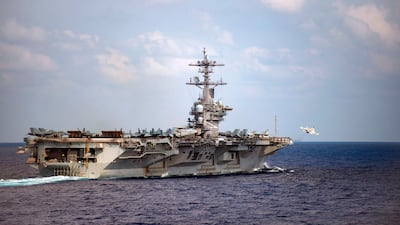
Hostilities in the Middle East have also affected oil prices, with the US disclosing plans to send a third aircraft carrier strike group to the Middle East.
A US official told The National on Thursday the USS Theodore Roosevelt was on its way to Central Command's area of operations, which spans the Middle East.
The Nimitz-class, nuclear-powered ship is accompanied by its carrier strike group, made up of several craft. A separate amphibious group carrying more than 2,000 US Marines has also departed for the region.
“Though flow out of the Middle East, at least for crude, is normalising, upwards pressure on prices continues as geopolitical risk persists,” said Kyle Rodda, senior financial market analyst at Capital.com.
“That risk premium increased last night off the back of reports the US could be preparing to deploy another aircraft carrier.”
This comes against the backdrop of US releasing more oil from the country's emergency stockpile in an effort to contain rising fuel prices due to energy supply disruption from the Iran war.
This week, the Energy Department said it was offering to loan energy companies up to 40 million barrels of crude oil from the Strategic Petroleum Reserve. The offer represents the last of the drawdown of 172 million barrels from the reserve ordered in March.
Traders are also keeping a close eye on the Opec+ meeting scheduled for Sunday, with the member countries expected to keep their oil production targets steady for November.

