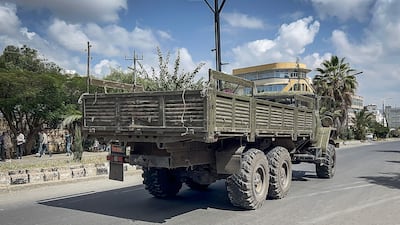

Eritrean troops have crossed into Ethiopia's Tigray region and come under fire from Ethiopian drones as they pushed south, a conflict monitor said. It is the clearest sign yet that Ethiopia's renewed internal troubles could spark a war between the two neighbours.
Eritrean troops have crossed the border at the town of Zalambessa and headed for the road between Adigrat and Idaga Hamus, said Dr Jalale Getachew Birru, East Africa analyst at the Armed Conflict Location and Event Data project (Acled).
“Ethiopian National Defence Forces drones targeted Eritrean troops at Guada as they travelled by vehicle towards Idaga Hamus,” he said.
Residents of Adigrat, about 25km south of the border, told Reuters they saw two military vehicles carrying dozens of Eritrean soldiers pass through the town on Wednesday morning.
Ethiopia demanded that the troops leave. “All foreign military forces operating within our sovereign territory must withdraw immediately,” said Enatalem Melese, Government Communication Minister.
Eritrea did not deny its troops had crossed the border. In a post on X, Information Minister Yemane Meskel on Wednesday accused Ethiopia of building “a fallacious narrative of 'self defence' to rationalise and camouflage its war of aggression”.
The crossing into Ethiopia comes days after federal forces retook Mekelle, the Tigrayan capital, from the Tigray People's Liberation Front (TPLF).
According to Acled data, Tigray Defence Forces, the TPLF's armed wing, have a heavy presence in Idaga Hamus and Adigrat.
Many TPLF leaders are in the rural Ahferom district of central Tigray, Dr Jalale said.
He said Eritrea is suspected of backing the Alliance for Survival, a coalition of seven armed groups, including the TPLF, that was formed last month to remove Prime Minister Abiy Ahmed.
Eritrea has two possible motives, he said. It was unhappy with the 2022 Pretoria agreement, which ended the war in Tigray, because it wanted the TPLF destroyed. Asmara's grievances against the TPLF date back to the 1998-2000 border war, when the party led Ethiopia.
Dr Jalale said it wants to turn Tigray into a buffer zone that is hostile to Addis Ababa. “Hence, Eritrean forces entered the war in Tigray to halt the Ethiopian government and allied forces from reaching the border and potentially fighting within Eritrea's territory,” he said.
The commander of the pro-government Tigray Peace Force, Gebreigziabher Beyene, made a similar point. Eritrea is “deliberately deploying its forces so that the fighting takes place inside Tigray rather than spilling into Eritrea”, he told AFP.
Ethiopia closed its embassy in Asmara last Thursday and expelled 10 Eritrean diplomats, accusing them of threatening national security. Eritrea responded by cutting ties.
The US has warned that “the Horn of Africa cannot sustain another military conflict and humanitarian crisis”. In a statement on Saturday, it urged both countries to exercise “maximum restraint”.
Eritrea's move also puts the spotlight on Egypt, which has its own dispute with Ethiopia over its share of the Nile, in addition to the latter's Red Sea ambitions.
Cairo has spent the past few years building ties with Asmara. In October 2024, Egyptian President Abdel Fattah El Sisi and his Eritrean counterpart Isaias Afwerki agreed with Somalia's President Hassan Sheikh Mohamud on a framework for strategic co-operation that includes Red Sea security.
Ahmed Moussa, a prominent pro-government Egyptian television host, said on Saturday that Egypt and Eritrea have a joint defence agreement, though no text has ever been made public.
With Cairo and Addis Ababa trading blame over the Nile dam and also expelling each other's diplomats last week, the question now is how far Egypt would go if its ally faces a serious Ethiopian attack.