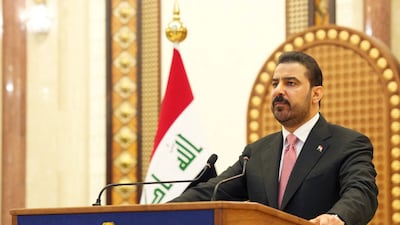

Iraqi Prime Minister Ali Al Zaidi is close to finalising his government, but the process to get there has already drawn fire – for the cost, their surnames and what it says about who really governs Iraq.
Mr Al Zaidi, a businessman who was nominated by the largest Shiite parliamentary bloc, the Co-ordination Framework, was sworn in in mid-May after parliament endorsed most of his proposed cabinet members, ending months of political deadlock.
Then, parliament voted in favour of 14 of the 16 ministerial nominees he presented, leaving Mr Al Zaidi with nine posts to fill. The ministers for defence, interior, labour and social affairs, culture, planning, youth and sport, migration and displacement, reconstruction, and higher education have yet to be appointed.

After months of deadlock, political blocs have agreed to fill and finalise the formation by creating four deputy prime ministers: two Shiites, one Sunni and one Kurd, according to three political sources involved in the negotiations.
The most significant – and controversial – name for deputy prime minister is Laith Al Khazali, brother of Qais Al Khazali, leader of the Iran-backed Asaib Ahl Al Haq (AAH) movement, one of Iraq’s most powerful paramilitary and political forces.

Laith Al Khazali’s appointment was initially rejected by Washington, which has pressed Baghdad to keep militia leaders and senior members out of top executive posts, two Iraqi and one western source said. The group is designated a terrorist organisation by Washington, as a central actor in attacks on US forces and a pillar of Iran’s influence in Iraq.
One of the sources close to the talks said Mr Al Zaidi managed to convince the Americans to drop their objection. The other two sources could not confirm it.
The agreement to create four deputy prime minister posts at a time when Iraq is struggling to pay salaries to contractors and farmers has sparked widespread condemnation in parliament. Critics say the move shows the pressure Mr Al Zaidi faces from parties and suggests he is unable to say no.
“These four posts alone will cost the state trillions of dinars per month in salaries, offices, advisers, protection and benefits, at a time we are telling people there is no cash,” an MPs' finance committee official told The National.

Austerity budget in wartime
The controversy comes as the Finance Ministry and parliament’s finance committee are locked in negotiations over the 2027 budget.
Iraq, Opec’s second-largest producer, is facing a cash crunch not seen since 2020, triggered by regional instability since the outbreak of the Iran war that has led to the closure of the Strait of Hormuz, and its spillover into energy shipping and investor confidence.
Since the war started, Iraq’s oil revenue has fluctuated, while spending on security, subsidised fuel and emergency imports has risen. The government has delayed salary payments to public employees in several provinces, deferred payments to contractors and wheat farmers, and drawn heavily on its Central Bank reserves, according to Finance Ministry officials and two advisers to the committee.
To close the gap, Iraq has officially devalued its currency again, setting a new official exchange rate of 1,500 Iraqi dinars per US dollar, starting from Wednesday, according to a document seen by The National.
The Council of Ministers approved the move late on Tuesday, based on a recommendation from the Central Bank of Iraq, the bank said in a directive sent to all licensed lenders, electronic payment companies and exchange houses.
According to the directive, the new structure is: the Central Bank will purchase from the Ministry of Finance at the price of 1,500 dinars. The sale price to banks is set at 1,510 dinars and to the public at 1,520 dinars.
The dinar was last devalued in 2020 from 1,182 to 1,450 to the dollar. That was later adjusted to 1,320 as the official rate under the previous government, though the market rate often hovered higher.
The Ministry of Finance has also proposed adding 100,000 new public-sector jobs demanded by parties as part of power-sharing deals. Half of these will be in the defence and interior ministries, as well as the Counter-Terrorism Service.
Against that backdrop, the decision to expand the top echelon of government is seen by many Iraqis as tone deaf.
“This is irresponsible and reckless behaviour,” said Majeed Ali, a taxi driver in Baghdad. “We are at the height of the crisis today, We desperately need every single dinar today, and the Prime Minister and the political parties are appointing four deputies to him.
“They keep saying we are having problems in security that need cash, and eye our pockets through imposing more taxes and tariffs, while they seek to siphon off more money from the budget for their parties,” he said.

The son-in-law for interior
A second flashpoint is the Interior Minister role, one of Iraq’s most sensitive security portfolios, overseeing police, federal police, border guards and intelligence.
State of Law Coalition leader and former prime minister Nouri Al Maliki is pushing his son-in-law, Yassir Al Maliki, for the post, according to three Shiite political sources.
The move has sparked heated debate in Iraq. Yassir Al Maliki is a former MP with no background in security or policing. Critics say the nomination entrenches family rule in Iraqi politics.
Supporters of Mr Al Maliki argue the Interior Ministry has traditionally been held by the State of Law bloc and that he is a trusted figure who can manage its vast patronage network.

Not final yet
The agreements are not final, sources cautioned. Horse-trading over deputy minister and director-general posts continues, and any candidate for the Interior Ministry must still pass a parliamentary vote and vetting.
Parliament is expected to hold a session on Thursday to vote on the remaining cabinet, including the deputies and interior, if the final deal is reached.
For Mr Al Zaidi, a compromise figure who emerged after months of stalemate, the deals illustrate the tightrope of Iraqi leadership: to govern, he must appease the blocs that nominated him – even if that means expanding a government that Iraqis increasingly see as too big, too expensive and too familial.
As one finance committee member put it: “We are hiring more ministers to manage a budget that says we have no money.”