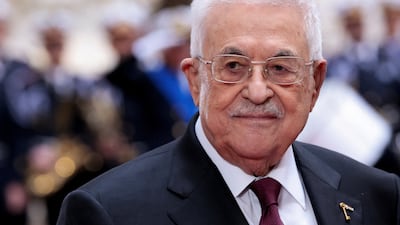
France on Thursday called on the US to grant Palestinian President Mahmoud Abbas a visa to attend the UN General Assembly in New York, after his request was denied for a second year.
The US on Wednesday said it had denied Mr Abbas permission to enter the country, which would prevent him from joining the annual gathering of world leaders next week.
“We call upon the United States to reconsider its position on this matter, in accordance with the existing headquarters agreement between the UN and the United States,” the spokesperson of the French Foreign Ministry, Pascal Confavreux, said in response to a question from The National.

The US State Department said it had extended visa restrictions on Palestinian Authority and Palestine Liberation Organisation officials before the 80th session of the General Assembly, which begins on Tuesday next week.
“The Palestine Liberation Organisation and Palestinian Authority have, once again, failed to live up to their commitments,” the State Department said in a statement released overnight.
It said the restrictions were imposed over actions by the PA and PLO “to internationalise the Israeli-Palestinian conflict, including through the International Criminal Court and International Court of Justice” and to pursue the “unilateral recognition” of a Palestinian state.
Washington also accused the groups of “backing terrorists”.
Mr Confavreux said the PA has made “significant commitments regarding reforms”, including allowing an audit by a US third-party company on paying families of those who died fighting Israel.
“It is crucial that elections in Palestine take place as soon as possible and under the best possible conditions,” he added. “This – along with the reform of school textbooks – was among the commitments made by President Abbas to the President of the Republic [France] and the Saudi Crown Prince last July.”
The PA also called on the US to reconsider its decision, calling it “an unjustified measure that runs counter to efforts aimed at restoring trust, developing Palestinian-US relations, and creating the political climate necessary to implement the two-state solution and achieve peace and stability in the region”.
“Resorting to international institutions and international law is a legitimate right of the state of Palestine and a peaceful, legal means to protect the Palestinian people and their rights,” the Palestinian Foreign Ministry said.
“This cannot be equated with the policies of occupation, settlement expansion, annexation, displacement, and settler violence – actions that pose the real threat to the two-state solution and prospects for peace.”
The State Department said it “has maintained the standing waiver for personnel notified to the PLO Observer Mission to the United Nations”, allowing accredited Palestinian representatives to continue operating at the UN despite the broader restrictions.
The UN General Assembly voted to allow Mr Abbas to address next week’s gathering of world leaders by video.
The resolution passed with 152 votes in favour, three against and four abstentions.
It is the second consecutive year Mr Abbas will address the annual gathering remotely.
Before the vote, US deputy ambassador to the UN, Tammy Bruce, urged countries to oppose the measure, saying the PA and PLO had failed to meet commitments made under the Oslo Accords.
"If the PA wants to be treated as a partner, it must stop subsidising terror and stop using diplomatic theatre as a substitute for serious governance," she said.
Several US allies have recognised Palestine as a state, further intensifying tension between Washington and the Palestinian leadership.
Palestinian officials have argued that decades of US-mediated negotiations have failed to end the Israeli occupation or establish an independent Palestinian state.
Under the 1947 UN headquarters agreement, the US is generally required to enable access to the world body's headquarters in New York, although Washington says it can deny visas on security, extremism and foreign-policy grounds.
The PA represents Palestinians at the UN, where the delegation is officially designated as the state of Palestine. Palestine has observer-state status at the UN rather than full membership, and therefore does not have a vote in the General Assembly.
The renewed restrictions come amid Washington's growing opposition to international legal proceedings involving Israel.
The administration has also imposed sanctions on officials of the International Criminal Court, including prosecutors and judges, after the court issued an arrest warrant for Israeli Prime Minister Benjamin Netanyahu in 2024 over alleged war crimes and crimes against humanity during Israel's military campaign in Gaza.

