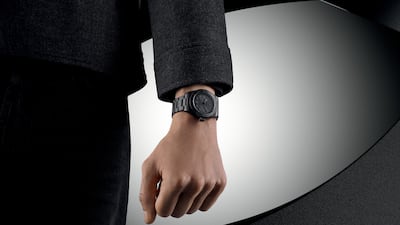

A clutch of new watch releases may have enthusiasts wondering why so many high-end brands are trying to convince them to invest serious money in models seemingly made out of plastic. Isn’t that what “throwaway” watches are made from? Isn’t that the preserve of Swatch, for all its marketing and design genius?
Of course, these watches aren’t really made from anything so humdrum. H Moser & Cie’s new Streamliner Pump and Bianchet’s Ultrafino Maserati are made from forged quartz fibre and forged carbon respectively, while Tudor’s latest Black Bay uses ceramic, including for its bracelet. Elsewhere, brands such as Richard Mille, IWC Schaffhausen, Audemars Piguet and Panerai have experimented with silicon carbide and bulk metallic glass.
Then there are materials with names straight out of science fiction. Panerai’s new Luminor Marina is made of Carbotech; Ulysse Nardin uses Carbonium; and Audemars Piguet has patented Chroma Forged Composite. Seriously, what happened to platinum and gold alloys or just good old steel?

“I think we’re in the midst of a big shift in what defines luxury now, and one idea – that it must be made in precious metal and come with a diamond bezel – doesn’t work anymore. That’s a shift the traditional watch industry is waking up to,” says Edward Margulies, co-founder of new brand Split, which offers watches made from Ceramod+, a proprietary composite that fuses ceramic with polymers.
It’s another material that might superficially resemble plastic, but is temperature-regulating, antibacterial, hypoallergenic, super-tough and lightweight. Other advanced materials can offer greater shock and corrosion resistance while allowing designers to create more unusual case shapes.
“A lot of watch brands still use steel, for example, because you can polish it and we’re programmed to think of shiny as expensive,” Margulies adds. “But we and some other watch brands are now breaking that connection. Frankly, a watch in a precious metal or in steel is starting to feel old-fashioned.”

That suggests a growing schism in both what the watch world offers and what its customers want, says Carlos Rosillo, chief executive of Bell & Ross. “There will likely always be demand for watches made from so-called ‘noble’ materials; the traditional, after all, is often conflated with the classic and timeless.”
Roger W Smith, considered one of the world’s great watchmakers, argues that his preference for trusty metals comes precisely because they have been tried and tested over generations, making them ideal for watches he hopes will themselves be enjoyed for generations. But, Rosillo says, there is increasingly another kind of customer: one who wants a watch made from materials that offer clear functional benefits while also projecting modernity.
Applying the latest scientific materials at least suggests a product is relevant in the 21st century – relevance being an eternal struggle for mechanical watchmakers in the digital age.

There is, then, a certain disconnect among those consumers who expect almost every other high-end product to employ the latest materials available but not their watches.
“After all,” says David Sharp, chief operating officer of watch brand and design house Horage, “look at some cars now and their wings aren’t made of steel panels anymore, but plastics or carbon fibre.
“The world is opening up to the use of more advanced materials, and we’re all more exposed to that. And, given nobody needs a watch anymore, it’s all the more important for the watch industry to bring new ideas to the table. There’s more innovation even at the lower end of the market – just look at Swatch’s bioceramic composite.”
We have seen new materials upset the status quo before, Sharp points out. A decade or so ago, more watch cases began to be made from titanium, challenging the received wisdom that an upscale watch must be a heavy one. Today, titanium is mainstream, while Rado, among other brands, has long driven interest in ceramics.
And when watch design superstar Gerald Genta’s 1972 Royal Oak for Audemars Piguet arrived in steel – “a heresy to many in the industry then”, as Sharp notes – that too radically repositioned what could be considered a luxury material. Steel watches can now command prices far above the intrinsic value of the metal itself.

Arguably, Richard Mille, a brand only 25 years old but now the sixth biggest in the world by revenue, has built its entire standing around avant-garde materials. Now many other brands are joining the gold rush to find something to, well, replace gold.
The growing importance of high-tech materials for cases, dials and bracelets is also, partly, an admission that advancing movement design is altogether harder and more incremental. Even there, some of the biggest innovations of recent years have come through materials science, notably the advent of silicon hairsprings and escape wheels, which require no lubrication and resist magnetic fields.
The importance of materials is further underscored by the fact that many are proprietary, giving brands an inbuilt point of exclusivity. IWC, for example, has Ceratanium, which combines the scratch-resistance of ceramic with the lightness of a special titanium alloy. It allowed the Swiss watch manufacturer, for the first time, to produce entirely black watch cases without coatings.

More recently, it introduced Ceralume, a blend of ceramic powder and Super-LumiNova pigments that allows, of all the things you might not need, a fun glow-in-the-dark case. Getting it to glow evenly all over is much harder than you might imagine, too.
As IWC’s head of research and innovation, Lorenz Brunner, puts it: “Proprietary materials are an important point of differentiation and also ultimately an expression of having deep expertise in this area. Every material has different properties and offers different advantages that customers now understand very well, especially once they receive some expert guidance.”
That understanding is critical. Edouard Meylan, chief executive of H Moser & Cie, laughs at how, not so long ago, the challenge would have been dealing with “the case of people saying: ‘You spent 30,000 on a plastic watch! Are you crazy?” Now, he says, there is greater appreciation for the advantages certain materials offer. Meylan concedes there is still plenty of spin involved. “Is saving 50 grams on your wrist going to make a difference to your life? Maybe if you’re an F1 driver,” he says. But perhaps that is no different from the decades of relentless spin that put gold and diamonds on their pedestals, both now teetering in the face of volatile market prices and synthetic alternatives respectively.
All the same, having cutting-edge science expressed on your person provides a talking point. “Technological materials have a certain appealing mystery to them,” Meylan suggests.
The same shift is making itself known elsewhere in luxury. Marek Reichman, chief creative officer at Aston Martin, has noted that while high-end cars once signalled their prestige through traditional materials such as leather and wood veneer, an overwhelming majority of customers now request next-generation textiles and carbon fibre instead. They may not make an appreciable difference to a car’s speed or handling, but they speak to what Reichman calls “a kind of new performance-derived luxury”. Superior materials speak of superiority, as it were.
Yet the performance of these materials, whether in a car or a watch, may well be ultimately irrelevant. Their appeal may lie less in what they do, or even what they suggest, than simply in how they look.
Most watches, after all, are bought for their aesthetic. Adrian Bosshard, chief executive of Rado, offers perhaps the simplest explanation for the rise of high-tech materials in watchmaking: with their distinctive colours, finishes and effects – from matte to gloss, marbling to grain – they just look very, very cool.


FOLLOW TN MAGAZINE