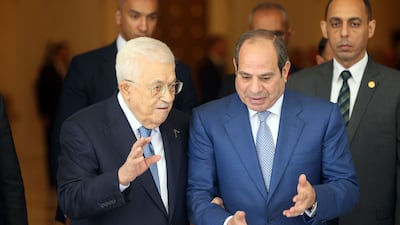

Egyptian President Abdel Fattah El Sisi met Palestinian President Mahmoud Abbas in Cairo on Wednesday for talks on Gaza, the ceasefire in the enclave and Palestinian reconciliation.
The talks come against the backdrop of a rapidly shifting factional landscape in Palestinian politics and an uncertain timescale for legislative elections.
Egyptian presidency spokesman Mohamed El Shennawy said Mr El Sisi had told Mr Abbas the Palestinian cause “will remain the central issue in the region until a just and comprehensive settlement is reached”. The Egyptian President also expressed his commitment to a two-state solution.

Mr El Sisi highlighted Cairo's backing for the Palestinian Authority and “efforts to achieve consensus among the different Palestinian forces”.
He restated Egypt's opposition to any displacement of Palestinians or “liquidation” of the Palestinian cause, and said Egypt would continue working with mediators to implement the Gaza ceasefire reached at the Sharm El Sheikh peace summit last October.
It comes amid a rapidly shifting political landscape within Palestinian politics, in which Egypt has been the pivotal external actor.
In July, Mr Abbas issued a presidential decree setting November 28 as the election date for the Palestinian Legislative Council. He called on Palestinians in the Israeli-occupied West Bank, East Jerusalem and the Gaza Strip to participate in “free and direct” elections. Presidential elections are due to follow in the first quarter of next year.
If held, the November vote would be the first Palestinian legislative election since Hamas's victory over Fatah in January 2006.
However, the election is again in doubt after Fatah secretary general Jibril Rajoub said it would not take place on time and called for a comprehensive national dialogue on the conditions for holding it.
Election manoeuvres
Regardless, Mr Abbas's decree has set off a pre-election hubbub that has partly played out in Egypt.
Last month, delegations from Fatah and the Democratic Reform Bloc, a breakaway Fatah faction led by exiled former security chief Mohammed Dahlan, convened in El Alamein for reconciliation talks, the first such engagement between the two camps in years.
The Fatah delegation was led by Palestinian Vice President Hussein Al Sheikh, seen as Mr Abbas's likely successor.
Democratic Reform deputy leader Samir Al Mashharawi said afterwards that “any alliances in the upcoming elections do not target the Fatah movement or its leadership”, describing the atmosphere as positive without anything practical agreed.
Days later, Egyptian Foreign Minister Badr Abdelatty received Mr Al Sheikh, alongside Palestinian National Council President Rawhi Fattouh and intelligence chief Majed Faraj, in a meeting Egypt's Foreign Ministry said addressed “efforts to achieve Palestinian reconciliation, restore Palestinian unity and continue the ongoing political reform process”.
Mr Dahlan's faction is not the only rival taking shape. A series of meetings took place in Cairo last month between Hamas and the Democratic Reform Bloc, alongside the Popular Front for the Liberation of Palestine, Islamic Jihad and the Palestinian National Initiative, aimed at exploring a joint electoral list.
Hamas official Husam Badran said the movement was “seriously considering” a coalition that could include Dahlan's movement, other factions and independent figures.
Hamas spokesman Hazem Qasem said the movement was working to build “the broadest possible national consensus” for the vote. Fatah's spokesman in Gaza, Munther Al Hayek, said his movement would run a single official list and would not form a joint slate with Hamas but was “open to alliances” among the other factions.
That leaves Mr Abbas exposed. Palestinian Central Elections Commission chairman Rami Hamdallah said preparations were moving ahead on schedule, with voter registration above 87 per cent in the West Bank.
But whether the vote takes place at all remains an open question. Mr Abbas, who postponed a previous election in 2021, retains the power to defer or cancel this one.

