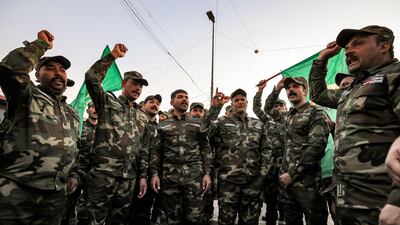

Iraq is debating a plan to establish a security ministry that would bring the Popular Mobilisation Forces and other bodies under a single structure amid mounting US pressure to curtail Iran-backed armed factions, The National has learnt.
The proposal has sparked political debate in Baghdad as it balances Washington’s demands, Tehran’s influence, regional tensions and domestic pressure to preserve the role of the PMF, formed in 2014 to fight ISIS, in the state security apparatus.
ISIS seized large parts of northern and western Iraq in mid-2014 as the state's US-trained security forces collapsed, prompting influential Shiite cleric Ayatollah Ali Al Sistani to issue a fatwa, or religious decree, calling on his followers to join the fight against the extremist group.

Thousands of Iraqis answered the call, including several powerful Shiite militias supported by Iran, some of which had been fighting in Syria’s civil war to support Bashar Al Assad, the country's president at the time.
After Iraq declared victory over ISIS in late 2017, the PMF and Iran-backed armed factions expanded their influence militarily, economically and politically. This extended reach has made them powerful enough to challenge the government in multiple instances.
Tehran-backed militias, including those that are part of the PMF, have claimed responsibility for hundreds of attacks inside and outside the country since the Iran war broke out on February 28. Operating under the banner of the Islamic Resistance in Iraq, they said they were acting to support Tehran in the face of US and Israeli attacks, avenge the killing of Iranian supreme leader Ayatollah Ali Khamenei and in response to strikes on their bases.
The integration of the PMF into the security forces while disarming other groups, and keeping politicians linked to them out of senior government posts, are the main demands of US President Donald Trump. Last year, the Iraqi government withdrew a contentious draft law to regulate the PMF and grant it more power after pressure from the US and other foreign powers.
An Iraqi politician, who asked not to be identified, said the new proposal seeks to merge the PMF and the Interior Ministry’s Federal Police, Rapid Response Force, and Border Guards into a force that would operate under a new Federal Security Affairs Ministry overseen by the Prime Minister, who is commander-in-chief of the state's armed forces.
The Co-ordination Framework, the largest parliamentary bloc comprising mainly Shiite, Iran-backed political parties and armed factions, has been “discussing the idea as a legal and security exit” regarding the PMF and militias, he said.
All political parties within the Framework that backed the newly installed Prime Minister Ali Al Zaidi are engaged in the dialogue, another politician said.
“For us, there is a desire to build a state and a government, and we have hopes for this man [Al Zaidi],” he added. “Many things can be achieved if we join hands and move towards conducting a joint, unified and national dialogue."
US guarantees sought
The US has opposed any participation in Iraq's government by members of Kataib Hezbollah, Harakat Hezbollah Al Nujaba, Kataib Sayyid Al Shuhada, Harakat Ansar Allah Al Awfiya, Imam Ali Brigades and Asaib Ahl Al Haq. Washington has designated these groups as terrorist organisations and placed sanctions on their senior members.
The second politician said some of these groups had shown a “strong desire for the plan but insist on guarantees before giving up their weapons”, including guarantees that their leaders will not be targeted, whether by force, sanctions or legal action.
“If the guarantees are there, then the issue is done,” he said. However, he noted that the “files of Iraq, Iran and Lebanon are interconnected and the continuing negotiations between Tehran and Washington will impact” the plan.
The PMF fought against ISIS in parallel with the Iraqi military, which was assisted by a US-led international coalition. Many of its factions were accused of human rights abuses against civilians, which the government and the PMF have acknowledged as “individual acts”.
The PMF currently has more than 200,000 fighters, the majority of whom are Shiite, distributed across 73 brigades. Most of the member groups also maintain an armed presence outside the PMF. Most of the leaders are Shiite, but the ranks also include Shiites not linked to factions, Sunnis and other minorities.

A third politician said Shiite political parties and the government are set to start talks on the militias “in earnest” after the Eid holiday, when Mr Al Zaidi submits the rest of his cabinet to parliament for approval.
He said the Co-ordination Framework has formed a committee led by Hadi Al Amiri, a senior Shiite politician and leader of the Badr Organisation, one of the biggest groups in the PMF, to “put in place the mechanism and oversee the disarmament and integration process”.
Some groups, including the Imam Ali Brigades and Asaib Ahl Al Haq, have “shown flexibility” towards the plan, he said, without elaborating.
'Long road' ahead
Other groups, such as Harakat Al Nujaba, one of the most prominent factions of the Islamic Resistance in Iraq, have begun signalling their opposition to the plan.
Speaking at a tribal gathering in the southern province of Basra on Friday, the cleric Hussein Al Sieidi, deputy head of Al Nujaba’s executive council, said that “the resistance’s weapons are a trust that cannot be bargained away”, adding that “disarming the resistance would leave society without protection”.
Mr Al Sieidi described the plan as “a purely American project” and warned that “passing the PMF integration project will come at a political and popular cost”.
Ihsan Al Sahamari, who heads the Baghdad-based Iraqi Political Thinking Centre, said the new ministry “could be one of the solutions to the crisis, but it may not be acceptable to the other party”, alluding to the militias.
Even if the ministry is formed, Mr Al Shammari argued, “the ideological crisis of the factions will come to surface” because of those groups that are opposed to disarming and integrating into the state security forces.
He said the plan would not resolve the issue of weapons outside state control. “All that will happen is to offer a new federal cover for PMF.”
Looking ahead, he said: “I believe the road is very long.”
“The issue is the political will, mainly among the Shiites,” he explained, adding that Iran “may not object at the beginning, but it could put obstacles in front of this project”.
Mr Al Shammari described the plan as “an appropriate exit during the term of Trump,” but added: “I think it will not be approved without guarantees [to militia leaders] of not being chased or targeted.”
And if the war between the US and Iran resumes, “it could vanish”, he said.

