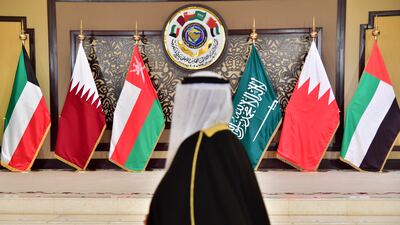
The UAE, Qatar, Bahrain, Saudi Arabia, Jordan and Oman have denounced maritime co-ordinates recently submitted by Iraq to the UN, which Kuwait has said infringe on its sovereign maritime territories.
On Saturday, Kuwait said Iraq had submitted a list of co-ordinates and a map describing Iraqi boundaries that included Fisht Al Eid and Fisht Al Eij islets, which it said had “never been the subject of any dispute” concerning Kuwait sovereignty over them.
Iraq said Fisht Al Eij is in the Khor Abdullah waterway and is claimed by both countries. In 2019, Iraq protested against Kuwait's move to construct a platform on it, accusing the country of encroaching on Iraqi maritime claims and navigational rights.

Kuwait summoned the Iraqi charge d'affaires to “deliver a formal protest note”, the country's foreign ministry said. It also urged Iraq to take into account the historical ties between the two countries and to act in accordance to the law, including the 1982 UN Convention on the Law of the Sea (Unclos), as well as bilateral agreements.

Earlier on Saturday, the Iraqi Foreign Ministry said it submitted the list of co-ordinates for its maritime zones in accordance with Unclos provisions.
Gulf states issued separate statements on Sunday to reaffirm their solidarity with Kuwait. The UAE expressed its “deep concern and denouncement” of the list submitted by Iraq and the “potential implications for Kuwait’s rights over its maritime areas and waters”.
The UAE Foreign Ministry called for “any related matters to be addressed through constructive dialogue and diplomatic channels, in a manner that enhances regional security and stability”.
Saudi Arabia said it was “closely monitoring” the situation as the list submitted by Iraq included areas adjacent to the Saudi-Kuwaiti divided zone, where both countries share natural resources in the area.
“Moreover, these co-ordinates violate the sovereignty of the fraternal State of Kuwait over its maritime areas and its water elevations,” Riyadh said.
Qatar similarly stated that the list “infringes upon the sovereignty of the State of Kuwait” and expressed its hope that the rules and principles of international law and the Unclos will be considered. Bahrain urged Iraq to “take into consideration the course of historical relations between Kuwait and Iraq, and their people”.
Oman has affirmed solidarity with Kuwait's sovereignty over all its maritime areas and water elevations.
Jordan’s Foreign Ministry said on Monday that Jordan is following with “the utmost concern” the Iraqi move regarding the maritime issue. The kingdom, the ministry said in a statement, supports “the sovereignty of the brotherly country of Kuwait on all of its territory and maritime areas”.
Iraq's Foreign Ministry said the co-ordinates are "precise" and defended the country's "rights and jurisdiction in its maritime areas", in accordance with the provisions of Unclos and international law. The determination of Iraq's maritime zones in accordance with the provisions of the 1982 UN Convention "constitutes a sovereign matter in which no State has the right to intervene", the ministry added in a statement.
The Oman Foreign Ministry called on Iraq "to take into consideration the course of its historical and fraternal relations with Kuwait, the principles of good neighbourliness, and the rules of international law, in a manner consistent with the understandings and agreements and memoranda of understanding between the two countries".
The maritime boundary remains a major issue more than 35 years after Saddam Hussein's invasion of Kuwait, and after both nations resumed diplomatic ties in 2003, after Saddam's downfall.
After Iraq's invasion of Kuwait in 1990, the UN Security Council passed Resolution 833 three years later which determined the land border between Iraq and Kuwait. However, the delineation of the maritime border was left to the two countries.
In September 2023, the Iraqi Federal Supreme Court struck down a maritime agreement meant to regulate navigation in the Khor Abdullah waterway following a lawsuit filed by several legislators. Since then, Kuwait, backed by Gulf states, has expressed concern about the court decision and Baghdad has said it honours its international deals and that it has no say over the court ruling.
Iraqi Foreign Minister Fuad Hussein discussed the issue on Sunday with Omani Foreign Minister Badr Al Busaidi. Mr Hussein said the Kuwaiti government gave its maritime maps and baselines to the UN in 2014 without consulting Iraq.
He added that Iraq "believes in and adheres" to international law in this area, as well as to relevant UN resolutions and bilateral agreements. He stressed Iraq's stance in "resolving problems through negotiations and dialogue, respecting the sovereignty of states and refraining from interfering in their internal affairs".

