

Convoys of army buses, anti-aircraft guns and rocket launchers sped along the road to Deir Ezzor as part of reinforcements sent to Syria's east amid heightened tension between the government in Damascus and the Kurdish-led Syrian Democratic Forces.
Travelling through the east of the country over the past few days, The National witnessed a significant military build-up, a clear sign that government troops are preparing for the conflict with the SDF to push east – and possibly cross the Euphrates river, the dividing line between SDF-held territory and government-controlled areas.
On Saturday, the military‘s build up turned into a fast-moving offensive pushing east.
“We declare the area west of the Euphrates a closed military zone after the PKK terrorist militias targeted the army forces while they were implementing the agreement,” the Syrian army said in a statement.
In March last year, the SDF signed an agreement with the Syrian government to integrate the Kurdish militia into the army after months of US negotiations.
The SDF is a US-backed force that has controlled significant parts of Syria since the civil war, including much of the resource-rich north-east. It has long been supported by Washington, which viewed it as a trusted ally in the fight against ISIS.
But since the fall of Bashar Al Assad’s regime, its integration has proved to be a major challenge for Syrian President Ahmad Al Shara, who has vowed to unify the country.
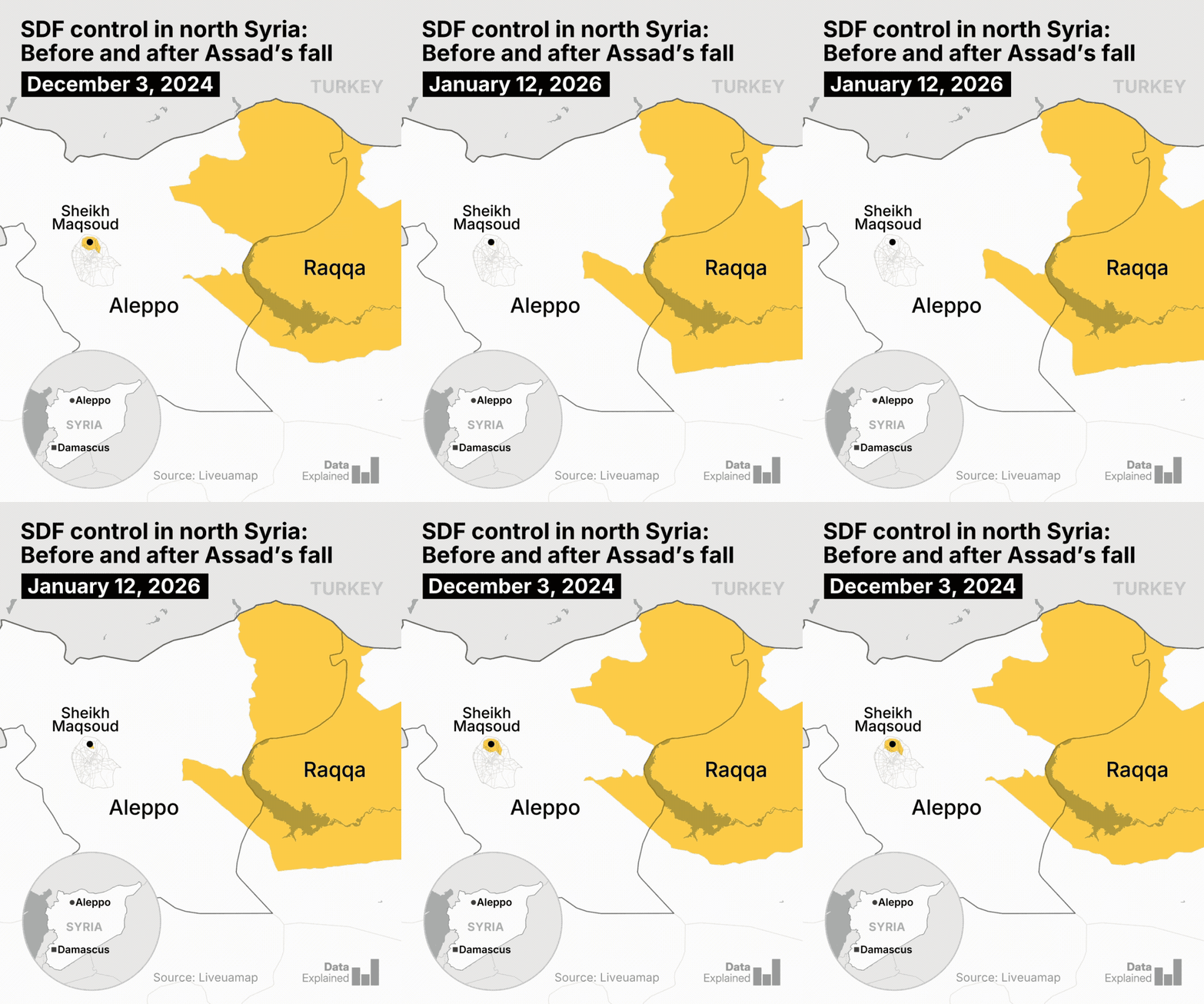
Tension rose sharply after five days of deadly clashes between government forces and SDF-affiliated fighters last week in Aleppo, over the control of three Kurdish-majority pockets, where the SDF has long been positioned. The fighting killed dozens of civilians, the SDF said, with many still missing, according to local officials.
The violence has brought the standoff between the two sides closer than ever to a wider military confrontation.
In Deir Ezzor, on the government-held banks of the Euphrates, war is on everyone’s lips. More than a distant possibility, it has become a concrete threat looming over the city. Already in tatters after years of war, Deir Ezzor would become yet another front line in the event of an all-out conflict between the SDF and Damascus.

Officials there said they were prepared for all options, even though they favoured a diplomatic solution, which has so far failed.
Experts said the latest military escalation marks a shift in Damascus’s approach, after talks stalled despite the March 10 agreement between Mr Al Shara and SDF commander Mazloum Abdi on integrating the force and handing control of border crossings and oilfields in the north-east to the central government.
“Damascus has clearly shifted its approach to the SDF, opening the door to a military ‘solution’ to the long-standing dispute, but at the same time it has not closed the door to a diplomatic approach,” wrote Gregory Waters, a Syria expert and a researcher at the Syrian Archive.
Fast gains
On Saturday, SDF commander Abdi said his forces would withdraw from eastern Aleppo “based on invitations from friendly countries and mediators”.
But the deal was short-lived, with both sides accusing each other of violating the ceasefire.
Fighting was raging on Saturday, as Syrian army announced fast gains on the ground, further expanding the front toward the east.
After announcing the takeover of more than a dozen positions in eastern Aleppo, Syrian forces pressed their offensive toward Tabqa and the Rasafa area in southern Raqqa province.
The Syrian forces accused the PKK, and remnants of the Assad regime, which they described as “allies of the SDF”, of using parts of these areas for “terrorist operations”.
The PKK, whose leadership is based in Iraq’s Qandil Mountains, is banned in Turkey, where it was founded, as well as in the EU and the US. The SDF denies being an extension of the PKK, formally known as the Kurdistan Workers’ Party, despite ideological and cultural ties.
The SDF has accused Damascus of violating the agreement by deploying in eastern Aleppo before its forces had time to withdraw, and by advancing into areas it said were “outside the scope” of the deal.
“Once Damascus’s forces have reached the Euphrates, either by force or by negotiation, there will likely be another military pause and new round of talks. This time, however, the SDF’s position will be far weaker and its room to manoeuvre far smaller,” Mr Waters said.
Oil, politics and ideology
Diplomatic and official sources told The National that the crux of the issue lies in the SDF’s conditions for integration, notably its refusal to allow Syrian security forces in convoys of more than five vehicles to enter the north-east.
“The most critical dispute, according to several involved mediators, was over access to the north-east,” said Mr Waters.
He added that, in the last talks before the Aleppo violence, “the SDF had insisted that the integration deal should require any police or military convoy of more than five cars to receive permission and an escort to enter the north-east. In other words, the SDF’s territory would remain semi-autonomous”.
Deep distrust also runs through the SDF’s ranks towards the new government. A commander in the YPJ, the women’s unit within the SDF, told The National she remained wary of the authorities because of the backgrounds of some factions that were integrated into Syria’s forces after the fall of the Assad regime.
Among them is Hayat Tahrir Al Sham (HTS), an offshoot of Al Qaeda’s former branch in Syria, which led the offensive against the Assad regime and has since stamped its authority on the state. Another is the Syria National Army (SNA), the SDF’s longtime nemesis, which it has fought in northern Syria. “If we come under attack, we are ready to defend ourselves,” the same commander previously told The National. That was almost a year ago, long before any confrontation with the central government.
Reports of militants operating outside the SDF’s control are further complicating the negotiations. Mr Al Shara, in a televised interview, blamed the escalation in Aleppo on the PKK for refusing to surrender despite an agreement negotiated by the US and France during the clashes. That hinted at a rift between the SDF command, led by Mr Abdi, and more hardline PKK elements.

The stakes of integrating the north-east are not only political, but also strategic and economic. The SDF issue is closely monitored by western investors, particularly in the oil sector, as most of Syria’s resources are located in SDF-held areas, which cover about 25 per cent of the country.
According to figures reviewed by the think tank Karam Shaar Advisory, if the central government in Damascus were to take control over the SDF-controlled areas, annual revenue could reach about $1.1 billion, making oil the country’s largest single source of income. Output is currently about a third of pre-conflict levels, the think tank said, with most of it ending up in SDF-linked entities.
The US, which is allied with both sides, and has been playing a major role in mediating, is also eyeing opportunities in the sector, with major oil companies signing memorandums of understanding with Damascus.
Civilians at risk
But the escalation does not mean all-out war – at least not yet. In his televised interview, Mr Al Shara reached out to the Kurdish community, insisting that their rights were “non-negotiable”.
In his article, Mr Waters said the battle of Aleppo was broadly seen as a success as it did not feature major violations, unlike the offensive on the coast in March and in Sweida in July, where human rights groups reported widespread abuses against Alawite and Druze communities.
Still, violations were reported by both sides, although on a smaller scale. For civilians in Aleppo, this was enough to bring back painful memories from the civil war. All civilians interviewed by The National during the clashes said they had no appetite for a broader war.
“It’s been 14 years. It’s enough, enough. We want to reconcile, we want to live,” Jomaa Haleem, who was displaced during the Aleppo clashes, told The National.

